On this page
Chapter 3 of NCERT's Exploring Society: India and Beyond, Part 2 (book code gees2, First Edition November 2025, Reprint 2026-27) picks up the story of India after the Gupta Empire lost its hold, around 600 CE. The chapter PDF runs to about the 10th century; Chapter 4, "Turning Tides", carries on to the 12th. CBSE publishes no separate 2026-27 curriculum for Classes 6 to 8, which follow the NCERT book, so this chapter is assessed by the school.
What is Empires and Kingdoms Class 7 about?
The chapter's main ideas:
After the Guptas, strong regional kingdoms rose, and none of them stayed on top for long.
Rulers usually supported Hindu, Buddhist and Jain traditions, whatever their own leaning.
The Bhakti tradition began in the south and spread across India.
Trade, temple building, literature, mathematics and astronomy grew.
Hūṇa and Arab invasions were met, and the book stresses India's resilience in facing them.
The book uses diacritics (Harṣhavardhana); we use simpler spellings.
Who ruled where between the 6th and 10th centuries?
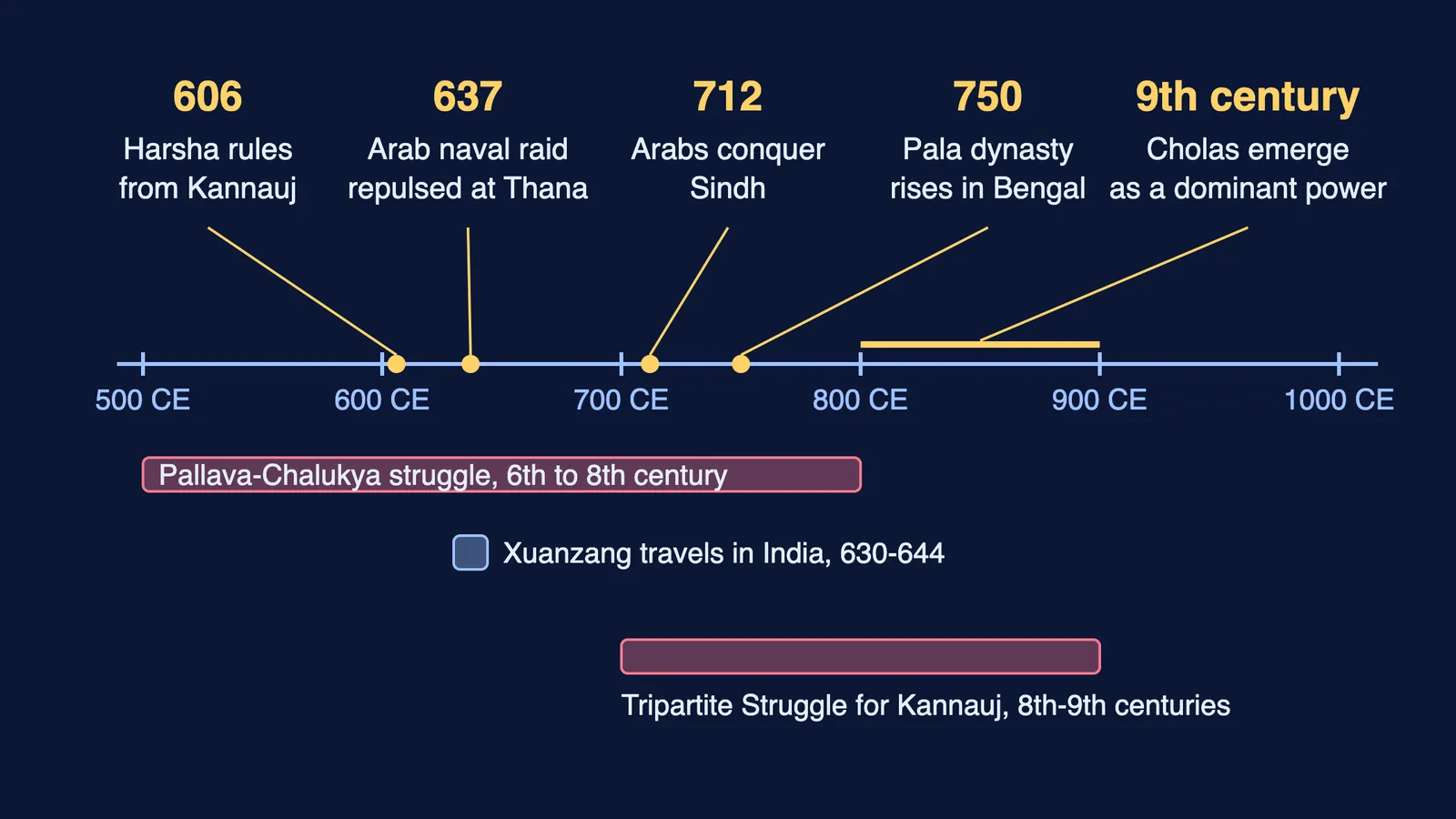
North. Harshavardhana took the throne at Kannauj in 606 CE. The Chinese pilgrim Xuanzang travelled in India between 630 and 644. Harsha's push south of the Narmada was stopped by the Chalukya king Pulakeshin II. Harsha died in 647, according to the chapter.
The fight for Kannauj. In the 8th and 9th centuries three powers fought over Kannauj with no lasting winner. The book calls this the Tripartite Struggle:
Palas (east): Gopala became king in 750 CE; Dharmapala founded Vikramashila, where nearly 3,000 scholars studied.
Gurjara-Pratiharas (west): founded by Nagabhata I in the mid-8th century; King Bhoja ruled most of north India in the 9th.
Rashtrakutas (Deccan): Dantidurga overthrew the Chalukyas in the mid-8th century; capital Manyakheta; Krishna I had the Kailashanatha temple carved at Ellora.
Kashmir. Lalitaditya Muktapida of the Karkota dynasty and, later, Queen Didda appear in Kalhana's 12th-century *Rajatarangini*.
Deccan and south. The Chalukyas ruled from Vatapi (Badami). The Pallavas of Kanchi carved temples at Mamallapuram, and their king Narasimhavarman I defeated Pulakeshin II. The Pandyas ruled from Madurai. The Cholas rose again under Vijayalaya in the 9th century, with Thanjavur as capital.
How did kingdoms work, and what changed in society?
Kings ruled core lands directly and the rest through *samantas*, subordinate rulers who led armies but could turn against a weak centre; the Rashtrakutas themselves had once been samantas of the Chalukyas. Land grants spread, the Pallavas built many irrigation tanks, and ports traded as far as East Africa and China. Jatis multiplied, and the book notes both discrimination against some communities and flexibility in the system. In the south, 12 Alvars and 63 Nayanars composed Tamil devotional poetry. Brahmagupta, born in 598 CE, set out rules for working with zero and negative numbers (NCERT chapter).
What foreign invasions does the chapter cover?
The Hunas pushed into the Ganga plains in the early 6th century until Aulikara kings defeated them; later many Hunas became part of Indian society. Arab naval raids hit the west coast from 637, and Muhammad bin Qasim took Sindh, which the book's timeline dates to 712. Indian chiefs won back most of it within two years of his death; later Arab pushes into Rajputana and Malwa were short-lived, and a Gwalior inscription credits the Gurjara-Pratihara king Nagabhata I with crushing a large Arab army. Indian numerals with zero later reached Europe through the Arabs.
Worked example: how to answer a "why" question
Question (our own, 5 marks is our suggestion): Why did no single kingdom dominate north India in the 8th and 9th centuries?
Name the players. The Palas, Gurjara-Pratiharas and Rashtrakutas all fought for Kannauj.
Give the reason the book gives. The rivals had similar military strength, administration and strategy, so wins kept changing hands.
Add the system's weakness. Rulers depended on samantas, whose loyalty could slip when the centre looked weak.
Close with the result. The struggle dragged on with no lasting victor.
Four points, one sentence each, using only facts from the chapter.
How does this chapter connect to the rest of the book?
It builds on the Gupta Era in Part 1 and on Chapter 2 (Buddhism and sea trade). Chapter 4 picks up the Cholas, the Western Chalukyas and the fate of Vikramashila. For related reading, see our guides to Bhakti and Sufi paths in Class 7, the Delhi Sultans from the older book, and Ashoka's empire, whose edict named the Cholas, Pandyas and Cheras as southern neighbours.
Practice questions (mark labels are our suggestion):
Name the three parties of the Tripartite Struggle and the region each came from. (3 marks)
How did land grants change farming and landholding in this period? Give two points. (3 marks)
Give two ways the Pallavas and the Rashtrakutas supported art or learning. (2 marks)
How do Xuanzang's travel account and Kalhana's Rajatarangini help historians study this period? Give one example from each. (5 marks)
Not sure where to start revising? Fermi's AI tutor works out what you already know and builds a plan for the session.