On this page
Eight original JEE Main-style Electrostatics questions, from a line charge to two spheres joined by a wire. Q3 and Q5 are numerical; the rest are single-correct. Each answer has its working and a trap line.
What does JEE Main 2027 test in Electrostatics?
Electrostatics is Unit 11 of the official Syllabus for JEE (Main) - 2027. It covers Coulomb's law, field and dipoles, Gauss's law for a wire, sheet and thin shell, potential and potential energy, conductors, and capacitors with and without a dielectric. The NCERT Class 12 chapters are Electric Charges and Fields and Electrostatic Potential and Capacitance.
The JEE (Main) 2027 Information Bulletin awards +4 for a correct answer and −1 for a wrong one in both sections. Numerical answers are rounded to the nearest integer.
How should you use this practice set?
Set a 25-minute timer and work on paper, without a calculator.
Before any formula, name the charge's shape: point, line, sheet or sphere.
Read every trap line, even where you were right.
Take k = 9 × 10⁹ N m² C⁻² and ε₀ = 8.85 × 10⁻¹² C² N⁻¹ m⁻². New to the chapter? Start with our guide on how to prepare Electrostatics for JEE Main. If a solution loses you partway, the Fermi Problem Library has worked problems with a step-by-step solver that explains the reasoning rather than printing an answer.
Easy: line charges, potential gradients and series capacitors
Q1 (easy). A very long straight wire carries a uniform charge of 4 nC per metre. What is the electric field 12 cm from the wire?
(A) 300 N/C (B) 2500 N/C (C) 600 N/C (D) 5000 N/C
Answer: (C). Gauss's law gives E = λ/(2πε₀r) = 2kλ/r = 2 × 9 × 10⁹ × 4 × 10⁻⁹/0.12 = 600 N/C. See the field of an infinite line charge using Gauss's law.
Trap: (A) drops the factor 2 by treating 2πε₀ as 4πε₀.
Q2 (easy). The potential along the x-axis is V = (5x² − 3x) volts, with x in metres. What is the electric field at x = 2 m?
(A) 17 V/m along −x (B) 17 V/m along +x (C) 14 V/m along −x (D) 7 V/m along −x
Answer: (A). E = −dV/dx = −(10x − 3) = −17 V/m at x = 2 m, so 17 V/m pointing along −x.
Trap: (B) drops the minus sign; field points towards falling potential.
Q3 (easy, numerical). Capacitors of 2 µF, 3 µF and 6 µF are joined in series across a 60 V supply. Find the energy stored in the 6 µF capacitor, in µJ.
Answer: 300. 1/C = 1/2 + 1/3 + 1/6 = 1, so C = 1 µF and each capacitor holds 60 µC. The 6 µF one has 60/6 = 10 V across it, so U = ½ × 6 µF × (10 V)² = 300 µJ.
Trap: 10800, which puts the full 60 V across the 6 µF capacitor.
Medium: dipoles, assembly energy and charged sheets
Q4 (medium). A short electric dipole of moment 2 × 10⁻⁸ C m sits at the origin, pointing along +x. What is the field at the point (0, 10 cm)?
(A) 1.8 × 10⁵ N/C along +x (B) 3.6 × 10⁵ N/C along +x (C) 3.6 × 10⁵ N/C along −x (D) 1.8 × 10⁵ N/C along −x
Answer: (D). On the equatorial line, E = kp/r³ = 9 × 10⁹ × 2 × 10⁻⁸/(0.1)³ = 1.8 × 10⁵ N/C, directed opposite to p.
Trap: (A) points along p, which is true only on the axis.
Q5 (medium, numerical). Charges of +2 µC, −3 µC and +4 µC are placed at the corners of a right triangle. The +2 µC charge is at the right angle, 30 cm from the −3 µC charge and 40 cm from the +4 µC charge. Find the work, in mJ, needed to assemble them from infinity.
Answer: −216. The third side is 50 cm. W = k(q₁q₂/0.3 + q₁q₃/0.4 + q₂q₃/0.5) = 9 × 10⁹ × 10⁻¹² × (−20 + 20 − 24) = −0.216 J = −216 mJ.
Trap: 576, from dropping the signs of the charges.
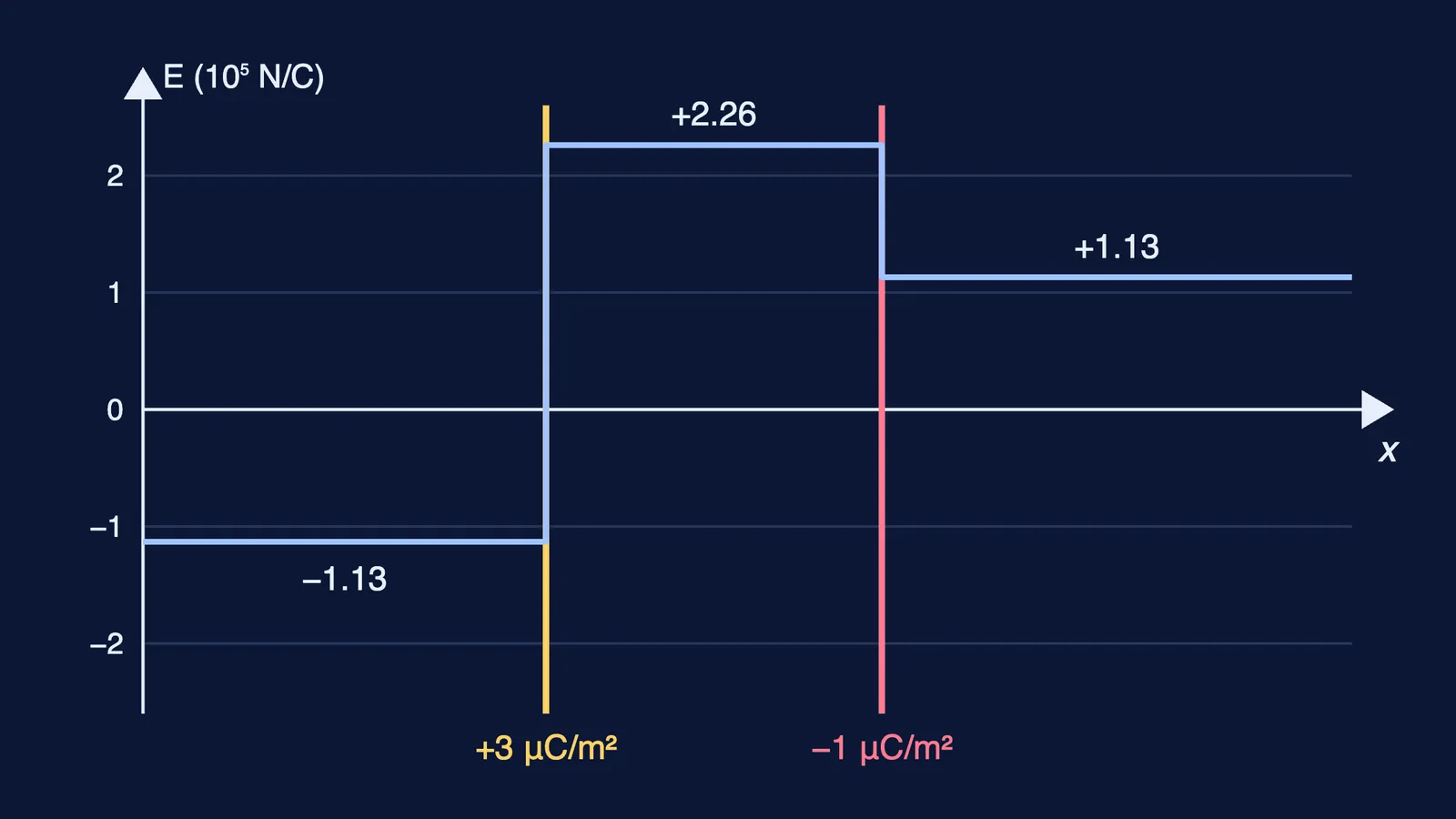
Q6 (medium). Two large parallel sheets carry surface charge densities of +3 µC/m² and −1 µC/m². What is the electric field in the region between them?
(A) 1.13 × 10⁵ N/C (B) 2.26 × 10⁵ N/C (C) 4.52 × 10⁵ N/C (D) 1.69 × 10⁵ N/C
Answer: (B). Each sheet gives σ/(2ε₀). Between them both fields point towards the negative sheet and add: E = (3 + 1) × 10⁻⁶/(2 × 8.85 × 10⁻¹²) = 2.26 × 10⁵ N/C.
Trap: (A) subtracts the fields, which is right only outside. See the field between two infinite charged sheets.
Hard: dielectrics in series and charge sharing between spheres
Q7 (hard). Two identical 6 µF air capacitors are connected in series across a 24 V battery. With the battery still connected, one of them is filled completely with a dielectric of constant 3. How much extra charge flows from the battery?
(A) zero (B) 108 µC (C) 36 µC (D) 144 µC
Answer: (C). Before: C = 3 µF and Q = 72 µC. After: 18 µF in series with 6 µF gives 4.5 µF, so Q = 108 µC. Extra charge = 36 µC.
Trap: (B) is the new total charge, not the extra charge that flowed.
Q8 (hard). A conducting sphere A of radius 3 cm carries +8 nC. A second conducting sphere B, of radius 9 cm, is uncharged and far away. The two are joined by a thin wire. Find the common potential and the ratio of surface charge densities σA : σB.
(A) 600 V; 3 : 1 (B) 600 V; 1 : 3 (C) 800 V; 1 : 1 (D) 1200 V; 9 : 1
Answer: (A). Joined conductors share one potential, so q/r is equal: qA = 2 nC, qB = 6 nC. V = 9 × 10⁹ × 2 × 10⁻⁹/0.03 = 600 V. Since σ = q/(4πr²), σA : σB = (2/9) : (6/81) = 3 : 1.
Trap: (D) shares the charge equally, leaving A at 1200 V and B at 400 V, so charge would still flow.
Redo the set in a week without the solutions, starting with the traps that caught you.