On this page
Each definition below is our own wording, checked against the Reprint 2026-27 Electrostatic Potential and Capacitance chapter. The CBSE Class XII Physics curriculum 2026-27 asks only for the formulae, not the derivation, of energy stored in a capacitor. For answer-writing and a revision plan, read our Electrostatic potential and capacitance Class 12 board guide.
What is electrostatic potential?
Conservative force: a force whose work between two points depends only on where you start and end, not the route. Example: the Coulomb force between stationary charges.
Electrostatic potential energy difference: the work an outside agent does to move a charge slowly between two points in a field. Only differences matter; zero is usually set at infinity.
Electrostatic potential (V): the work done per unit positive test charge in bringing it slowly from infinity to a point. Don't confuse with potential energy, which is that work for the actual charge q, so U = qV.
Potential difference: the work per unit positive charge to carry a test charge from one point to another.
Potential of a point charge: V = Q/(4πε₀r), falling as 1/r and negative for a negative charge. Example: 4 × 10⁴ V at 9 cm from a 4 × 10⁻⁷ C charge, per NCERT's Example 2.1. Don't confuse with the field, which falls as 1/r².
Potential of a dipole: depends on distance and on the angle with the dipole moment, and falls as 1/r² far away. It is zero everywhere on the equatorial plane.
Superposition of potentials: the potential of many charges is the algebraic sum of their potentials.
What are equipotential surfaces?
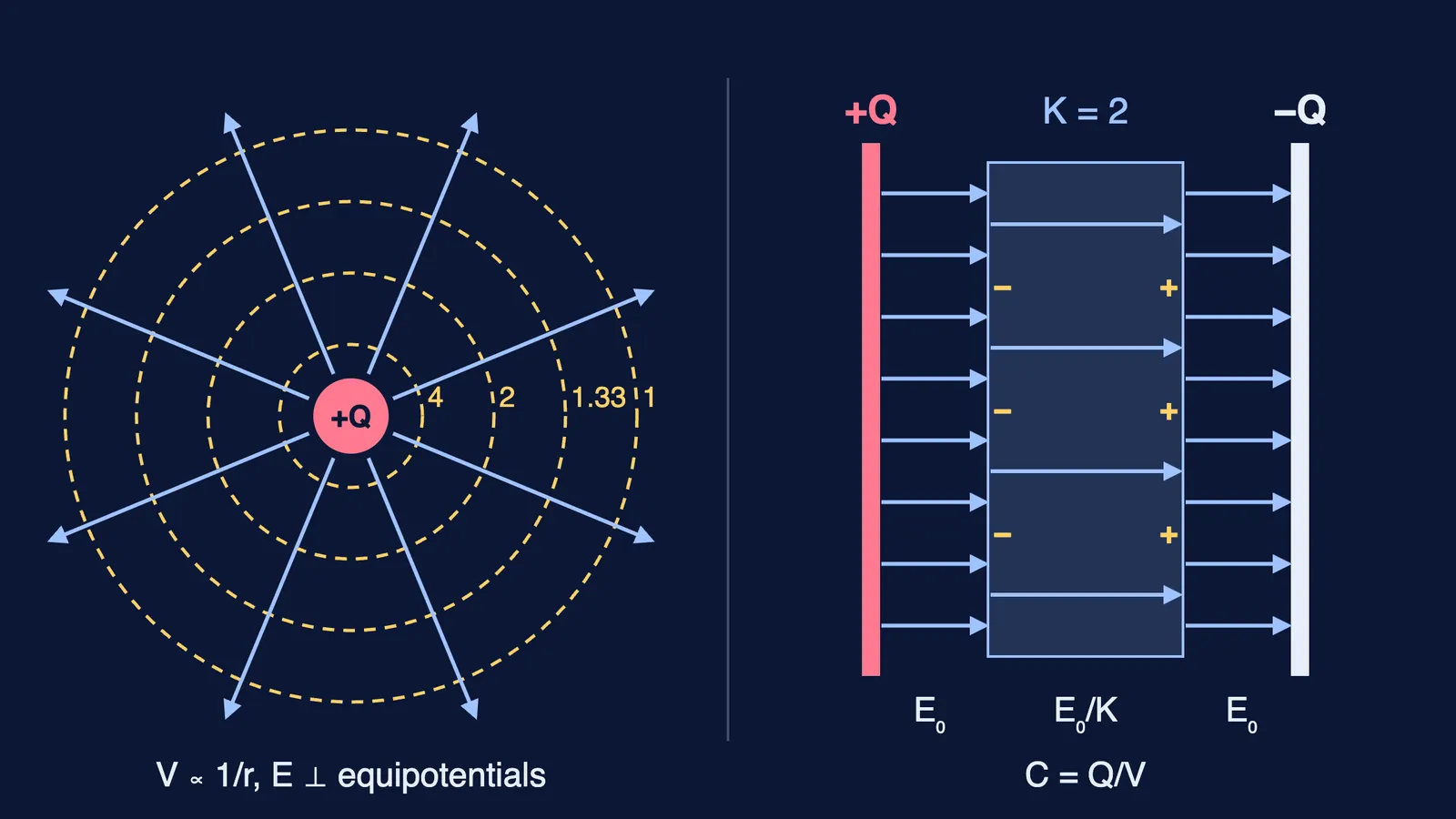
Equipotential surface: a surface on which every point has the same potential, so moving a charge along it takes no work. Example: spheres around a point charge.
Field and equipotentials: the electric field is always perpendicular to the equipotential surface through a point.
Potential gradient: the field points the way potential drops fastest, and its size is the change in potential per unit distance normal to the equipotential, E = −dV/dl. Don't confuse: crowded equipotentials mean a strong field.
How is potential energy of charges defined?
Potential energy of a system of charges: the total work done to bring the charges from infinity to their places. For two charges it is q₁q₂/(4πε₀r₁₂), positive for like charges and negative for unlike ones; assembly order does not matter.
Potential energy in an external field: the work to bring a charge q to a point where an outside source sets the potential V, equal to qV.
Electron volt (eV): the energy an electron gains across 1 V, equal to 1.6 × 10⁻¹⁹ J, as given in the NCERT chapter.
Potential energy of a dipole: U = −pE cos θ in a uniform field, taking zero when the dipole is perpendicular to the field. It is lowest when aligned with the field.
What happens inside conductors and dielectrics?
Conductor (electrostatics): a material with free charge carriers; in the static state the field inside is zero, any excess charge sits on the surface, and the whole body is at one potential.
Field at a conductor's surface: always normal to the surface, of size σ/ε₀, where σ is the surface charge density.
Electrostatic shielding: an empty cavity inside a conductor has zero field, whatever charges sit outside. Example: a metal box guarding delicate equipment.
Dielectric: an insulator with no (or negligible) free charge carriers.
Polar and non-polar molecules: a polar molecule such as H₂O or HCl has a permanent dipole moment; a non-polar one such as O₂ or H₂ does not, but gains an induced dipole moment in a field.
Polarisation (P) and susceptibility (χₑ): P is the dipole moment per unit volume of a dielectric; for a linear isotropic dielectric P = ε₀χₑE, where χₑ is a property of the material.
Free and bound charges: free charges can move through a conductor; bound charges are the uncancelled dipole ends on a dielectric's surfaces. Bound charges only reduce the field inside; free charges in a conductor cancel it.
Which terms describe capacitors and capacitance?
Capacitor: a pair of conductors kept apart by an insulating gap, usually holding +Q and −Q. Its "charge" means one plate's charge.
Capacitance (C): the ratio Q/V, set by geometry and the medium between the conductors, not by Q or V. Its unit is the farad, 1 F = 1 C V⁻¹.
Parallel plate capacitor: two large plates of area A a small distance d apart, with C = ε₀A/d in vacuum. Example: A = 1 m² and d = 1 mm give about 8.85 × 10⁻⁹ F, per the chapter, so practical units are µF, nF and pF.
Dielectric strength: the largest field a material can take before it breaks down and conducts; about 3 × 10⁶ V m⁻¹ for air, according to the same chapter.
Dielectric constant (K): the factor, greater than 1, by which capacitance rises when a dielectric fills the gap, K = C/C₀. Don't confuse with permittivity, ε = ε₀K, which carries units.
Series combination: every capacitor carries the same charge and the voltages add, so 1/C = 1/C₁ + 1/C₂ + ….
Parallel combination: every capacitor has the same voltage and the charges add, so C = C₁ + C₂ + …. Don't confuse with resistors, where the series and parallel rules are the other way round.
Energy stored in a capacitor: ½CV² = Q²/2C = ½QV, pictured as stored in the field between the plates.
Energy density: energy per unit volume of an electric field, ½ε₀E².
If a term still feels abstract, the Fermi Concept Library has every concept in physics, each with its own lesson and its place in the map.
How to learn these terms
Learn in pairs: potential and potential energy, polar and non-polar, series and parallel.
Draw equipotentials and field lines for a point charge and a uniform field, and check that they cross at right angles.
Sketch a capacitor with a dielectric slab and mark the free charges on the plates and the bound charges on the slab faces.
Rework NCERT's Example 2.9 capacitor network, then stretch with our capacitance of inclined plates walkthrough.
Revise fields first with our Electric charges and fields Class 12 guide.