On this page
Chapter 2 of the NCERT Class 12 Physics textbook (reprint 2026-27) builds its results by derivation rather than by stating them. Below are five of those derivations, each with a setup, short numbered steps, the result to box and the slip students most often make. For the wider plan for this chapter, read our electrostatic potential and capacitance board guide.
The CBSE Class XII Physics syllabus for 2026-27 includes the potential of a point charge, a dipole and a system of charges, the energy of a dipole in a field, and the parallel plate capacitor with and without a dielectric. It marks energy stored in a capacitor "no derivation, formulae only", so that one is left out here.
How do you derive the potential due to a point charge?
Setup: a charge Q at the origin; find the potential at P, a distance r away, with V = 0 at infinity.
Potential at P is the work done to bring a unit positive charge from infinity to P, slowly, against the field.
The work is the same along any path, so take the radial line.
At distance r′ the field pushes the unit charge outward with force Q/(4πε₀r′²).
Over a small step dr′ the external work is −Q dr′/(4πε₀r′²); the minus sign is there because dr′ is negative on the way in.
Integrate from r′ = ∞ to r′ = r: W = Q/(4πε₀r).
Result: V = Q/(4πε₀r), positive for Q > 0 and negative for Q < 0.
Where students slip: dropping the minus sign in step 4 and ending with a negative potential for a positive charge.
How do you derive the potential of an electric dipole?
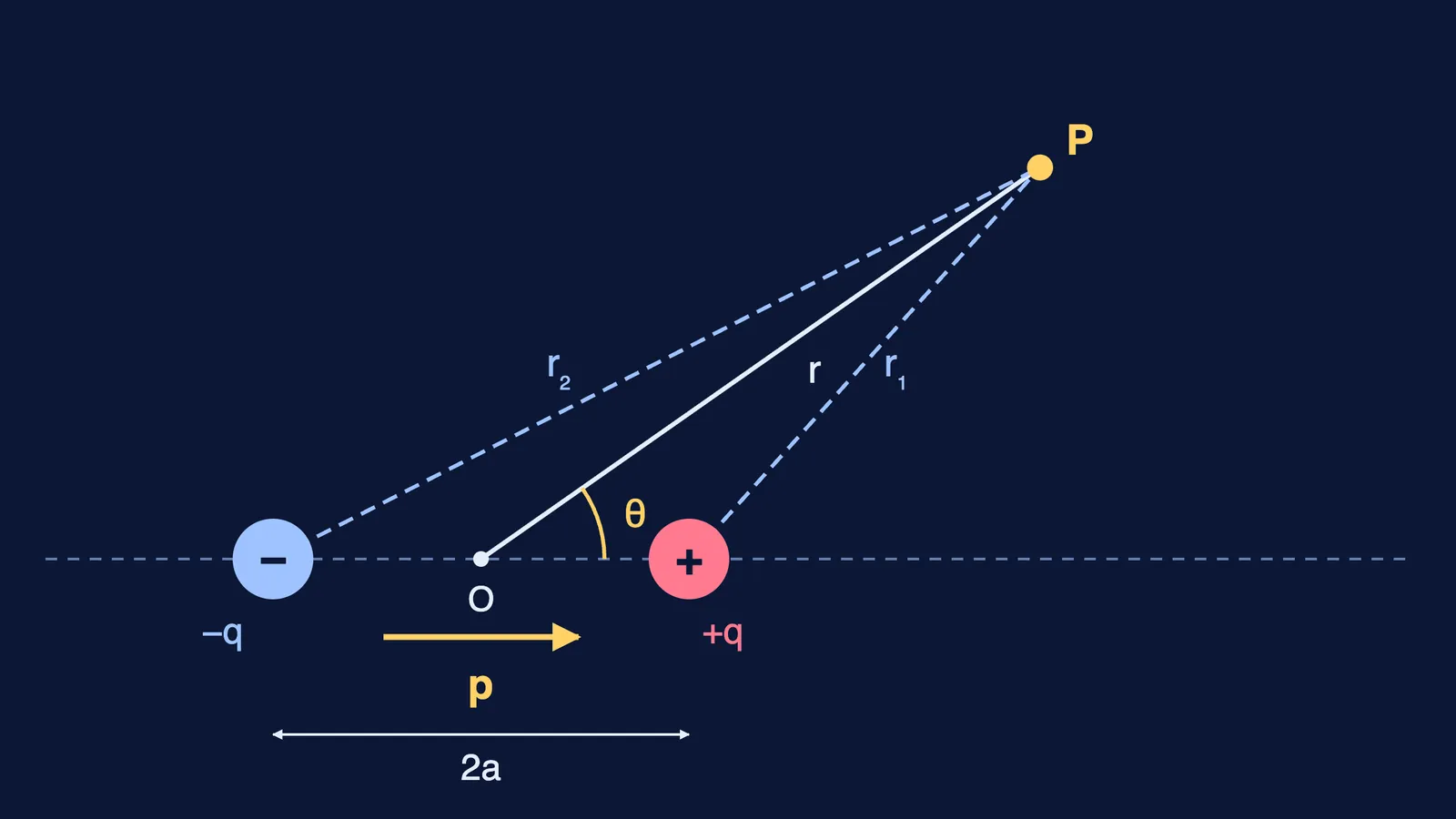
Setup: +q and −q a distance 2a apart, centre O; P at distance r from O, with OP at angle θ to the dipole moment p = q × 2a (see the figure above).
Add the two potentials: V = (q/4πε₀)(1/r₁ − 1/r₂), where r₁ and r₂ are the distances of P from +q and −q.
Cosine rule: r₁² = r² + a² − 2ar cos θ and r₂² = r² + a² + 2ar cos θ.
For r much larger than a, drop a²/r²: r₁² ≈ r²(1 − 2a cos θ/r).
Binomial expansion to first order: 1/r₁ ≈ (1/r)(1 + a cos θ/r) and 1/r₂ ≈ (1/r)(1 − a cos θ/r).
Subtract: 1/r₁ − 1/r₂ ≈ 2a cos θ/r². Multiply by q/4πε₀ and use p = 2qa.
Result: V = p cos θ/(4πε₀r²) for r ≫ a; on the axis V = ±p/(4πε₀r²), and on the equatorial plane V = 0.
Where students slip: writing the field's 1/r³ dependence here. Dipole potential falls as 1/r².
What is the potential energy of a dipole in a uniform field?
Setup: a dipole p in a uniform field E, at angle θ to it. There is no net force, only a torque of size pE sin θ.
Turn the dipole slowly with an external torque equal and opposite to pE sin θ.
Work to turn it from θ₀ to θ₁ is the integral of pE sin θ dθ, which is pE(cos θ₀ − cos θ₁).
This work is stored as potential energy. Choose U = 0 at θ₀ = 90°.
Then U(θ) = −pE cos θ, which is −p·E in vector form.
Result: U = −pE cos θ; least (−pE) when p is along E, greatest (+pE) when p is opposite to E.
Where students slip: taking U = 0 at θ = 0. The zero is chosen at 90°, which is why U is negative for small angles. Our post on why 0° is stable and 180° is not covers the stability question.
How do you derive the capacitance of a parallel plate capacitor?
Setup: two plates of area A, a gap d with d² ≪ A, vacuum between them, charges +Q and −Q, so σ = Q/A.
Each plate acts like an infinite sheet with field σ/(2ε₀) on each side.
Outside both plates the two fields point opposite ways and cancel: E = 0.
Between the plates they point the same way and add: E = σ/ε₀ = Q/(ε₀A), from + to −.
The field is uniform, so V = Ed = Qd/(ε₀A).
C = Q/V.
Result: C = ε₀A/d, set only by the geometry.
Where students slip: using σ/(2ε₀) between the plates, which counts one plate only. The region-by-region picture is in our post on the field between two charged sheets.
How does a dielectric change the capacitance?
Setup: the same capacitor with a linear dielectric filling the whole gap; plate charge stays ±Q.
The field polarises the dielectric, which acts like two sheets with surface charge ±σp facing the plates.
The field in the gap now comes from the net density σ − σp: E = (σ − σp)/ε₀.
For a linear dielectric σ − σp is proportional to σ; write σ − σp = σ/K, with K > 1.
So V = Ed = Qd/(ε₀KA), and C = Q/V.
Result: C = Kε₀A/d = KC₀, so K = C/C₀ and the permittivity of the medium is ε = Kε₀.
Where students slip: writing σ + σp in step 2. The induced charge on each face is opposite to the plate beside it, so it weakens the field.
How should you practise these derivations?
Draw the figure first: the dipole with r₁, r₂ and θ; the plates with fields marked in all three regions; induced charges at the dielectric faces.
State each approximation as you use it (r ≫ a, d² ≪ A, a linear dielectric). Without them the results are not true.
Reproduce one derivation a day, closed book, then check it against the textbook line by line.
Check units at the end: C = ε₀A/d must come out in farads, and V = Q/(4πε₀r) in volts.
NCERT also derives the energy of a system of charges (U = q₁q₂/(4πε₀r₁₂)) and the series and parallel combination formulas; add them once these five feel easy.
If the dipole geometry is hard to picture, the Fermi Simulation Lab has interactive simulations for the ideas that are easier to see than to read.