On this page
Electromagnetic Induction is Chapter 6 of the NCERT Class 12 Physics textbook, Part I (reprint 2026-27). The CBSE Physics syllabus for 2026-27 places it in Unit IV and lists Faraday's laws, induced emf and current, Lenz's law, and self and mutual induction. For answer-writing, see our Electromagnetic induction Class 12 board exam answer guide.
What is electromagnetic induction?
Electromagnetic induction: producing an emf, and so a current in a closed circuit, by changing the magnetic flux linked with it. Example: pushing a bar magnet's north pole into a coil makes a galvanometer deflect.
Induced emf: the emf that appears when the magnetic flux through a coil or conductor changes.
Induced current: the current that induced emf drives round a closed circuit, I = ε/R. Don't confuse with: induced emf, which appears even across an open circuit, where no current flows.
Relative motion: moving the magnet or moving the coil gives the same effect; what matters is that one moves relative to the other. Example: no deflection while the magnet is held still.
What is magnetic flux, and how can you change it?
Area vector (A): a vector normal to a surface, with size equal to its area.
Magnetic flux (ΦB): how much magnetic field passes through a surface, ΦB = BA cos θ, where θ is the angle between B and A. It is a scalar.
Weber (Wb): the SI unit of flux, equal to one tesla metre squared (T m²).
Flux linkage (NΦB): the total flux linked with a closely wound coil of N turns, since every turn carries the same flux.
Ways to change flux: change B, change the area, or rotate the coil to change θ.
What do Faraday's law and Lenz's law say?
Faraday's law of induction: the size of the induced emf equals how fast the magnetic flux through the circuit changes, ε = –dΦB/dt; for N turns, ε = –N dΦB/dt.
Lenz's law: the induced emf always points the way that fights the flux change behind it; any current it drives tries to undo that change. Don't confuse with: Faraday's law, which gives the size of the emf; Lenz's law gives its direction.
Lenz's law and energy conservation: if the induced current helped the change, a gently pushed magnet would speed up forever, a perpetual-motion machine. Instead you do work against the opposing force, which ends up as Joule heat.
Steady field, no emf: a constant flux, however large, induces nothing. Example: a still loop between strong fixed magnets.
What is motional emf?
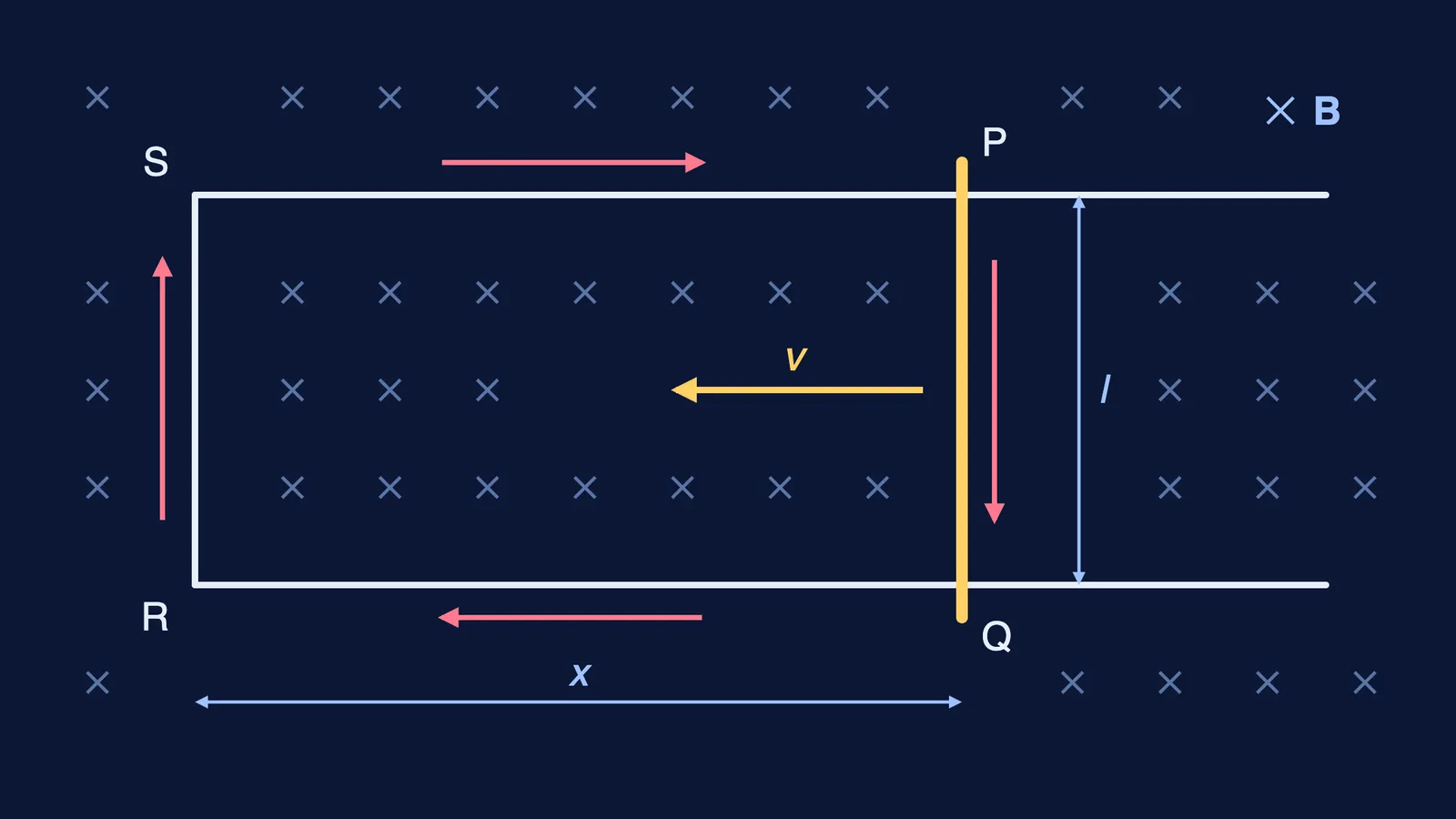
Motional emf: the emf across a conductor moving through a magnetic field, ε = Blv for a rod of length l moving at speed v perpendicular to a uniform field B.
Lorentz force view: each free charge in the rod feels a force qvB along it; work per unit charge over length l gives Blv again.
Induced electric field: when the conductor is still and the field changes, an electric field must push the charges, so a time-varying magnetic field produces an electric field. Don't confuse with: the electric field of static charges, which NCERT notes has different properties.
Rotating rod emf: a rod of length R turning at angular speed ω about one end, in a field B along the axis, has emf ½BωR² between centre and rim. Example: for a spoked wheel, the number of spokes does not change the emf, because the spokes are connected in parallel.
What are self-inductance and mutual inductance?
Inductance: flux linkage divided by current, NΦB/I, a scalar that depends only on geometry and the material inside.
Henry (H): the SI unit of inductance; dimensions [M L² T⁻² A⁻²].
Mutual inductance (M): the flux linkage in one coil per unit current in a neighbouring coil, so ε1 = –M dI2/dt. Also called the coefficient of mutual induction; M12 = M21. It depends on the coils' separation and relative orientation. Example: for two long co-axial solenoids, M = μ0 n1 n2 π r1² l (r1: inner solenoid radius, l: length).
Self-induction: an emf induced in a coil by a change in its own current, ε = –L dI/dt. Don't confuse with: mutual induction, where the changing current is in another coil.
Self-inductance (L): flux linkage per unit current in the same coil; for a long solenoid with a core of relative permeability μr, L = μr μ0 n² A l. A soft iron core raises L.
Back emf: another name for the self-induced emf, because it opposes any rise or fall of current. This is why L acts as electrical inertia, like mass in mechanics.
Magnetic energy: building up current I in an inductor stores energy ½LI². The magnetic energy stored per unit volume is B²/2μ0. Don't confuse with: ½ε0E², the electric energy density.
How does an AC generator use induction?
AC generator: a machine that turns mechanical energy into electrical energy by rotating a coil in a magnetic field, so the flux through it keeps changing. NCERT covers it in Section 6.8; CBSE lists it under Alternating Current (see our Alternating Current Class 12 board guide).
Armature: the coil that is rotated, on an axis perpendicular to the field.
Slip rings and brushes: connect the rotating coil's ends to the external circuit.
Instantaneous emf: ε = NBAω sin ωt; the peak value ε0 = NBAω occurs when sin ωt = ±1.
Alternating current (ac): current whose direction reverses periodically. Example: the NCERT chapter gives 50 Hz as the frequency of rotation of generators in India.
How to learn these terms
Pair the two laws: Faraday gives "how much", Lenz gives "which way".
Redraw the diagram above from memory: rails, sliding rod, field into the page, then mark v and the current direction using Lenz's law.
Write self and mutual inductance side by side: one coil or two.
Link each energy term to its partner: ½LI² with ½mv², B²/2μ0 with ½ε0E².
Revisit Moving Charges and Magnetism for B = μ0nI, the base of the solenoid formulas here.
If Lenz's law is hard to picture, the Fermi Simulation Lab has interactive simulations for the ideas that are easier to see than to read.