On this page
In electromagnetic induction and AC, marks are often lost to the right formula used in the wrong place. Below are eight frequent slips, each with the wrong working, the physics, a fix on an original example and one habit. All of it stays inside Unit 14 of the NTA syllabus for JEE (Main), Unit 14 of the NMC syllabus for NEET (UG)-2026, and NCERT Class 12 Physics Chapter 6 and Chapter 7.
Direction slips (flux versus field, Lenz's law) are covered in three mistakes in finding induced current direction, so this list skips them.
Which motional emf formula fits a rotating rod or a bent wire?
Using the tip speed in Blv for a rotating rod.
Wrong: a 0.4 m rod turns at 50 rad/s about one end in a 0.3 T field perpendicular to its plane of rotation, so "v = ωl = 20 m/s and emf = Blv = 0.3 × 0.4 × 20 = 2.4 V".
Why it fails: Blv assumes one speed for the whole rod. Here speed grows from zero at the pivot to ωl at the tip, so the average is ωl/2 and emf = ½Bωl², as NCERT derives.
Fix: emf = ½ × 0.3 × 50 × 0.4² = 1.2 V, half the wrong answer.
Habit: before writing Blv, ask whether every point of the conductor has the same velocity.
Using the arc length of a curved wire.
Wrong: a semicircular wire of radius 0.1 m moves at 4 m/s, perpendicular to its diameter, in a 0.5 T field normal to its plane. "Length = πr = 0.314 m, so emf = 0.5 × 0.314 × 4 = 0.63 V."
Why it fails: a straight wire joining the same ends, moving with it, would close a loop whose flux never changes, so both give the same emf. Only the straight-line length perpendicular to v counts.
Fix: effective length = diameter = 0.2 m, so emf = 0.5 × 0.2 × 4 = 0.4 V.
Habit: for any bent wire, join its ends with a straight line and use that length.
Why does doubling the turns quadruple the inductance?
Scaling self-inductance with N instead of N².
Wrong: a 0.25 m long solenoid of 500 turns and cross-section 4 cm² has L ≈ 0.50 mH. "Rewind it with 1,000 turns over the same length, and L doubles to 1.0 mH."
Why it fails: the field scales with N, and the flux linkage is N times the flux per turn, so L = μ₀N²A/l (NCERT's μ₀n²Al) grows as N².
Fix: L = 4π × 10⁻⁷ × 1000² × 4 × 10⁻⁴ / 0.25 ≈ 2.0 mH, four times the original. At 3 A the stored energy ½LI² rises from about 2.3 mJ to about 9.0 mJ.
Habit: when turns change, check whether the length stays fixed before scaling.
Are your rms values and reactances right?
Dividing an rms value by √2 again.
Wrong: a 60 Ω heater runs on a 120 V supply. "Vrms = 120/√2 = 84.9 V, so P = 84.9²/60 = 120 W."
Why it fails: supply and meter values are rms unless stated as peak; NCERT notes household 220 V is an rms value.
Fix: P = 120²/60 = 240 W. The peak voltage is 120 × √2 ≈ 170 V.
Habit: label every AC number "rms" or "peak" when you copy it from the question.
Using f instead of ω in the reactance.
Wrong: for a 20 µF capacitor at 50 Hz, "XC = 1/(fC) = 1/(50 × 20 × 10⁻⁶) = 1,000 Ω".
Why it fails: XC = 1/(ωC) and XL = ωL use angular frequency, ω = 2πf.
Fix: XC = 1/(2π × 50 × 20 × 10⁻⁶) ≈ 159 Ω. At 100 Hz it halves to about 80 Ω, while an inductor's reactance would double.
Habit: write ω = 2πf as the first line of every AC numerical.
Why don't voltages and power add simply in a series LCR circuit?
Adding VR, VL and VC as plain numbers.
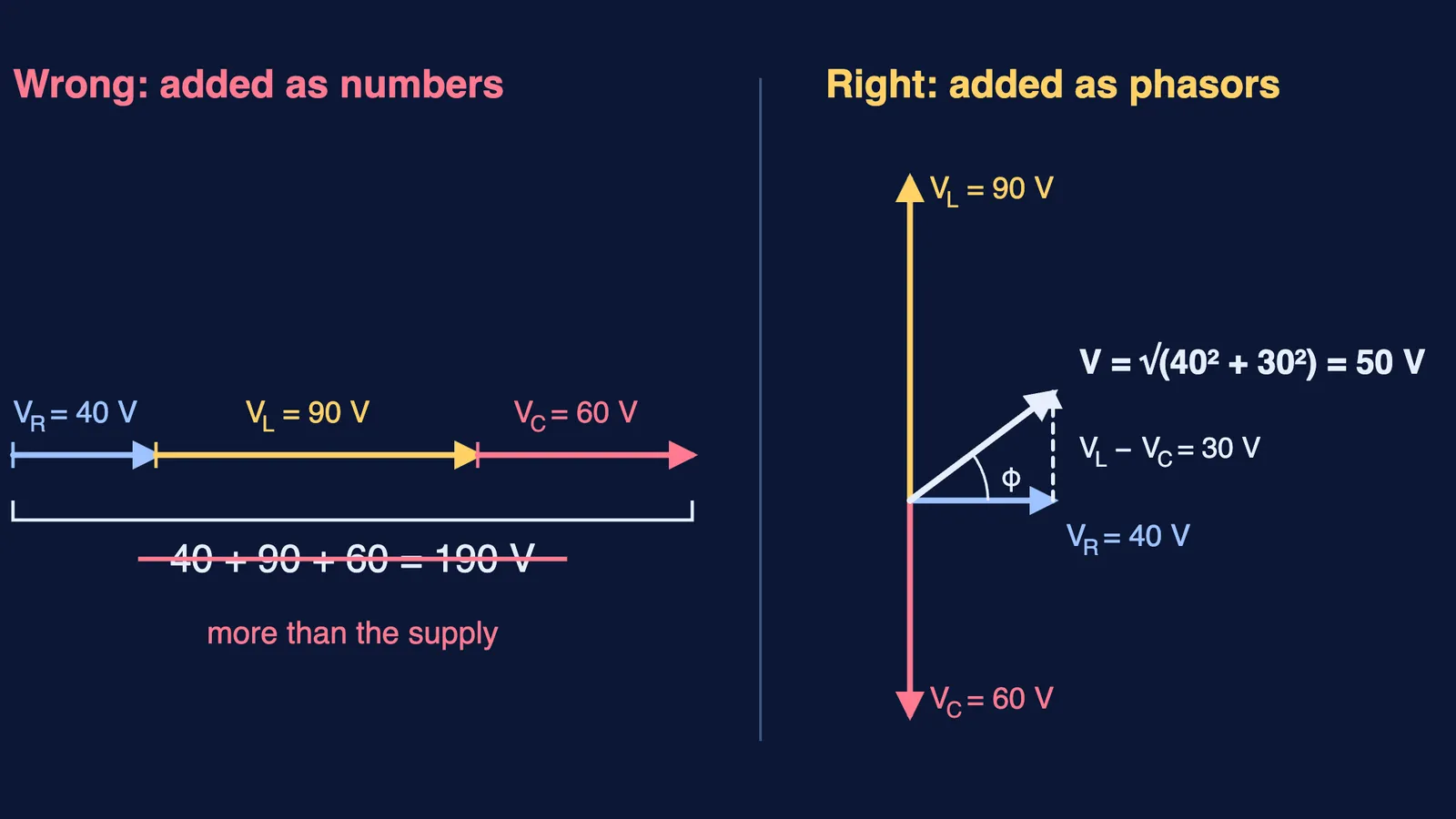
Wrong: in a series LCR circuit the meters read VR = 40 V, VL = 90 V and VC = 60 V, so "the supply is 190 V".
Why it fails: VL leads the current by 90°, VC lags it by 90° and VR is in phase, so they peak at different times and add as phasors (the picture above).
Fix: V = √(VR² + (VL − VC)²) = √(40² + 30²) = 50 V, with the current lagging by φ ≈ 36.9°. VL alone exceeds the supply, which is allowed.
Habit: draw the phasor diagram before adding any two AC voltages.
Dropping the power factor.
Wrong: the same circuit carries 2 A rms, so "P = VI = 50 × 2 = 100 W".
Why it fails: average power is Vrms Irms cos φ. The inductor and capacitor store and return energy each cycle; that part of the current is wattless.
Fix: cos φ = R/Z = 40/50 = 0.8, so P = 50 × 2 × 0.8 = 80 W. Check: R = 40 V / 2 A = 20 Ω, and I²R = 2² × 20 = 80 W.
Habit: check with I²R; both routes must match.
What does a step-up transformer step down?
Stepping current up along with voltage.
Wrong: an ideal transformer with turns ratio 1:20 takes 110 V at 4 A, so "the secondary gives 2,200 V at 80 A".
Why it fails: that is 176 kW out from 440 W in. For an ideal transformer NCERT gives Vs/Vp = Ns/Np and Is/Ip = Np/Ns, since power in equals power out.
Fix: Vs = 110 × 20 = 2,200 V and Is = 4/20 = 0.2 A, so power out is 440 W, matching power in.
Habit: after any transformer answer, check VpIp = VsIs.
A 60-second self-check before you mark
Stuck on why your answer is off? The Fermi Problem Library has worked problems with a step-by-step solver that explains the reasoning rather than printing an answer.
For a full plan for this unit, read how to prepare EMI and AC for NEET or how to prepare Electromagnetic Induction and AC for JEE Main.