On this page
Electric charges and fields is Chapter 1 of Unit I in the CBSE Class 12 Physics syllabus for 2026-27. The terms below follow the NCERT Class 12 Physics chapter on electric charges and fields (Reprint 2026-27), put into plain words. For board answers and a revision plan, read our electric charges and fields Class 12 board exam guide.
Charging by induction is not in the current rationalised NCERT chapter, so it is not covered here.
What are the basic properties of electric charge?
Electric charge: a property of matter that makes bodies push or pull on each other; it comes in two kinds, positive and negative, and like charges repel while unlike charges attract.
Charging by friction: rubbing moves electrons between bodies; no charge is made. Example: glass rubbed with silk loses electrons.
Conductor: a material in which charges (electrons) can move about fairly easily. Example: metals, the human body, the earth. Don't confuse with: insulator.
Insulator: a material that resists the flow of charge, so charge stays where it is put. Example: glass, plastic, nylon.
Point charge: a charged body so small compared with the distances involved that its charge is treated as sitting at one point.
Additivity of charge: the total charge of a system is the sum of its charges with signs. Example: +1, +2, −3, +4 and −5 units add up to −1 unit.
Conservation of charge: the total charge of an isolated system never changes. Example: when a neutron turns into a proton and an electron, the total stays zero.
Quantisation of charge: any free charge is a whole-number multiple of e, so q = ne. Don't confuse with: conservation, which is about the total, not the step size.
Elementary charge (e): the size of the charge on a proton (+e) or an electron (−e), about 1.602 × 10⁻¹⁹ C according to NCERT.
Coulomb (C): the SI unit of charge, the charge carried in 1 s by a current of 1 A.
What does Coulomb's law say?
Coulomb's law: the force between two point charges varies as the product of the charges over the square of their distance, along the line joining them.
Permittivity of free space (ε₀): the constant in Coulomb's law for vacuum, about 8.854 × 10⁻¹² C² N⁻¹ m⁻², which makes k = 1/4πε₀ about 9 × 10⁹ N m² C⁻², as given in NCERT.
Superposition principle: the force on one charge from many others is the vector sum of the forces each exerts alone.
Continuous charge distribution: charge spread so densely over a line, surface or volume that we treat it as smooth.
Linear charge density (λ): charge per unit length, in C/m. Example: a charged straight wire.
Surface charge density (σ): charge per unit area, in C/m². Example: a charged plane sheet or a conductor's surface.
Volume charge density (ρ): charge per unit volume, in C/m³. Don't confuse with: σ, which is per area.
What is an electric field?
Electric field (E): the force on a small positive test charge at a point, divided by that charge; a vector in N/C. Example: radially outward around a positive charge.
Test charge: a tiny charge used to measure the field without disturbing it. Don't confuse with: source charge, which produces the field.
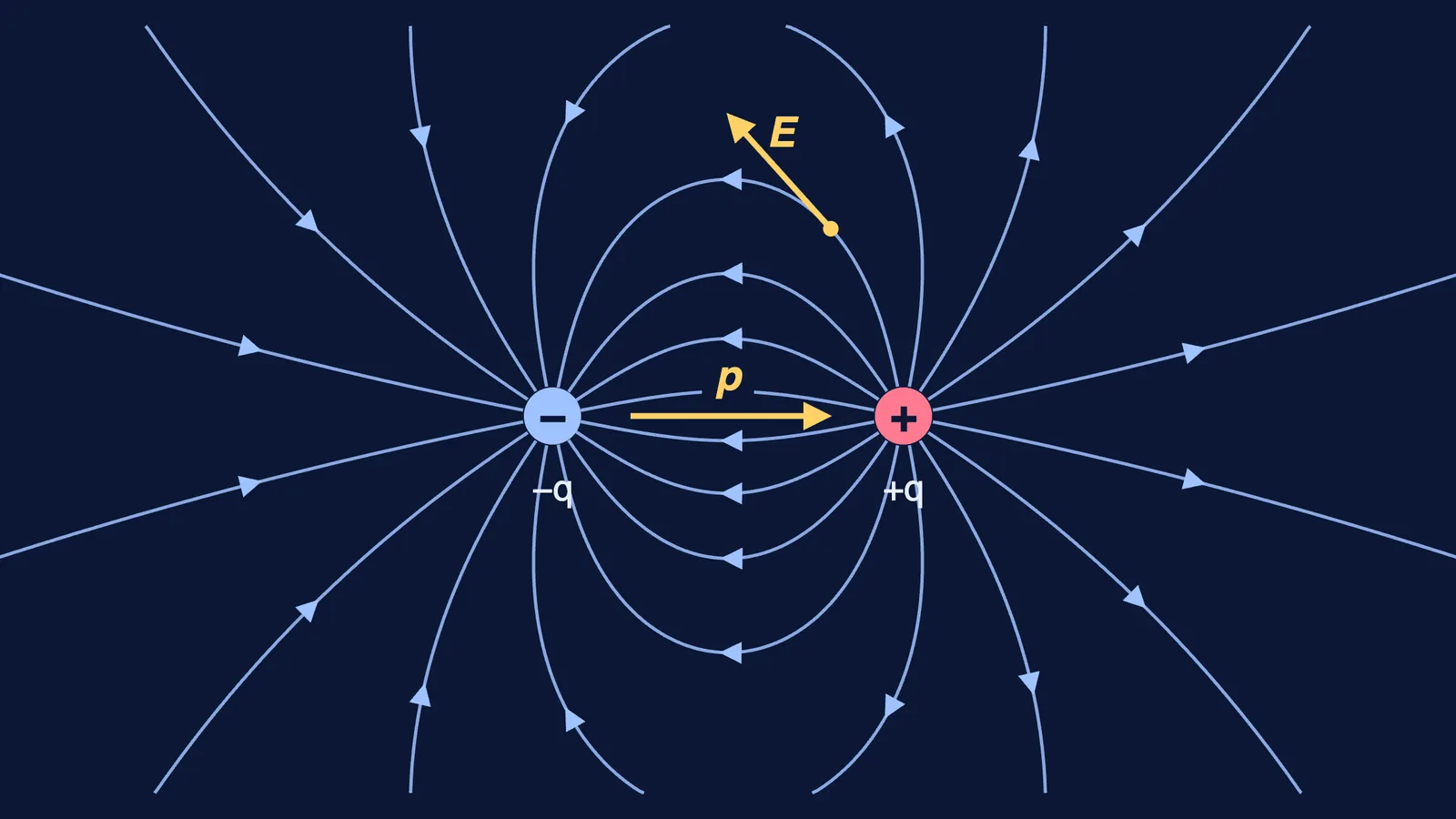
Electric field line: a curve whose tangent at every point gives the field's direction there; lines crowd where the field is strong.
Properties of field lines: they run from positive to negative charges (or infinity), never cross and never form closed loops.
What is an electric dipole?
Electric dipole: equal and opposite charges, +q and −q, a distance 2a apart; total charge zero, field not zero.
Dipole moment (p): a vector of size q × 2a pointing from −q to +q, measured in C m. Don't confuse with: the direction of the field between the charges, which runs from +q to −q.
Dipole axis and equatorial plane: the axis joins the two charges; the equatorial plane is perpendicular to it through the centre. Far away the dipole field falls as 1/r³, faster than the 1/r² of a single charge, according to NCERT.
Polar molecule: one whose centres of positive and negative charge do not coincide, giving a permanent dipole moment. Example: water.
Non-polar molecule: one whose charge centres coincide, so its dipole moment is zero until a field is applied. Example: CO₂, CH₄.
Torque on a dipole: in a uniform field the net force is zero, but a torque τ = p × E turns p to line up with E.
What is Gauss's law?
Area vector: a small area treated as a vector along its normal; on a closed surface the normal points outward.
Electric flux (φ): how much field passes through a surface, E ΔS cos θ for a small area, in N C⁻¹ m². Example: zero when the field runs parallel to the surface.
Gaussian surface: the closed surface you choose for Gauss's law, matched to the symmetry and never through a point charge.
Gauss's law: the total flux through any closed surface equals the enclosed charge divided by ε₀. Don't confuse with: the field on the surface, which depends on charges inside and outside too.
Applications of Gauss's law: an infinite line charge gives a radial field falling as 1/r; an infinite plane sheet gives σ/2ε₀ at any distance; a thin spherical shell acts outside as if its charge sat at the centre, with zero field inside.
For the formulas with units, see our electric charges and fields formulas with examples; for the Gauss's law results in full, our step-by-step derivations.
How to learn these terms
Learn mixed-up pairs together: conductor and insulator, source charge and test charge, conservation and quantisation, λ and σ.
Say the direction rule with every vector: field away from +q, dipole moment from −q to +q, area vector outward.
Sketch field lines for one charge, two like charges and a dipole, and check each against the field-line properties.
Write each Gauss's law case as a card: surface chosen, charge enclosed, field found.
If field lines and flux still feel abstract, the Fermi Simulation Lab has interactive simulations for ideas that are easier to see than to read.