On this page
Eight new JEE Main questions on Dual Nature of Matter and Radiation, easy to hard, each with a worked solution and the trap: the wrong option a rushed student picks.
Unit 17 of the NTA Syllabus for JEE (Main) - 2027 covers the photoelectric effect, Einstein's equation, the particle nature of light and the de Broglie relation. The matching text is NCERT Class 12 Physics Chapter 11 (Reprint 2026-27). New to the chapter? Start with our guide on how to prepare Dual Nature of Matter for JEE Main.
How should you use this practice set?
The JEE (Main) 2027 information bulletin gives +4 for a correct answer and −1 for a wrong one in both the multiple-choice and numerical-value sections; numerical answers are rounded to the nearest integer.
Give yourself 16 minutes for all eight.
Cover each solution and choose first.
Q5 is numerical-value: no options, enter an integer.
For every miss, write the trap in one line.
Take h = 6.63 × 10⁻³⁴ J s, c = 3.0 × 10⁸ m/s, e = 1.6 × 10⁻¹⁹ C, electron mass 9.1 × 10⁻³¹ kg, proton mass 1.67 × 10⁻²⁷ kg, 1/4πε₀ = 9 × 10⁹ N m²/C² and hc = 1240 eV nm.
Easy: photons, matter waves and the K-ν graph
Q1 (easy). A detector counts 2.5 × 10¹⁴ photons per second of 414 nm light. What power does it receive?
(A) 40 µW (B) 75 µW (C) 120 µW (D) 0.12 µW
Answer: (C). Each photon carries hc/λ = 4.8 × 10⁻¹⁹ J, about 3.0 eV. P = 2.5 × 10¹⁴ × 4.8 × 10⁻¹⁹ = 1.2 × 10⁻⁴ W = 120 µW. Trap: (B) writes 3.0 eV as 3.0 × 10⁻¹⁹ J.
Q2 (easy). An electron and a proton have the same kinetic energy. Compare their de Broglie wavelengths.
(A) The proton's is about 43 times longer (B) The electron's is about 43 times longer (C) The electron's is about 1835 times longer (D) They are equal
Answer: (B). λ = h/√(2mK), so at equal K, λ ∝ 1/√m. The ratio is √(1.67 × 10⁻²⁷ / 9.1 × 10⁻³¹) = √1835 ≈ 43, the lighter electron having the longer wavelength. Trap: (C) uses the mass ratio without the square root.
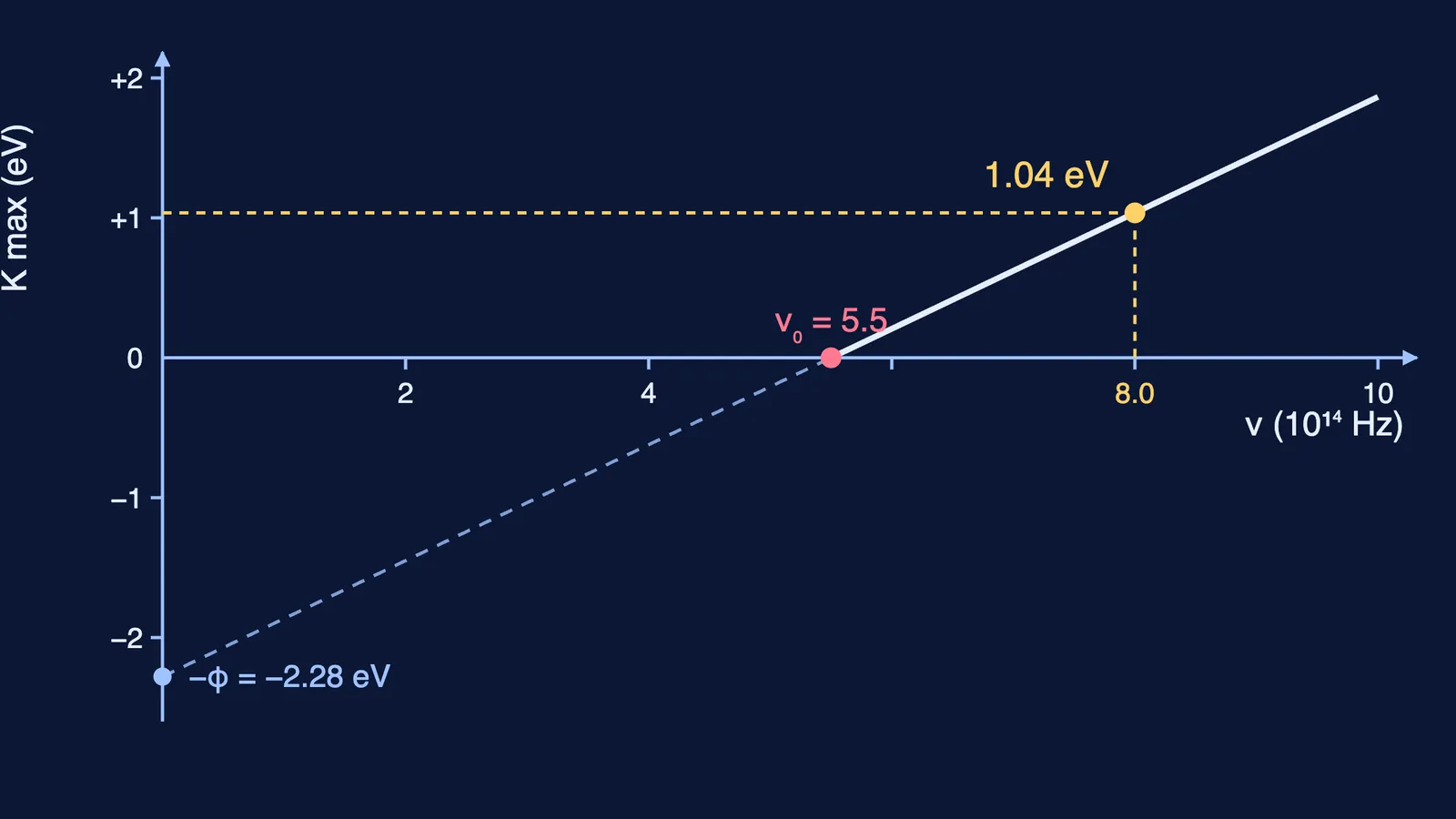
Q3 (easy). For a metal, the graph of maximum kinetic energy of photoelectrons against frequency is a straight line meeting the frequency axis at 5.5 × 10¹⁴ Hz. What is K(max) for light of 8.0 × 10¹⁴ Hz?
(A) 3.32 eV (B) 2.28 eV (C) 1.04 eV (D) 5.59 eV
Answer: (C). The slope is h = 4.14 × 10⁻¹⁵ eV s. K(max) = h(ν − ν₀) = 4.14 × 10⁻¹⁵ × 2.5 × 10¹⁴ ≈ 1.04 eV. Trap: (A) is the whole photon energy hν; the work function hν₀ = 2.28 eV must come off first.
Medium: two wavelengths, a ratio and a retarding field
Q4 (medium). Light of 200 nm and then 400 nm falls on the same metal. The fastest photoelectrons in the first case are three times as fast as in the second. What is the work function?
(A) 1.55 eV (B) 2.71 eV (C) 3.10 eV (D) 6.20 eV
Answer: (B). Photon energies are 6.2 eV and 3.1 eV. A 3 : 1 speed ratio means a 9 : 1 energy ratio, so 6.2 − φ = 9(3.1 − φ). That gives 8φ = 21.7 and φ ≈ 2.71 eV. Trap: (A) sets the energy ratio to 3, forgetting K ∝ v². See how to find work function from two wavelengths.
Q5 (medium, numerical). A photon and an electron each have a wavelength of 0.20 nm. The photon's energy is N times the electron's kinetic energy. Find N to the nearest integer.
Answer: 165. Photon: E = hc/λ. Electron: p = h/λ, so K = h²/(2mλ²). Dividing, N = 2mcλ/h = (2 × 9.1 × 10⁻³¹ × 3.0 × 10⁸ × 0.20 × 10⁻⁹)/(6.63 × 10⁻³⁴) ≈ 164.7, so 165. Trap: writing the electron's energy as pc, which is true only for a photon, gives N = 1.
Q6 (medium). Light on an emitter gives a stopping potential of 1.2 V. The collector is now held at −0.8 V relative to the emitter. What is the greatest kinetic energy with which an electron reaches the collector?
(A) 0.4 eV (B) 1.2 eV (C) 2.0 eV (D) 0.8 eV
Answer: (A). The fastest electrons leave with eV₀ = 1.2 eV; climbing the 0.8 V retarding potential costs 0.8 eV, leaving 0.4 eV. Trap: (C) adds the potentials, treating a negative collector as one that speeds electrons up.
Hard: magnetic fields and a charging sphere
Q7 (hard). Light of 248 nm falls on a metal. The fastest photoelectrons, moving perpendicular to a uniform magnetic field of 2.0 × 10⁻⁴ T, travel in a circle of radius 2.4 cm. What is the work function?
(A) 2.0 eV (B) 0.95 eV (C) 3.0 eV (D) 7.0 eV
Answer: (C). From r = mv/eB, p = eBr = 1.6 × 10⁻¹⁹ × 2.0 × 10⁻⁴ × 0.024 = 7.68 × 10⁻²⁵ kg m/s. K = p²/2m = 3.24 × 10⁻¹⁹ J ≈ 2.0 eV. The photon carries 1240/248 = 5.0 eV, so φ ≈ 3.0 eV. Trap: (B) uses K = p²/m, dropping the 2, which doubles K.
Q8 (hard). An isolated, initially neutral metal sphere of radius 1.5 cm has a work function of 4.2 eV. It is lit by 177 nm ultraviolet light. How many electrons does it lose before emission stops?
(A) 2.9 × 10⁷ (B) 4.4 × 10⁷ (C) 7.3 × 10⁷ (D) 2.9 × 10⁹
Answer: (A). Each photon carries 1240/177 ≈ 7.0 eV, so K(max) = 2.8 eV. Emission stops when the sphere reaches 2.8 V and pulls even the fastest electrons back. Q = 4πε₀rV = (0.015 × 2.8)/(9 × 10⁹) = 4.7 × 10⁻¹² C, so n = Q/e ≈ 2.9 × 10⁷. Trap: (C) charges the sphere to the full 7.0 V photon energy, forgetting the work function.
What should you do after this set?
Score yourself at +4/−1. Unit slips (Q1, Q7)? Redo them with every conversion written out. Energy-balance misses (Q3, Q4, Q6, Q8)? Work through our photoelectric effect problems and their traps.
For more practice, the Fermi Problem Library has worked problems with a step-by-step solver that explains the reasoning rather than printing an answer.