On this page
Dual Nature of Radiation and Matter is Chapter 11 of the NCERT Class 12 Physics textbook, Part II (reprint 2026-27). The CBSE Physics syllabus for 2026-27 lists it as Unit VII: the photoelectric effect and its experimental study, Einstein's photoelectric equation, and matter waves with the de Broglie relation. The terms follow that order. For answer-writing, see our Dual nature of radiation and matter Class 12 board exam guide.
What is work function, and how do electrons leave a metal?
Values in this section come from NCERT Chapter 11.
Free electrons: electrons that move inside a metal and carry its current, but are held back at the surface by positive ions.
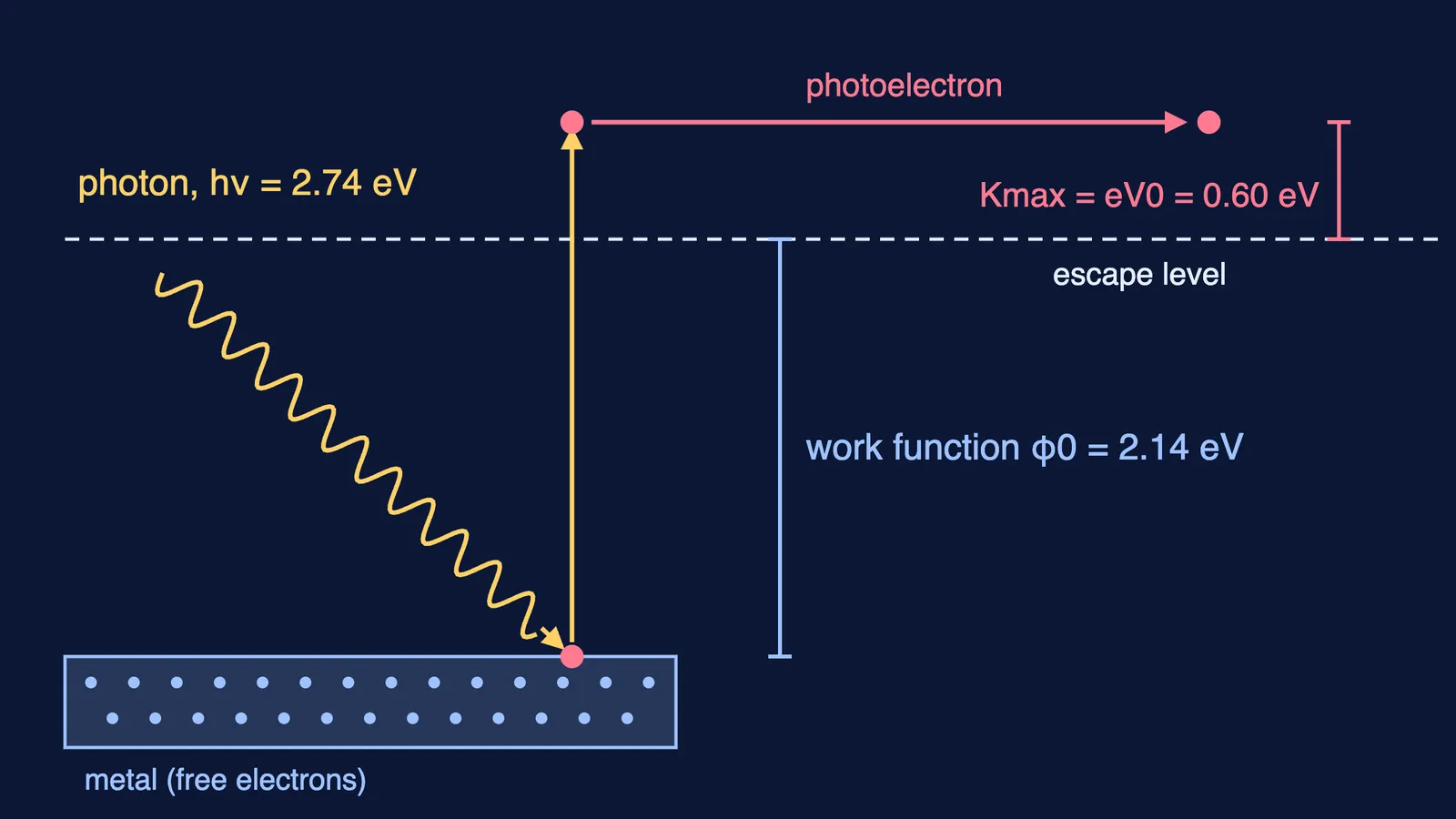
Work function (φ0): the smallest energy you must give a free electron to free it from a particular metal; it depends on the metal and the state of its surface. Example: 2.14 eV for caesium.
Electron volt (eV): the energy an electron gains when accelerated through 1 volt; 1 eV = 1.602 × 10^-19 J.
Thermionic emission: heating the metal until free electrons have enough energy to get out.
Field emission: pulling electrons out with a very strong electric field, about 10^8 V/m, as in a spark plug.
Photoelectric emission: light of a suitable frequency knocks electrons out of the surface.
Photoelectron: an electron released by light. Don't confuse with: a photon, the packet of light that releases it.
What happens in the photoelectric effect experiment?
These follow sections 11.3-11.4 of NCERT Chapter 11.
Photoelectric effect: electrons leaving a metal because light of high enough frequency shines on it. Hertz first noticed it in 1887: ultraviolet light strengthened the sparks in his detector.
Hallwachs' and Lenard's observations: Hallwachs saw a negatively charged zinc plate lose its charge under ultraviolet light; Lenard saw current cross an evacuated tube only while the light was on.
Photosensitive substance: a material that emits electrons when lit. Example: zinc and cadmium need ultraviolet light; alkali metals such as sodium and caesium respond even to visible light.
Emitter and collector: the lit plate C that gives out electrons, and the plate A that gathers them.
Photocurrent: the current of photoelectrons reaching the collector; at a fixed frequency it is directly proportional to intensity.
Accelerating and retarding potential: a positive collector attracts electrons; a negative one repels them, so only faster ones cross.
Saturation current: the highest photocurrent, reached when every emitted electron gets to the collector.
Stopping (cut-off) potential (V0): the smallest retarding potential that brings the photocurrent to zero. Then Kmax = eV0. Don't confuse with: saturation current, which depends on intensity while V0 does not.
Maximum kinetic energy (Kmax): the energy of the fastest photoelectrons; tightly bound electrons come out slower.
Threshold frequency (ν0): the lowest frequency that ejects electrons from a given metal; below it, no emission however bright the light. Example: 5.16 × 10^14 Hz for caesium.
Instantaneous emission: above ν0, electrons come out with no noticeable delay, within about 10^-9 s, even in very dim light.
Why did the wave theory fail where Einstein succeeded?
Wave picture of light: light as an electromagnetic wave with energy spread continuously over the wavefront. It predicts faster electrons in brighter light, emission at any frequency, and a delay in dim light; experiments contradict all three.
Quantum of radiation: a discrete packet of light energy, hν. Einstein proposed in 1905 that one electron absorbs one whole quantum.
Planck's constant (h): the constant linking a quantum's energy to its frequency, 6.626 × 10^-34 J s (NCERT).
Einstein's photoelectric equation: Kmax = hν − φ0, energy conservation for one photon absorbed by one electron. Since φ0 = hν0, it also reads eV0 = h(ν − ν0).
Intensity (photon picture): proportional to the number of photons crossing unit area each second; it changes how many electrons come out, not how fast. Don't confuse with: frequency, which sets each photon's energy.
Millikan's verification: Millikan measured the slope (h/e) of the V0 against ν line, found h, and confirmed Einstein's equation by 1916.
What is a photon?
Photon: a particle of light with energy E = hν = hc/λ, momentum p = hν/c = h/λ and speed c. It has no charge, so electric and magnetic fields do not bend it.
Photon number: brighter light of one colour means more photons per second, not more energetic ones. Example: a 2.0 mW beam at 6.0 × 10^14 Hz carries about 5.0 × 10^15 photons per second (NCERT Example 11.1).
Photon collisions: energy and momentum are conserved, but photons can be absorbed or created.
Compton effect: X-rays scattering off electrons, studied by A.H. Compton; more evidence for photons.
What are matter waves and the de Broglie wavelength?
Dual nature of radiation: light behaves as a wave in interference, diffraction and polarisation, and as particles when exchanging energy with matter.
de Broglie hypothesis: Louis de Broglie's 1924 proposal that moving matter, such as electrons, can show wave behaviour too.
Matter waves (de Broglie waves): the waves that go with any moving piece of matter, such as an electron or a proton.
de Broglie relation: λ = h/p = h/mv. Wavelength is a wave idea, momentum a particle idea; h links them.
de Broglie wavelength: the wavelength of a moving particle; it depends on momentum, not on charge or the kind of particle. Example: an electron at 5.4 × 10^6 m/s has λ = 0.135 nm, comparable to X-rays, while a 150 g ball at 30 m/s has λ = 1.47 × 10^-34 m, far too small to measure (NCERT Example 11.3).
How to learn these terms
Learn the pairs together: photon and photoelectron, saturation current and stopping potential, intensity and frequency, work function and threshold frequency.
Redraw the energy diagram above: work function step, hν arrow, Kmax as the leftover.
Sketch the three NCERT graphs (photocurrent against intensity, photocurrent against collector potential, V0 against ν) and label them.
Practise numbers with our photoelectric effect problems and traps, then carry quantised energy into our Atoms Class 12 board exam guide.
If intensity and frequency are hard to picture, the Fermi Simulation Lab has interactive simulations for ideas that are easier to see than to read.