On this page
Depreciation, provisions and reserves feeds almost everything after it in Accountancy, from final accounts to Class 12 partnership work. Here is what the 2026-27 syllabus keeps, both methods on one original example, the entries, and provisions versus reserves.
What does the 2026-27 CBSE syllabus keep in this chapter?
The CBSE Accountancy curriculum for 2026-27 places the chapter inside Unit 2, printed as "Unit-2: Accounting Process" with 44 marks, out of 80 theory marks for the year. Those 44 marks are shared with the rest of the unit, including journal, ledger, cash book, bank reconciliation, trial balance and rectification of errors.
Inside that unit, the same curriculum keeps:
meaning, features, need, causes and factors of depreciation; depletion and amortisation
the straight line method (SLM) and the written down value method (WDV), their differences and advantages, "Excluding change of method"
two ways of recording depreciation, and treatment of disposal of an asset
provisions, reserves and the difference between them; revenue, capital, general, specific and secret reserves
Study from the current NCERT chapter 7, Depreciation, Provisions and Reserves, which is marked "Reprint 2026-27".
How do SLM and WDV differ?
NCERT defines SLM as charging the same amount of depreciation every year: (cost − estimated net residual value) ÷ useful life. Under WDV, the same chapter applies a fixed percentage to the book value at the start of each year, so the charge shrinks every year and the asset never reaches zero. For the SLM formula alone, see our explainer on the straight-line method of depreciation; here both methods share one asset.
Worked example: one machine, two methods
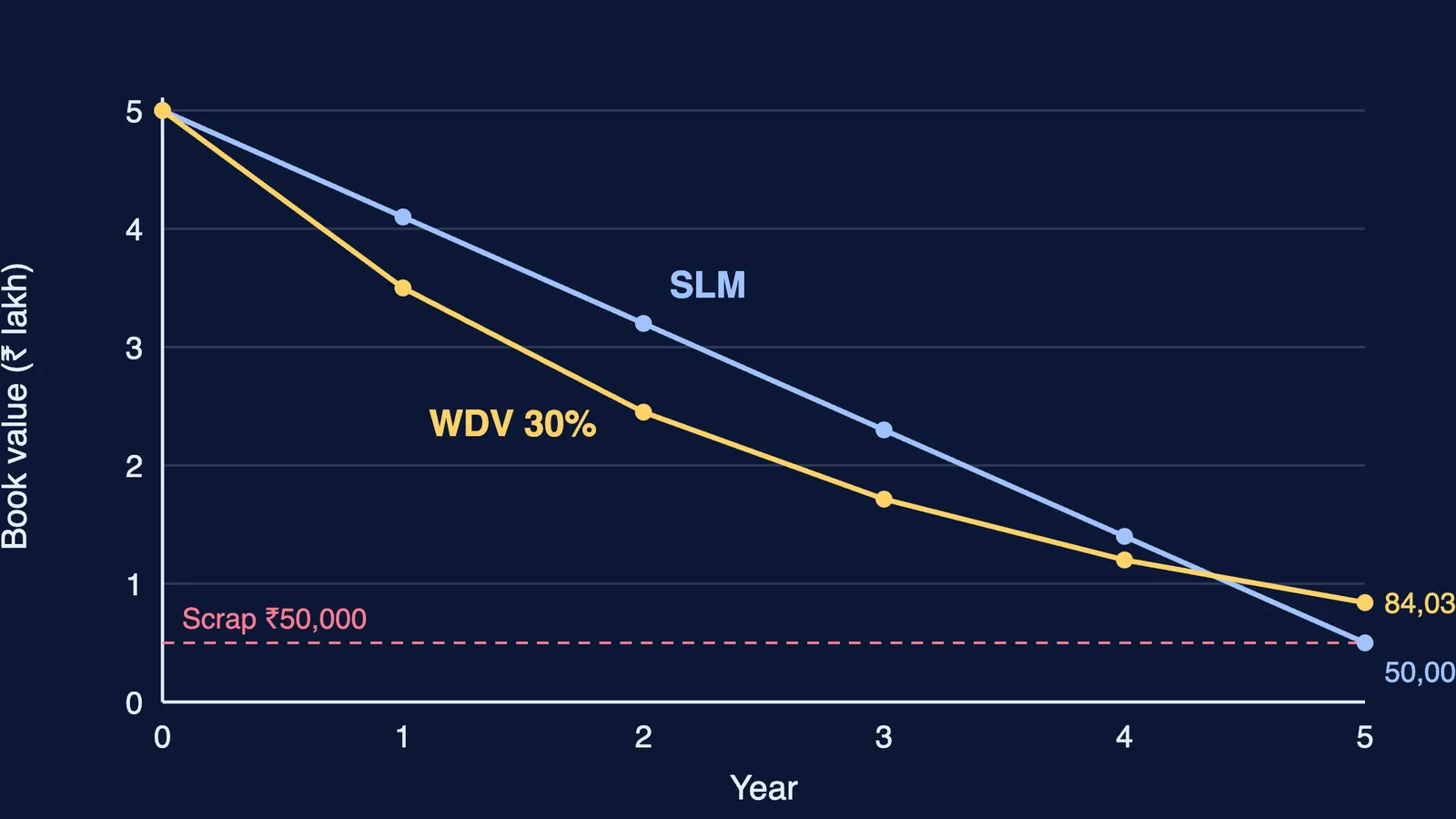
A printing shop buys a machine for ₹4,80,000 plus ₹20,000 installation, so its cost is ₹5,00,000. Expected life is 5 years and scrap value ₹50,000. Compare SLM with WDV at 30% a year.
SLM: (5,00,000 − 50,000) ÷ 5 = ₹90,000 every year, which is 18% of cost.
WDV at 30%:
Year 1: 30% of 5,00,000 = ₹1,50,000; book value ₹3,50,000
Year 2: 30% of 3,50,000 = ₹1,05,000; book value ₹2,45,000
Year 3: 30% of 2,45,000 = ₹73,500; book value ₹1,71,500
Year 4: 30% of 1,71,500 = ₹51,450; book value ₹1,20,050
Year 5: 30% of 1,20,050 = ₹36,015; book value ₹84,035
SLM book values run ₹4,10,000, ₹3,20,000, ₹2,30,000, ₹1,40,000 and ₹50,000. WDV charges ₹60,000 more in Year 1, less from Year 3, and ends at ₹84,035.
Now say the machine is sold for ₹2,00,000 at the end of Year 3. Under SLM the book value is ₹2,30,000, so there is a loss of ₹30,000. Under WDV it is ₹1,71,500, so there is a profit of ₹28,500. Same machine, same price, opposite results.
How do you record depreciation in the books?
The NCERT chapter gives two methods. Both end the year with Profit and Loss A/c Dr. To Depreciation A/c; they differ in the first entry:
Charging to asset account: Depreciation A/c Dr. To Machine A/c. The machine appears at book value in the balance sheet.
Provision for depreciation account: Depreciation A/c Dr. To Provision for Depreciation A/c. The machine stays at original cost, and accumulated depreciation is shown separately.
In our SLM example, accumulated depreciation after Year 3 is ₹2,70,000. On sale, transfer it to the machine account first, then credit the ₹2,00,000 received and take the ₹30,000 loss to profit and loss. These balances then flow into final accounts with adjustments.
What is the difference between provisions and reserves?
A provision is a charge against profit; a reserve is an appropriation of profit, according to NCERT. The chapter sets out the rest:
Purpose: a provision covers a known expense or loss of this period whose amount is uncertain, such as doubtful debts; a reserve strengthens the business.
When: a provision must be made even if there is no profit; a reserve cannot be created without profit.
Tax: a provision reduces taxable profit; a reserve, made from profit after tax, does not.
Balance sheet: a provision is deducted from the asset or shown with current liabilities; a reserve sits after capital.
Dividend: a provision cannot be distributed; a general reserve can.
Learn reserve types as pairs: general versus specific, and revenue (from operating profits) versus capital (mainly from capital profits such as profit on sale of fixed assets). A secret reserve is hidden: you will not find it in the balance sheet.
Which mistakes cost marks in this chapter?
Leaving installation or freight out of the asset's cost.
Charging WDV on original cost instead of opening book value.
Charging a full year's depreciation on an asset bought mid-year.
Forgetting to transfer accumulated depreciation before working out profit or loss on sale.
Calling a provision an appropriation.
Posted to the wrong account anyway? Our guide to rectification of errors in Class 11 shows the fix.
Fermi's AI tutor can work out what you already know and build a plan for the session, so you sit down to a clear next step.
Practice: redo the example with WDV at 20% and a ₹2,50,000 sale after Year 2. Profit or loss?