

On this page
Businesses buy assets like computers, vehicles and machinery to operate. Over time, these assets lose their value due to wear and tear or becoming obsolete. Depreciation is the accounting process of spreading the cost of an asset over its working life.
The straight-line method is the simplest and most commonly used technique for calculating this depreciation (Wikipedia). It assumes that the asset loses value at a constant rate every year.
What is the straight-line method formula?
The straight-line formula calculates a fixed depreciation expense for each year. It is written as:
Annual Depreciation Expense = (Cost − Salvage Value) / Useful Life
To use this formula, you need three pieces of information:
Cost: The total initial price paid for the asset, including any fees to deliver and install it.
Salvage Value: The estimated amount the asset will be worth at the end of its useful life, also known as the residual or scrap value.
Useful Life: The number of years the business expects the asset to be productive.
The difference between the cost and the salvage value (the numerator in the formula) is called the depreciable base. This is the total amount of value the asset will lose over its entire lifespan.
How do you calculate straight-line depreciation?
Consider an example of calculating this method (Wikipedia). Suppose a company buys a delivery van for £35,000. The business plans to use the van for 7 years, after which they estimate they can sell it for £7,000.
Find the depreciable base: Subtract the salvage value from the cost (£35,000 − £7,000 = £28,000).
Divide by the useful life: Divide that base by the number of years (£28,000 / 7 = £4,000).
The company will record a depreciation expense of £4,000 every year for 7 years. Each year, the "book value" of the van on the company's balance sheet will drop by exactly £4,000 until it reaches the £7,000 salvage value.
This method works well for assets like office furniture or buildings, where the utility stays relatively constant over time. For more complex exam or homework problems involving equations, reading up on Quadratic word problems in Class 10 can help you build strong foundational math skills.
How does straight-line depreciation affect financial statements?
When a business calculates its straight-line depreciation, it must record this loss of value in its accounting records. This affects two main financial statements: the income statement and the balance sheet.
On the income statement, the annual depreciation is recorded as an expense. This reduces the company's reported profit for the year, which can in turn lower its tax bill. Even though no actual cash leaves the business when depreciation is recorded—the cash was already spent when the asset was purchased—it is treated as a cost of doing business.
On the balance sheet, the business does not simply erase the asset's original cost. Instead, it uses a contra-asset account called Accumulated Depreciation. This account keeps a running total of all the depreciation expenses recorded since the asset was bought. To find the current book value of the asset, you subtract the accumulated depreciation from the original purchase price. This provides a transparent view of both what the asset originally cost and how much of its value has been consumed.
What are the advantages and disadvantages of the straight-line method?
The primary advantage of the straight-line method is its simplicity. It requires only three basic figures—cost, salvage value, and useful life—and involves a single calculation that applies for the entire lifespan of the asset. This predictability makes forecasting and budgeting much easier for small businesses.
However, the method has its drawbacks. It assumes the asset provides equal value and suffers equal wear and tear every year. In reality, many assets, such as vehicles and electronics, lose a significant portion of their value almost immediately after purchase. Furthermore, as an asset ages, it often requires more maintenance and repairs. Under the straight-line method, the depreciation expense remains flat, meaning the total cost of owning the asset (depreciation plus maintenance) actually increases in its later years.
Straight-line vs reducing-balance method
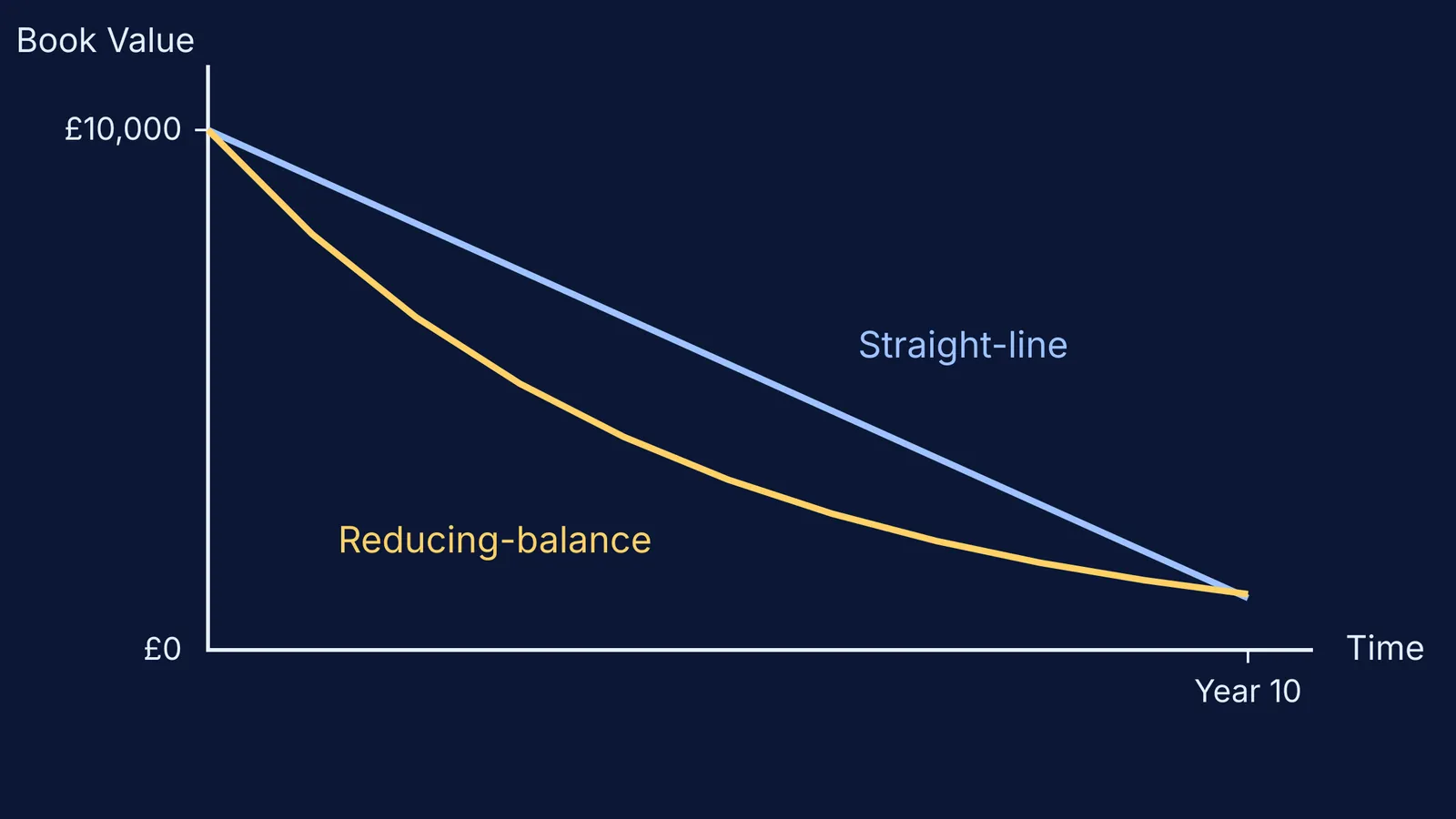
While the straight-line method spreads the cost evenly, the reducing-balance (or diminishing-balance) method accelerates the depreciation (Wikipedia).
In the reducing-balance method, depreciation is calculated by applying a fixed percentage rate to the asset's remaining book value at the start of each year, rather than to its original cost. Because the book value drops each year, the depreciation expense is highest in the first year and decreases steadily over time.
Expense timing: Straight-line keeps the expense flat. Reducing-balance loads the heaviest expenses into the early years.
Calculation base: Straight-line uses the fixed depreciable base. Reducing-balance uses the constantly updating book value.
Asset type: The reducing-balance method is often a better representation for assets like computers and vehicles that lose most of their value quickly in their first few years of use.
If you find yourself stuck on the maths behind these formulas, the Fermi Concept Library maps out every concept in mathematics. Fermi's AI tutor works out what you already know and builds a plan for the session, checking your understanding as it goes.
A quick checklist for depreciation problems
When you sit down to solve a depreciation problem, keep this framework in mind:
Identify the full starting cost, including hidden fees like installation.
Check if a salvage or scrap value is given. If it is omitted, assume it is zero.
Determine the required method (straight-line or reducing-balance).
For reducing-balance, check if the rate needs to be applied to the remaining balance instead of the starting cost. Just like when you are Converting a quantity between unit systems, paying attention to the exact definitions avoids common mistakes.


