On this page
Most d- and f-block questions in JEE Main test a few moves: count d electrons, read an E° table and balance a permanganate reaction. These 8 original questions practise them, easy to hard; two are numerical-value questions.
The set stays inside Unit 11, d- and f-Block Elements, of the NTA's Syllabus for JEE (Main) - 2027. Every fact and data value comes from Unit 4 of NCERT Class 12 Chemistry Part I, the d- and f-Block Elements chapter (Reprint 2026-27).
How should you use this d- and f-block practice set?
Hide the answers; allow about two minutes per question.
Write the d-electron count or electron change before reading the options.
Read the trap line even when you are right.
Log each miss by cause and redo it after three days.
For the theory, see our guide on how to prepare d- and f-Block Elements for JEE Main.
Easy: can you track chromium and its oxidation states?
Q1 (easy). In which pair is the metal in the same oxidation state in both species?
(A) MnO₄⁻ and MnO₄²⁻ (B) CrO₄²⁻ and Cr₂O₇²⁻ (C) Fe₂O₃ and FeO (D) MnO₂ and Mn₂O₃
Answer: (B). In CrO₄²⁻, x + 4(−2) = −2, so x = +6. In Cr₂O₇²⁻, 2x + 7(−2) = −2, so x = +6. NCERT notes chromium keeps this state as chromate and dichromate interconvert. Trap: (A) looks matched, but permanganate is +7 and manganate is +6.
Q2 (easy). In NCERT's preparation of K₂Cr₂O₇, KCl is added to sodium dichromate solution. Why?
(A) It reduces leftover chromate to dichromate (B) K₂Cr₂O₇ is less soluble than Na₂Cr₂O₇, so it crystallises out (C) It raises chromium from +3 to +6 (D) It lowers the pH so chromate turns into dichromate
Answer: (B). Na₂Cr₂O₇ + 2KCl → K₂Cr₂O₇ + 2NaCl is a simple exchange; NCERT section 4.4 notes that sodium dichromate is more soluble, so orange K₂Cr₂O₇ crystals separate. Trap: (D) describes the earlier acidification step, not KCl's role.
Medium: can you use magnetic moments, E° values and titrations?
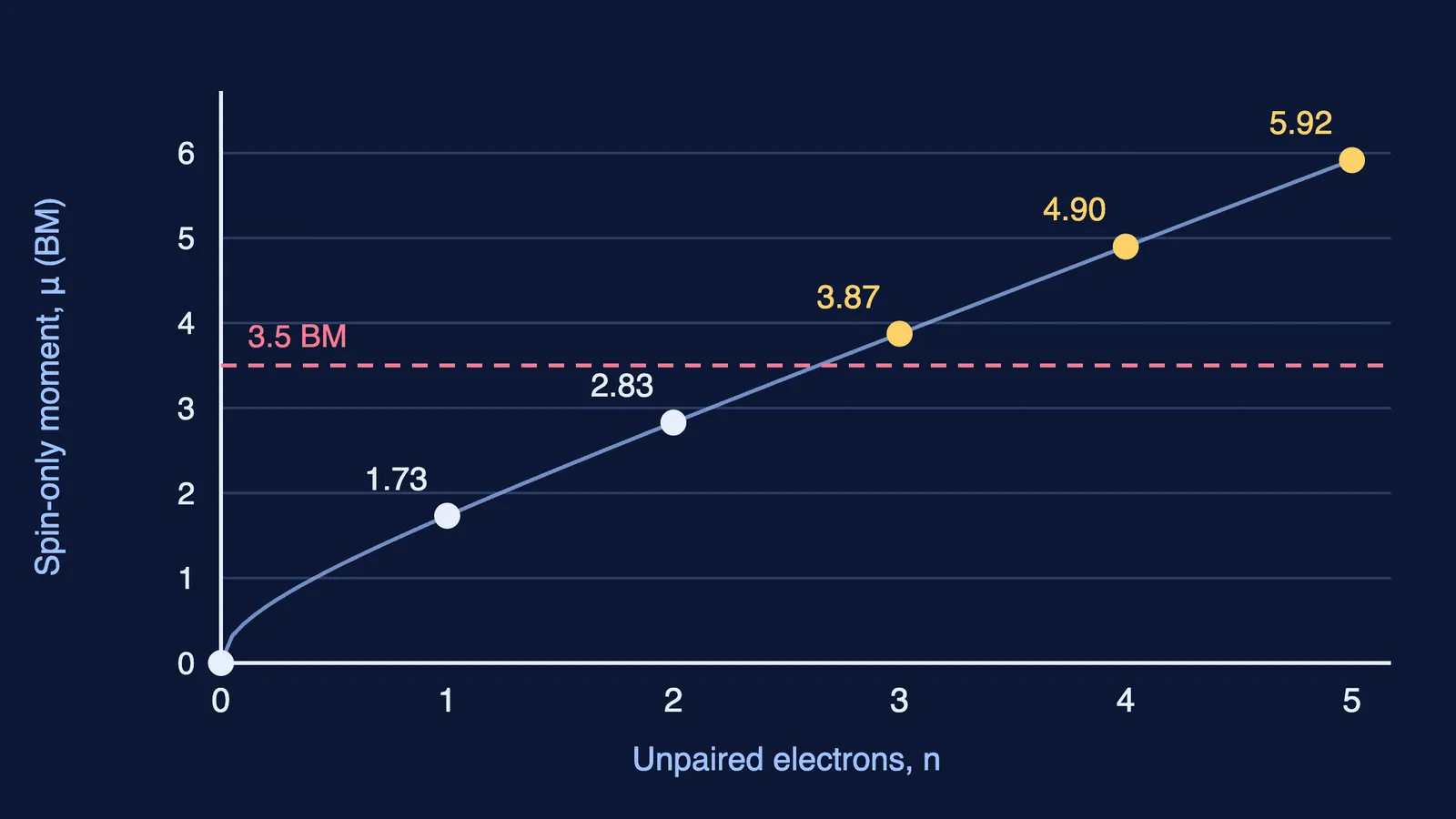
Data from NCERT Unit 4: μ = √(n(n+2)) BM, where n is the number of unpaired electrons, and E°(M³⁺/M²⁺) from Table 4.2: Cr −0.41 V, Mn +1.57 V, Fe +0.77 V, Co +1.97 V.
Q3 (medium, numerical). How many of these aquated ions have a spin-only magnetic moment greater than 3.5 BM? V²⁺, Cr³⁺, Mn²⁺, Fe²⁺, Co²⁺, Ni²⁺, Cu²⁺, Ti³⁺, Fe³⁺
Answer: 6. The d counts are 3, 3, 5, 6, 7, 8, 9, 1 and 5, giving 3, 3, 5, 4, 3, 2, 1, 1 and 5 unpaired electrons. Since n = 3 already gives √15 = 3.87 BM, every ion with n ≥ 3 counts. Trap: answering 3 by treating μ as roughly n.
Q4 (medium). From the E°(M³⁺/M²⁺) values above, which pair names the strongest reducing agent (an M²⁺ ion) and the strongest oxidising agent (an M³⁺ ion) in water?
(A) Co²⁺ reducing, Cr³⁺ oxidising (B) Fe²⁺ reducing, Mn³⁺ oxidising (C) Cr²⁺ reducing, Mn³⁺ oxidising (D) Cr²⁺ reducing, Co³⁺ oxidising
Answer: (D). The most negative couple (−0.41 V) makes Cr²⁺ the easiest to oxidise; the most positive (+1.97 V) makes Co³⁺ the strongest electron acceptor. Trap: (C) remembers that Mn³⁺ is a strong oxidant but does not compare +1.57 V with +1.97 V.
Q5 (medium). 25.0 mL of an acidified Fe²⁺ solution needs 18.0 mL of 0.0200 M KMnO₄ to reach the end point. What is the molarity of Fe²⁺?
(A) 0.0144 M (B) 0.0720 M (C) 0.0432 M (D) 0.0864 M
Answer: (B). NCERT gives 5Fe²⁺ + MnO₄⁻ + 8H⁺ → Mn²⁺ + 4H₂O + 5Fe³⁺. Moles of MnO₄⁻ = 0.0180 × 0.0200 = 3.60 × 10⁻⁴, so Fe²⁺ = 5 × 3.60 × 10⁻⁴ = 1.80 × 10⁻³ mol, and 1.80 × 10⁻³ / 0.0250 = 0.0720 M. Trap: (A) takes a 1:1 ratio; (D) uses dichromate's 6 electrons instead of permanganate's 5.
Hard: can you handle the f-block and multi-step stoichiometry?
Q6 (hard). Statement I: Ce⁴⁺ is a strong oxidising agent and Eu²⁺ is a strong reducing agent, since both tend to return to the common +3 state. Statement II: Yb²⁺, with a filled 4f¹⁴ subshell, is an oxidising agent.
(A) Both statements are correct (B) Both are incorrect (C) Statement I is correct, Statement II is incorrect (D) Statement I is incorrect, Statement II is correct
Answer: (C). NCERT section 4.5.3 calls Ce(IV) a strong oxidant and Eu²⁺ a strong reductant, each reverting to +3. It calls Yb²⁺ a reductant, like Eu²⁺. Trap: (A) reasons that a stable f¹⁴ ion must be oxidising; NCERT calls half-filled Tb(IV) an oxidant, but Yb²⁺ a reductant.
Q7 (hard). Which statement about the lanthanoid contraction is correct?
(A) It makes the radii of Zr (160 pm) and Hf (159 pm) almost equal, so the two have very similar properties. (B) It happens because one 4f electron shields another more strongly than one d electron shields another. (C) Atomic radii fall perfectly regularly from La to Lu. (D) Europium has the smallest atomic radius in the series.
Answer: (A). NCERT gives exactly this consequence. Trap: (B) reverses the cause; 4f shielding is weaker. (C) ignores the irregular atomic radii; (D) fails because Eu's atomic radius, 199 pm in Table 4.9, is the largest.
Q8 (hard, numerical). Both equations below are from NCERT section 4.4. 26.1 g of MnO₂ is fused with KOH in air (2MnO₂ + 4KOH + O₂ → 2K₂MnO₄ + 2H₂O). The manganate then disproportionates in acid: 3MnO₄²⁻ + 4H⁺ → 2MnO₄⁻ + MnO₂ + 2H₂O. Taking Mn = 55, K = 39 and O = 16, what mass of KMnO₄ forms in one pass (MnO₂ not recycled), in grams, to the nearest integer?
Answer: 32. MnO₂ = 87 g/mol, so 26.1 g is 0.300 mol, giving 0.300 mol K₂MnO₄. Two of every three manganate ions become permanganate: 0.200 mol × 158 g/mol = 31.6 g, or 32. Trap: 47 assumes every manganate ion becomes permanganate.
What should you do after this set?
Sort your misses: Q1 and Q3 are counting, Q2 and Q7 recall, Q4 data, and Q5, Q6 and Q8 redox. Next, take Coordination Compounds for JEE Main next, and use our electrochemistry JEE Main practice set to drill E° reasoning further.
If a wrong method, not a missing fact, cost you the mark, the Fermi Problem Library has worked problems with a step-by-step solver that explains the reasoning rather than printing an answer.