On this page
These eight JEE Main-style questions are new, not taken from NCERT, exemplar or past papers. Each solution ends with the trap: the wrong answer most students reach, and why.
What does JEE Main test in Current Electricity?
In the JEE (Main) 2027 syllabus published by NTA (linked from jeemain.nta.nic.in), Current Electricity is Unit 12 of Physics, from drift velocity and resistivity to cells, Kirchhoff's laws and the metre bridge. Every question stays inside that list and the NCERT Class 12 chapter. For theory and a study plan, see our guide on how to prepare Current Electricity for JEE Main.
How should you use this set?
Cover the solutions and attempt all eight in about 20 minutes.
Mark each miss with its cause: concept, algebra or misreading.
Redo every miss two days later, without notes.
Easy: resistance, drift and power
Q1 (easy). A 10 Ω wire is drawn out so that its length becomes 1.5 times the original. Its volume and resistivity do not change. What is its new resistance?
(A) 6.67 Ω (B) 15 Ω (C) 22.5 Ω (D) 33.75 Ω
Answer: (C). With volume fixed, R = ρL/A is proportional to L². R = 10 × 1.5² = 22.5 Ω.
Trap: (B) forgets that the wire also gets thinner.
Q2 (easy). A copper wire of cross-section 2.0 mm² carries 3.2 A. The free-electron density is 8.0 × 10²⁸ m⁻³ and e = 1.6 × 10⁻¹⁹ C. What is the drift speed?
(A) 1.25 × 10⁻¹⁰ m/s (B) 1.25 × 10⁻⁷ m/s (C) 1.25 × 10⁻⁴ m/s (D) 1.25 × 10² m/s
Answer: (C). v_d = I/(neA) = 3.2/(8.0 × 10²⁸ × 1.6 × 10⁻¹⁹ × 2.0 × 10⁻⁶) = 1.25 × 10⁻⁴ m/s.
Trap: (B) converts mm² to m² with 10⁻³ instead of 10⁻⁶; (A) leaves the area in mm².
Q3 (easy). Bulbs rated 40 W, 200 V and 160 W, 200 V are joined in series across a 200 V supply. Treating their resistances as constant, what power does the 40 W bulb use?
(A) 6.4 W (B) 25.6 W (C) 32 W (D) 40 W
Answer: (B). R = V²/P gives 1000 Ω and 250 Ω. The current is 200/1250 = 0.16 A, so the 40 W bulb uses I²R = 25.6 W and the 160 W bulb only 6.4 W.
Trap: (A) assumes the higher-rated bulb still dominates. In series, the larger resistance takes more power. If power formulas blur, see which electric power formula to use.
Medium: temperature, cells and loading
Q4 (medium). A carbon resistor (α = −5.0 × 10⁻⁴ per °C) and a nichrome resistor (α = +4.0 × 10⁻⁴ per °C) are in series. Their total is 90 Ω and, to first order, does not change with temperature. What is the carbon resistor's value?
(A) 40 Ω (B) 45 Ω (C) 50 Ω (D) 72 Ω
Answer: (A). The changes cancel when R_c α_c + R_n α_n = 0, so 5R_c = 4R_n. With R_c + R_n = 90 Ω, R_c = 40 Ω and R_n = 50 Ω.
Trap: (C) swaps the two values.
Q5 (medium). Twelve identical cells, each 2.0 V with internal resistance 0.25 Ω, should be in series, but three are connected the wrong way round. The battery drives a 9 Ω resistor. What is the current?
(A) 0.8 A (B) 1.0 A (C) 1.5 A (D) 2.0 A
Answer: (B). Each reversed cell cancels one correct cell, so the net emf is (12 − 6) × 2.0 = 12 V. All twelve internal resistances still count: 3 Ω. I = 12/(3 + 9) = 1.0 A.
Trap: (C) subtracts only three cells' emf; each reversed cell also cancels a correct one.
Q6 (medium). A 60 Ω rheostat is connected across an ideal 12 V battery, with the slider at its midpoint. A 30 Ω lamp is connected between the slider and the negative end. What is the voltage across the lamp?
(A) 3 V (B) 4 V (C) 6 V (D) 8 V
Answer: (B). The lamp is in parallel with the lower 30 Ω, giving 15 Ω, in series with the upper 30 Ω. V = 12 × 15/45 = 4 V.
Trap: (C) is the unloaded voltage; the load pulls it down.
Hard: can you solve an unbalanced bridge and a power curve?
Q7 (hard). An ideal 6 V battery has its positive terminal at A and negative at C. Between A and C there are two paths: A to B is 2 Ω, B to C is 4 Ω; A to D is 4 Ω, D to C is 2 Ω. A 4 Ω resistor joins B and D. What current flows in BD?
(A) 0 (B) 0.3 A from B to D (C) 0.3 A from D to B (D) 0.5 A from B to D
Answer: (B). Take C as 0 V. The junction rule at B and D gives 2V_B − V_D = 4.8 and 2V_D − V_B = 1.2 (in volts), so V_B = 3.6 V and V_D = 2.4 V. The current is (3.6 − 2.4)/4 = 0.3 A from B to D.
Trap: (D) finds V_B = 4 V and V_D = 2 V with BD removed, then puts them back. (A) assumes balance, but 2/4 ≠ 4/2.
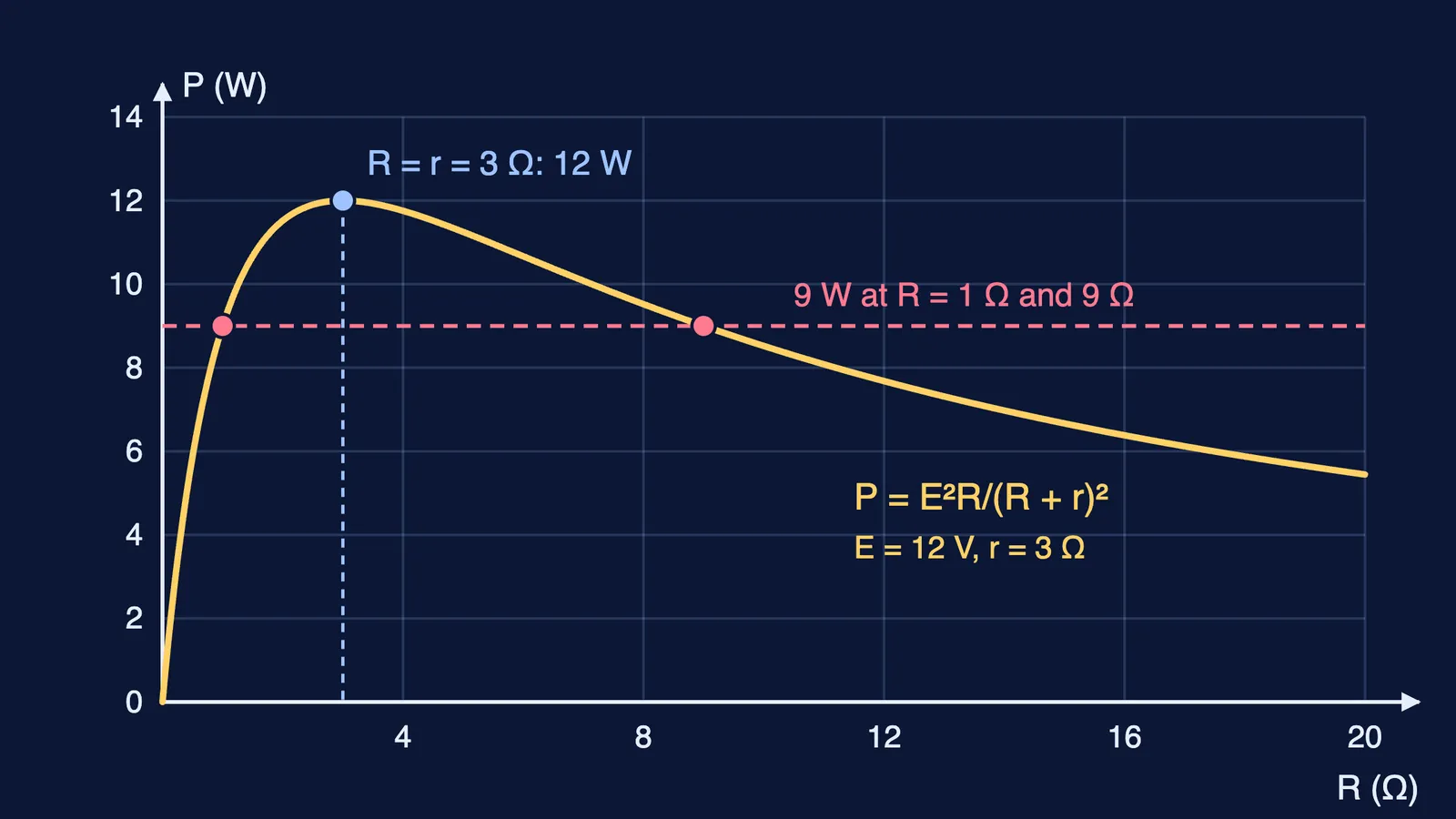
Q8 (hard, numerical value). A cell delivers 9 W to a 1 Ω resistor, and also 9 W to a 9 Ω resistor used in its place. What is the maximum power, in watts, it can deliver to any external resistor?
Answer: 12. P = E²R/(R + r)². Equal power at R₁ and R₂ requires r² = R₁R₂, so r = 3 Ω. Then 9 = E² × 1/16 gives E = 12 V. The maximum is at R = r: E²/4r = 144/12 = 12 W.
Trap: taking r as the average, 5 Ω. It is the geometric mean, √(1 × 9) = 3 Ω.
What should you do after this set?
7 or 8 correct: try multi-loop circuits; our guide to Current Electricity for JEE Advanced shows the next level.
4 to 6: redo the misses, then 15 fresh circuit questions.
Under 4: reread the NCERT sections on cells and Kirchhoff's rules first.
If the same step keeps going wrong, the Fermi Problem Library has worked problems with a step-by-step solver that explains the reasoning rather than printing an answer.