On this page
The NCERT Class 12 Physics Part I chapter on Current Electricity (reprint 2026-27) builds its formulas from two ideas: electrons drifting between collisions, and potential drops round a closed loop. The CBSE 2026-27 Class XII Physics syllabus keeps drift velocity, mobility, internal resistance, combinations of cells, Kirchhoff's rules and the Wheatstone bridge in Unit II, so every result below is in scope. For how to set out a full answer on the paper, read our guide to writing Current Electricity board answers.
Which derivations does the NCERT chapter work through?
The chapter derives, among others: R = ρl/A (by joining and splitting identical slabs), drift velocity, conductivity, power P = IV = I²R = V²/R, terminal voltage of a cell, cells in series and in parallel, and the Wheatstone bridge balance condition. The five longer ones are below, step by step.
Drift velocity: vd = −eEτ/m
Setup: a metal wire with uniform field E inside; N free electrons (charge −e, mass m) collide with fixed ions.
With no field, electrons leave each collision in random directions, so the average of their velocities vi just after collision is zero.
With the field on, each electron accelerates at a = −eE/m.
If ti is the time since electron i last collided, its velocity now is Vi = vi − (eE/m)ti.
Average over all N electrons. The vi average to zero, and the ti average to τ, the relaxation time (mean time between collisions).
So the average velocity is vd = −(eE/m)τ.
Result: vd = −eEτ/m, a steady drift opposite to E, and mobility μ = |vd|/E = eτ/m.
Where students slip: they write vd = aτ without saying why the random part averages to zero, or they drop the minus sign that shows electrons drift against the field.
The drift is slow: NCERT's Example 3.1 estimates about 1.1 mm/s for 1.5 A in a copper wire of cross-section 1.0 × 10⁻⁷ m² (NCERT chapter).
Conductivity: σ = ne²τ/m
Setup: a flat area A inside the wire, normal to E; n free electrons per unit volume.
In a short time Δt, every electron within a distance |vd|Δt behind the area crosses it. That is a cylinder of volume A|vd|Δt.
Charge crossing in Δt is ne·A|vd|Δt, and by definition this equals IΔt. So I = neA|vd|.
Put |vd| = eEτ/m: I = (ne²τ/m)AE.
Current density j = I/A, so j = (ne²τ/m)E.
Compare with Ohm's law in the form j = σE.
Result: σ = ne²τ/m, so resistivity ρ = 1/σ = m/(ne²τ).
Where students slip: they quote I = neAvd without the cylinder argument that produces it.
Terminal voltage: V = ε − Ir and I = ε/(R + r)
Setup: a cell of emf ε and internal resistance r, connected across an external resistor R, current I.
Open circuit (R very large, I = 0): the terminal potential difference equals the emf ε.
With current I flowing inside the cell from the negative to the positive electrode, the electrolyte takes a drop of Ir.
So the terminal voltage is V = ε − Ir.
Across the external resistor, Ohm's law gives V = IR.
Set the two equal: IR = ε − Ir, so I(R + r) = ε.
Result: V = ε − Ir and I = ε/(R + r); the largest possible current, with R = 0, is ε/r.
Where students slip: they call emf a force (it is a potential difference) or add Ir instead of subtracting it.
Cells in parallel: 1/req = 1/r1 + 1/r2 and εeq/req = ε1/r1 + ε2/r2
Setup: two cells (ε1, r1) and (ε2, r2) with positive terminals joined at B1 and negative terminals at B2; total current I leaves B1.
Junction at B1: I = I1 + I2.
Both cells sit across the same two points, so V = ε1 − I1r1 = ε2 − I2r2.
Rearrange each: I1 = (ε1 − V)/r1 and I2 = (ε2 − V)/r2.
Add them: I = ε1/r1 + ε2/r2 − V(1/r1 + 1/r2).
Solve for V: V = (ε1r2 + ε2r1)/(r1 + r2) − I·r1r2/(r1 + r2).
Compare with one equivalent cell, V = εeq − Ireq.
Result: εeq = (ε1r2 + ε2r1)/(r1 + r2) and req = r1r2/(r1 + r2). For series cells the same method gives εeq = ε1 + ε2 and req = r1 + r2.
Where students slip: in step 5 they forget to multiply through by r1r2/(r1 + r2), or they keep a plus sign for a cell connected the other way round (its emf becomes −ε2).
Wheatstone bridge balance: R2/R1 = R4/R3
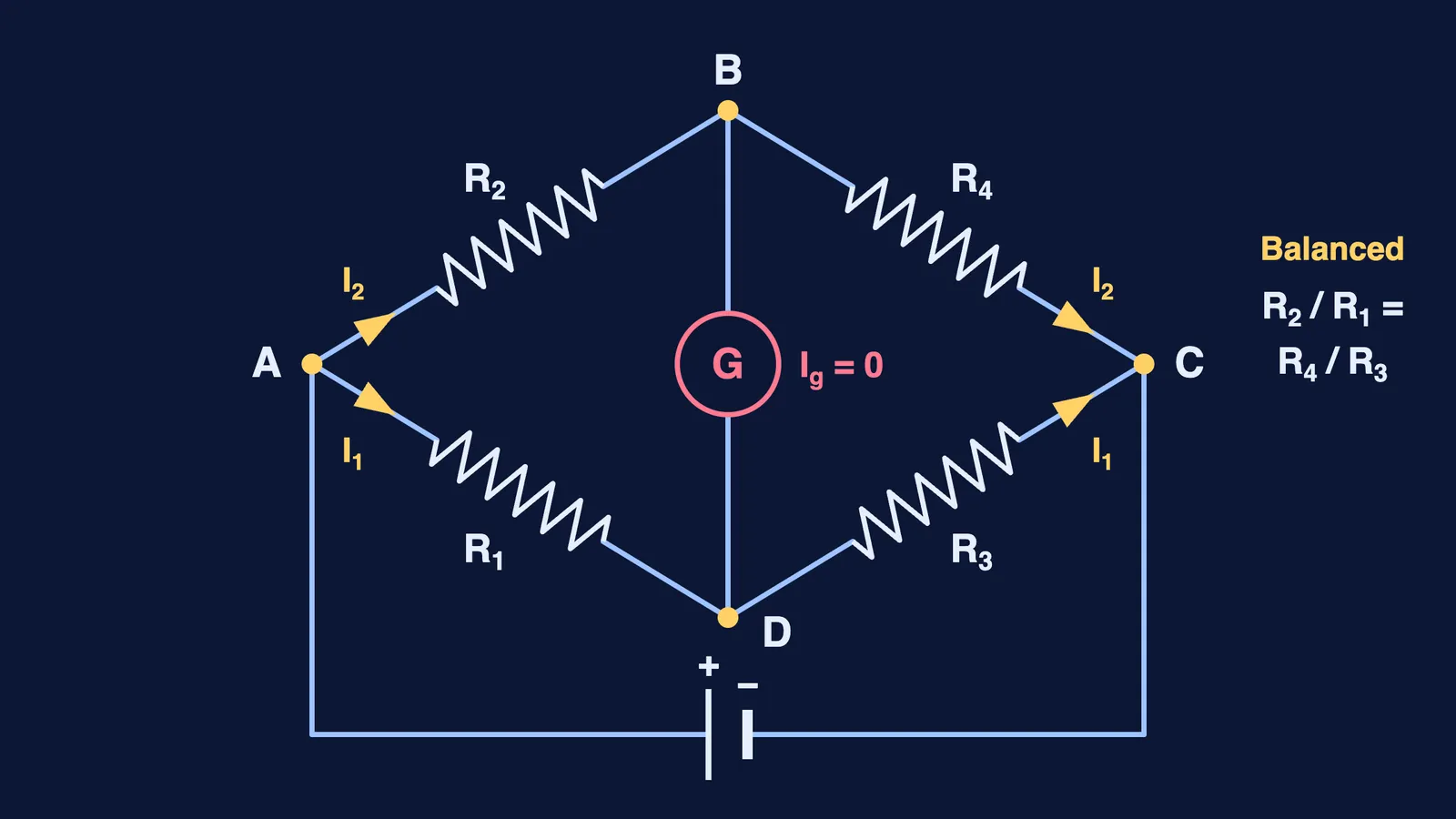
Setup: four resistors on a diamond ABCD (R2 on AB, R4 on BC, R1 on AD, R3 on DC), a cell across A and C, a galvanometer G across B and D, cell resistance ignored.
Balance means no current through G: Ig = 0.
Junction rule at D and B: the current I1 through R1 continues through R3, and I2 through R2 continues through R4.
Loop rule round ADBA: −I1R1 + 0 + I2R2 = 0, so I1/I2 = R2/R1.
Loop rule round CBDC: I2R4 + 0 − I1R3 = 0, so I1/I2 = R4/R3.
Equate the two ratios.
Result: R2/R1 = R4/R3, so an unknown R4 = R3R2/R1.
Where students slip: sign errors in the loop rule. If the junction rule feels like a formula to memorise, our post on why Kirchhoff's junction rule follows from charge conservation shows where it comes from.
How should you practise these derivations?
Draw and label the figure before writing any equation.
Say the physical idea behind each step aloud (random velocities average to zero; charge in a cylinder; drops round a loop).
Rewrite each from a blank page on two different days, then check against the chapter.
Change one detail and redo it: reverse a cell in the parallel combination, or put the unknown resistor in a different arm of the bridge.
Then use the results in real questions with our Current Electricity case study questions.
If drift is hard to picture, the Fermi Simulation Lab has interactive simulations for the ideas that are easier to see than to read.