On this page
Three original Current Electricity cases, easy to hard, each with four questions and worked answers. For derivations and layout, see our Current Electricity Class 12 board exam guide first.
What do case-study questions on Current Electricity look like?
The CBSE 2026-27 Physics sample paper has two case study-based questions of four marks each, in Section D. Calculators are not allowed, so these numbers work out by hand. Every idea is in the CBSE 2026-27 Physics syllabus and the rationalised NCERT Chapter 3.
Case 1: The hostel kettle
Meera's hostel kettle in Chennai is labelled 220 V, 1100 W. She boils water for six minutes each evening; the hostel pays ₹8 per unit (kWh). While it runs, Meera notices that the heating element gets red hot but the two-core flexible cord stays cool. The cord's two copper wires have a total resistance of about 0.2 Ω, and they are in series with the element. Treat the kettle as running at its rated values.
(i) The current drawn by the kettle is: (a) 0.2 A (b) 5 A (c) 50 A (d) 242 A
(ii) What is the resistance of the element while the kettle is working?
(iii) How much does Meera's six-minute boil cost?
(iv) Explain, with numbers, why the element gets hot but the cord does not.
Answers.
(i) (b). I = P/V = 1100/220 = 5 A.
(ii) R = V²/P = 220²/1100 = 44 Ω (check: V/I = 220/5 = 44 Ω).
(iii) Energy = 1.1 kW × 0.1 h = 0.11 kWh, so the cost is 0.11 × ₹8 = ₹0.88.
(iv) The same current flows through both, so P = I²R decides. The element gets about 1100 W; the cord gets about 5² × 0.2 = 5 W. The element's resistance is 220 times larger, so it takes 220 times the power.
Case 2: The robot that slowed down
A school team in Bhopal builds a line-following robot for a contest. It runs on four identical cells in series, each with emf 1.5 V and internal resistance 0.5 Ω. The drive motor behaves like a 10 Ω resistor. On the morning of the contest the robot crawls: while changing batteries, a teammate put one cell in the wrong way round. Later, the wheels jam against a wall and the motor's effective resistance falls to 2 Ω.
(i) What are the emf and the internal resistance of the correctly assembled pack?
(ii) Find the current through the motor and the voltage across it.
(iii) With one cell reversed, the current becomes: (a) 0.5 A (b) 0.375 A (c) 0.25 A (d) zero
(iv) When the wheels jam, find the current and the pack's terminal voltage, and explain why the terminal voltage falls.
Answers.
(i) In series, emfs and internal resistances add: ε = 4 × 1.5 = 6 V and r = 4 × 0.5 = 2 Ω.
(ii) I = ε/(R + r) = 6/(10 + 2) = 0.5 A. Motor voltage V = IR = 5 V (check: ε − Ir = 6 − 1 = 5 V).
(iii) (c). The reversed cell's emf counts with a negative sign: ε = 1.5 + 1.5 + 1.5 − 1.5 = 3 V. Its internal resistance still adds, so r = 2 Ω and I = 3/12 = 0.25 A. Option (b) comes from dropping the reversed emf instead of subtracting it (4.5/12).
(iv) I = 6/(2 + 2) = 1.5 A and V = ε − Ir = 6 − 3 = 3 V. A bigger current means a bigger drop Ir inside the cells, so less voltage is left for the motor.
Case 3: The dairy's temperature bridge
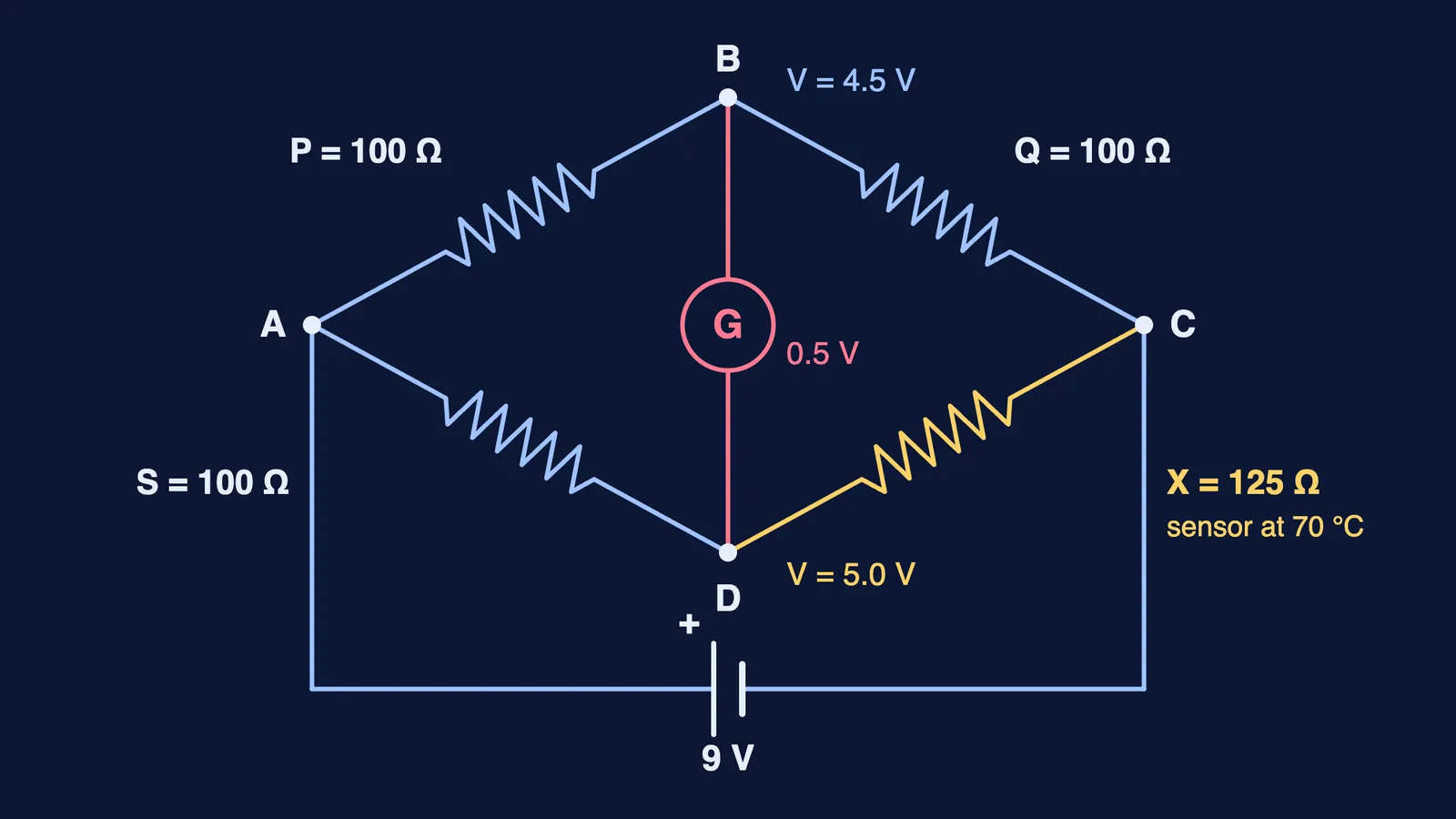
A milk cooperative near Anand checks the temperature of its heating tank with a metal sensor wire, X, placed in a Wheatstone bridge. Arms AB = P = 100 Ω and BC = Q = 100 Ω are fixed; arm AD = S is a variable resistor; X forms arm DC. A 9 V battery with negligible internal resistance is joined across A (positive) and C, and a galvanometer across B and D. The sensor reads 100 Ω at 20 °C, and its temperature coefficient of resistance is α = 5.0 × 10⁻³ °C⁻¹. At 20 °C, with S = 100 Ω, the galvanometer shows no deflection.
(i) At balance, which relation holds? (a) P/Q = S/X (b) P/Q = X/S (c) PQ = SX (d) P + Q = S + X
(ii) Find the sensor's resistance when the milk reaches 70 °C.
(iii) To which value must S be set to balance the bridge again at 70 °C?
(iv) At 70 °C, if S is left at 100 Ω and the galvanometer is disconnected, find the potentials of B and D (taking C as zero) and the direction of current through the galvanometer once it is reconnected.
Answers.
(i) (a). No current through G means B and D share a potential, giving P/Q = S/X.
(ii) X = R₀[1 + α(T − T₀)] = 100[1 + 0.005 × 50] = 125 Ω.
(iii) S = X × P/Q = 125 × 100/100 = 125 Ω.
(iv) V_B = 9 × Q/(P + Q) = 9 × 100/200 = 4.5 V. V_D = 9 × X/(S + X) = 9 × 125/225 = 5.0 V. D is 0.5 V higher, so current flows from D to B through the galvanometer.
How should you attack case-study questions on Current Electricity?
Underline every value and unit first. Convert to kWh only for cost.
For cells, write the equivalent ε and r first, then use I = ε/(R + r) and V = ε − Ir.
Name the bridge arms with the passage's letters before writing the balance ratio; swapping two arms is the usual slip.
Sanity-check: a cord should take a tiny share of the power; a jammed motor should draw more current.
When a sub-question asks you to explain, give the formula, the numbers and one reason.
For more practice on the reasoning style, see our guide to case-based questions in board exams and the assertion-reason set on Current Electricity. If a step keeps going wrong, the Fermi Problem Library has worked problems with a step-by-step solver that explains the reasoning rather than printing an answer.