On this page
Contemporary Centres of Power is the second chapter of Contemporary World Politics. This guide turns the current NCERT chapter (Reprint 2026-27) into timelines and a comparison grid for long answers.
How many marks is Contemporary Centres of Power worth?
The CBSE Political Science curriculum for 2026-27 gives the chapter 6 marks out of the 40 for Part A. It lists four topics: the European Union, ASEAN, China's rise as an economic power, and Japan and South Korea as emerging powers. Its annexure notes on BRICS, Russia, India and the EU will not be assessed in the board exam.
Why did the European Union become a centre of power?
NCERT starts with Europe's ruin after 1945 and the Marshall Plan, under which the OEEC was set up in 1948. Learn the steps:
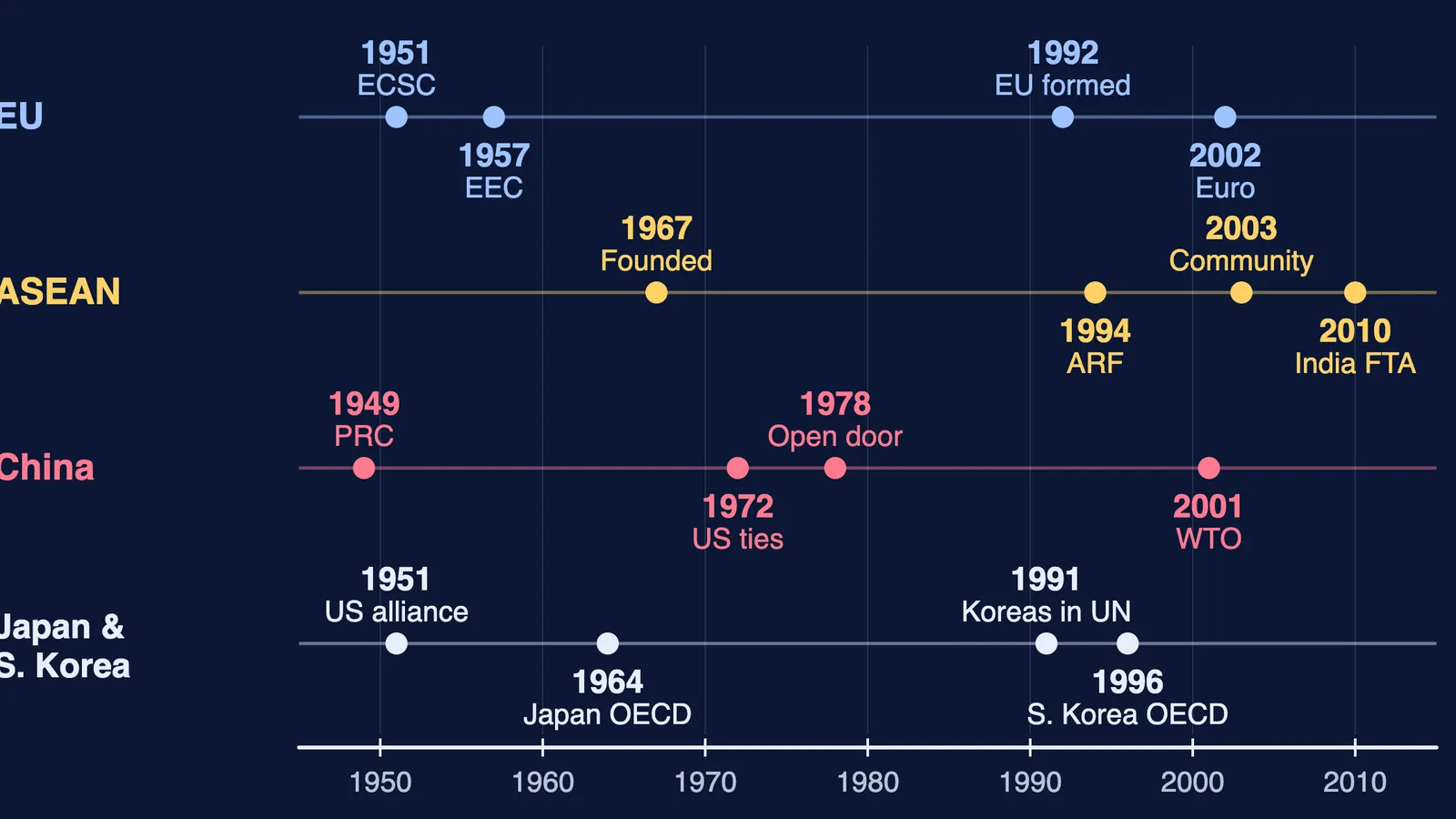
1951: six countries set up the European Coal and Steel Community.
1957: the Treaties of Rome created the European Economic Community.
1992: the Treaty of Maastricht established the European Union.
2002: the euro was introduced in 12 member states.
NCERT sorts the EU's influence into three kinds. Economically, its share of world trade exceeds the US share. Politically, France holds a permanent seat on the UN Security Council. Militarily, the EU's pooled armed forces rank second in size worldwide. Its limits: members often split on foreign and defence policy, as over the Iraq invasion, and Euroskepticism persists.
What is the ASEAN Way?
ASEAN was set up in 1967 by Indonesia, Malaysia, the Philippines, Singapore and Thailand through the Bangkok Declaration, according to NCERT.
The ASEAN Way is NCERT's name for interaction among members that is informal, non-confrontationist and cooperative, built on respect for national sovereignty. Unlike the EU, ASEAN shows little desire for supranational institutions.
In 2003 ASEAN agreed to build an ASEAN Community with three pillars: security, economic and socio-cultural. The ASEAN Regional Forum, set up in 1994, coordinates security and foreign policy. For India, the Look East policy of the early 1990s and the Act East policy from 2014 brought closer economic ties, and the ASEAN-India free trade agreement took effect in 2010.
How did China become an economic power?
After 1949, China followed the Soviet model: state-owned heavy industry, little foreign trade and growth of 5-6 per cent a year, which NCERT says was not enough for a population growing 2-3 per cent a year (NCERT). The turn came in stages:
1972: relations with the United States ended China's isolation.
1973: Premier Zhou Enlai proposed the four modernisations of agriculture, industry, science and technology, and the military.
1978: Deng Xiaoping launched the open door policy and a programme of economic reform.
1982 and 1998: agriculture, then industry, were privatised.
2001: China joined the WTO.
China avoided shock therapy and opened step by step; trade barriers were first removed only in Special Economic Zones. NCERT also records the costs, including unemployment, environmental damage and rural-urban inequality.
On India-China relations, NCERT covers the 1962 border conflict, Rajiv Gandhi's December 1988 visit, and bilateral trade growing from $338 million (1992) to over $84 billion (2017). It also notes the recent downturn over border disputes and the China-Pakistan Economic Corridor.
How do Japan and South Korea compare?
In NCERT, Japan joined the OECD in 1964, was the third largest economy in 2017, and is the G-7's only Asian member. It has been allied with the US on security since 1951, and Article 9 of its Constitution renounces war. South Korea's rapid growth from the 1960s to the 1980s is called the Miracle on the Han River; it joined the OECD in 1996, and both Koreas became UN members on 17 September 1991.
A comparison grid for 6-mark answers:
Basis of power: EU, economic union turned political; ASEAN, economic association; China, state-led market economy; Japan and South Korea, technology and exports.
How they act: EU, supranational rules; ASEAN, consultation; China, trade ties that temper disputes; Japan, alliance with the US.
Limits: EU, divided foreign policy; ASEAN, a smaller economy than the US, EU or Japan; China, inequality; Japan, Article 9.
How do you write a 6-mark answer on this chapter?
The 2026-27 sample paper offers a 6-mark choice: the influential role of the EU and ASEAN, or China's economic policies. Its marking scheme groups the first answer under economic integration, regional peace and collective influence, and lists the second as a dated sequence from 1972 to the SEZs.
Practice questions written for this guide:
(1 mark) Name the treaty, signed in 1992, that established the European Union.
(2 marks) Give two ways the ASEAN Way differs from the EU's working.
(4 marks) Explain two limits on the EU's ability to act as one power.
(6 marks) Compare China and Japan as alternative centres of power.
Revise the previous chapter with our End of bipolarity Class 12 guide and the Cold War era Class 12 guide, then time yourself with the 20-minute board answer-writing drill.
If you are unsure where to start, Fermi's AI tutor can work out what you already know and build a plan for the session.