On this page
Chapter 9 of *Indian Constitution at Work* asks a simple question: how has India run on one Constitution since 26 January 1950 while countries such as the Soviet Union and France rewrote theirs? NCERT's answer has three parts: a workable amendment procedure, flexible interpretation by the courts, and maturity in political practice (NCERT, Chapter 9, reprint 2026-27).
In the CBSE 2026-27 Political Science curriculum, this chapter and Chapter 10, The Philosophy of the Constitution, share 4 marks. No per-chapter split is printed, and every sub-topic of the chapter stays in the syllabus.
How is the Indian Constitution amended?
NCERT describes the Constitution as both flexible and rigid (NCERT, Chapter 9). There are three routes:
Simple majority, like an ordinary law. Articles that say Parliament may act "by law", such as Articles 2 and 3 on admitting new states or changing state boundaries, need no special procedure.
Special majority in both Houses, under Article 368. Each House votes separately; there is no joint session.
Special majority plus ratification by half the State legislatures. This applies to provisions on the distribution of powers between the Union and the States, and on representation. A simple majority in each State legislature is enough.
Amendments start only in Parliament, need no referendum, and cannot be returned by the President for reconsideration.
What does special majority mean? A worked example
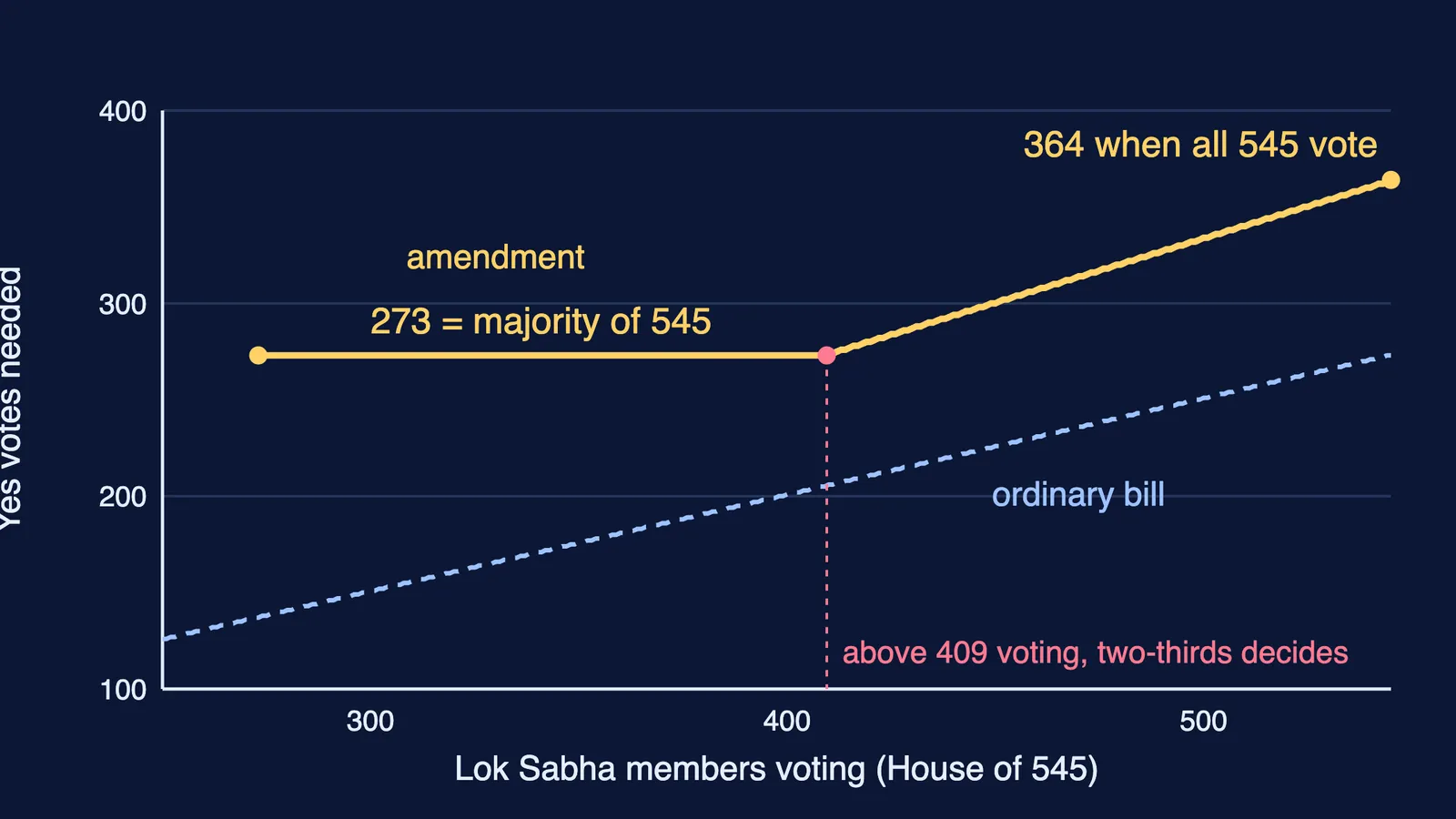
An amendment bill needs two things at once in each House: yes votes from a majority of its total membership (more than half), and from at least two-thirds of the members present and voting (Article 368(2); NCERT, Chapter 9). NCERT's example takes a Lok Sabha of 545, so the floor is 273 votes.
Try it on an imaginary House of 250 members, where the floor is 126 (a majority of 250):
180 members vote. Two-thirds is 120, below the floor, so the bill needs 126.
210 members vote. Two-thirds is 140, above the floor, so the bill needs 140.
The hero chart shows the same rule for 545 members: the line stays flat at 273 until more than 409 vote, then climbs to 364 when all 545 vote. The dashed line is an ordinary bill, which needs only a simple majority of those voting. So a party with a thin majority must win over some of the opposition.
Why has the Constitution been amended so many times?
By 26 January 2024 the Constitution had been amended 106 times in 74 years (NCERT, Chapter 9). NCERT notes that ten amendments came in 1974-76, under a single-party majority, and ten more in 2001-03, under coalition politics, so the count does not depend only on the size of the ruling majority. NCERT sorts them into three groups and then looks at the controversial ones:
Technical or administrative: raising High Court judges' retirement age from 60 to 62 (15th), raising judges' salaries (54th), and extending SC/ST reserved seats every ten years.
Differing interpretations: amendments, especially in 1970-75, made when Parliament disagreed with a court ruling.
Political consensus: anti-defection (52nd and 91st), voting age lowered from 21 to 18 (61st), local governments (73rd and 74th), and reservation amendments (77th, 81st, 82nd). See our guide to the 73rd and 74th Amendments.
Controversial: the 38th, 39th and 42nd, made during the Emergency declared in June 1975. The 42nd changed the Preamble, the Seventh Schedule and 53 articles, and added Fundamental Duties. After the 1977 elections, the 43rd and 44th reversed most of these changes.
What is the basic structure doctrine?
The Supreme Court set out the basic structure theory in the Kesavananda Bharati case in 1973 (NCERT, Chapter 9). It does three things:
Parliament may not pass an amendment that violates the basic structure.
Within that limit, Parliament may amend any part of the Constitution.
The judiciary decides what the basic structure is and whether an amendment breaches it.
The phrase "basic structure" appears nowhere in the text, which is why NCERT calls the doctrine itself an example of a living constitution: it came from reading the spirit, not only the letter. The Court restated it in the Minerva Mills case (1980), and the review commission of 2000, chaired by Justice Venkatachaliah, kept within its limits. For the rights these cases protect, read our guide to rights in the Indian Constitution.
Practice questions for the exam
(1 mark) Who decides whether an amendment violates the basic structure?
(2 marks) A House of 300 members votes on an amendment and 240 are present and voting. How many yes votes are needed? Show both conditions.
(4 marks) Give two reasons why amendments to Union-State powers need ratification by the States.
(6 marks) Courts can change how the Constitution works without any formal amendment. Explain with two examples from the chapter.
Answer to question 2: a majority of 300 is 151, and two-thirds of 240 is 160; the larger figure applies, so 160 votes are needed.
For how the Constituent Assembly wrote it, see Constitution: why and how. If maths or science also fill your timetable, Fermi's AI tutor can work out what you already know and build a plan for the session.