On this page
Concepts of Genetics is the first chapter of Unit III, Genetics and Molecular Biology, in CBSE Class 11 Biotechnology (subject code 045). The CBSE Biotechnology curriculum 2026-27 lists four topics for it: the historical perspective, multiple alleles, genetic mapping, and linkage and crossing over.
How many marks is Concepts of Genetics worth in Class 11 Biotechnology?
Unit III carries 20 marks in the 70-mark theory paper, according to the 2026-27 curriculum. Those 20 marks are shared with the unit's second chapter, Genes and Genomes: Structure and Function, so no separate figure exists for this chapter. Practicals carry another 30.
The prescribed book is CBSE's A Text Book of Biotechnology Class XI. We found no official PDF of it on cbseacademic.nic.in, so this guide follows the curriculum's topic list and uses the NCERT reference book: Chapter 6, Basic Principles of Inheritance (Reprint 2026-27). That NCERT chapter also covers sex-linked and extrachromosomal inheritance, polyploidy and reverse genetics; the curriculum's line for this chapter does not list them.
How it differs from core Biology: core Biology meets these ideas in Class 12 Principles of Inheritance and Variation; the Biotechnology book presents them as groundwork, since you must know which genes control a trait before you can change it. Taking Biology too? Our Class 12 principles of inheritance guide covers the board-exam side.
What is the historical perspective of genetics?
All five points come from the NCERT Biotechnology chapter.
Mendel studied seven contrasting trait pairs in garden pea and published in 1866.
In 1900, Carl Correns, Hugo de Vries and Erich von Tschermak rediscovered his work.
Bateson and Punnett found two sweet pea genes that did not assort independently, but could not explain it.
Morgan's Drosophila work in 1910 supplied the explanation: genes sit in a line on chromosomes.
In 1931, Harriet Creighton and Barbara McClintock showed in maize that recombinants carried visibly exchanged parts of chromosome 9.
What are multiple alleles? A worked cross
A gene has multiple alleles when more than two forms of it exist in a population, though any one diploid person carries only two. The standard example is the human ABO blood group gene I, with alleles I^A, I^B and i, as NCERT's core Biology chapter explains. I^A and I^B are codominant with each other, and both are dominant over i.
Three alleles give six genotypes and four blood groups. In general, n alleles give n(n + 1)/2 genotypes.
Worked cross: an AB parent (I^A I^B) and a B parent carrying i (I^B i).
Offspring: I^A I^B (AB), I^A i (A), I^B I^B (B), I^B i (B).
Ratio: 1/4 AB, 1/4 A, 1/2 B; no O, since the AB parent has no i.
How do linkage and crossing over change a dihybrid ratio?
Linkage means genes on one chromosome tend to be inherited together, so they do not give the 9:3:3:1 of independent assortment. Crossing over is the swap of segments between non-sister chromatids of a homologous pair during meiosis, which creates non-parental (recombinant) combinations.
In the NCERT Biotechnology chapter, Morgan's test cross of grey-bodied, long-winged F1 females with black-bodied, vestigial-winged males gave 83 per cent parental and 17 per cent non-parental flies. For the cell-level story, see Sutton, Boveri and Morgan's chromosomal theory.
How do you build a genetic map from recombination frequency?
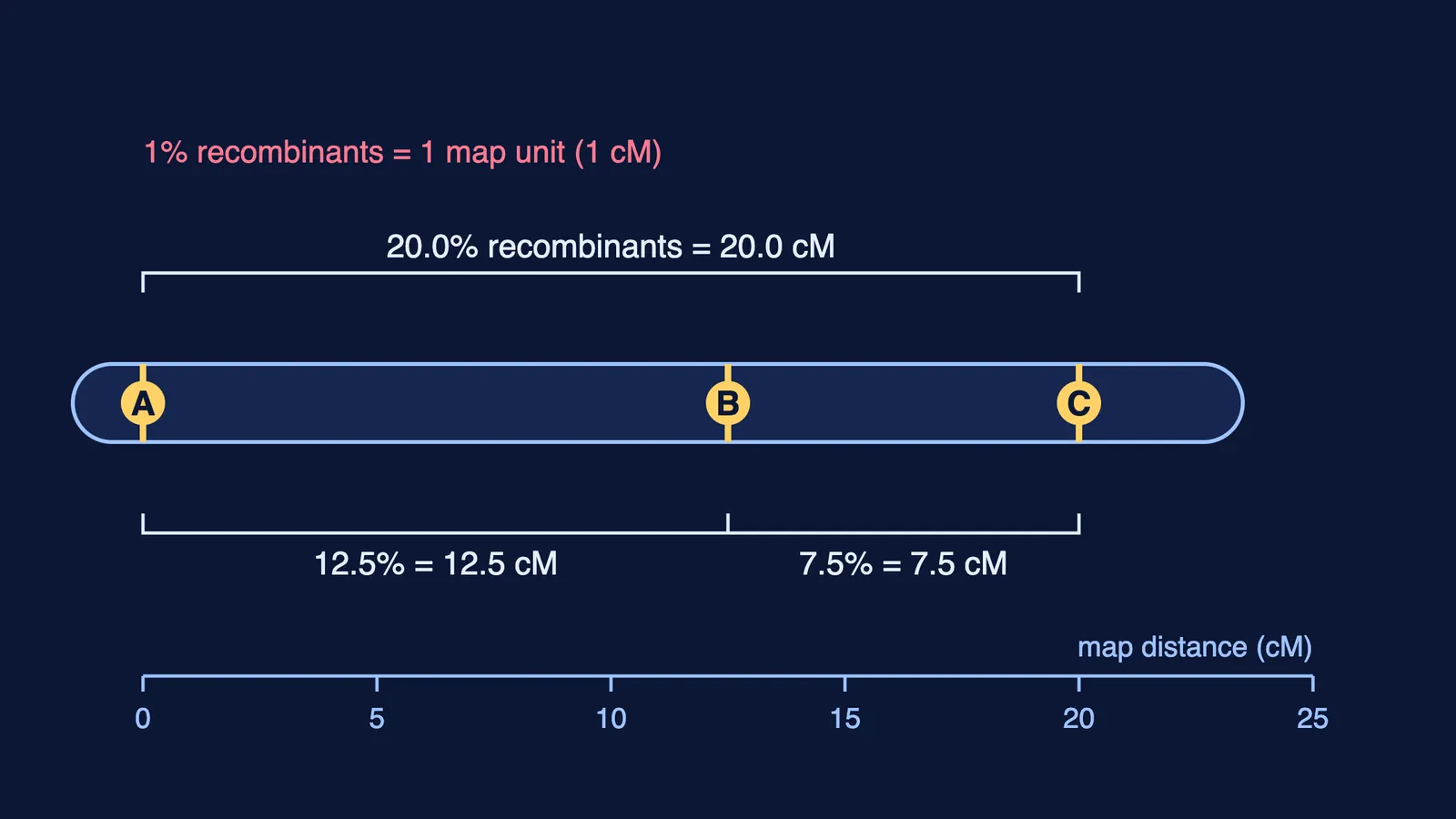
1% recombinants between two genes equals 1 map unit, or 1 centimorgan (cM), per the NCERT Biotechnology chapter. A three-gene example, with our own numbers:
A and B. A test cross gives 316 + 314 parental and 47 + 43 recombinant offspring, 720 in all. Recombination frequency = 90 ÷ 720 × 100 = 12.5%, so A and B are 12.5 cM apart.
B and C. Another test cross gives 36 recombinants out of 480: 7.5%, or 7.5 cM.
A and C. A third gives 120 recombinants out of 600: 20.0%, or 20.0 cM.
Order. 12.5 + 7.5 = 20.0, so B sits between A and C.
To practise with simulated crosses, try our recombination frequency and gene map walkthrough.
Practice questions for Concepts of Genetics
The mark labels are our suggestion.
(1 mark) Name the three scientists who rediscovered Mendel's work in 1900.
(2 marks) A gene has four alleles in a population. How many genotypes are possible? Show your working.
(2 marks) Why does a test cross of two linked genes show more parental than recombinant offspring?
(3 marks) A test cross gives 228 + 232 parental and 21 + 19 recombinant offspring. Find the map distance in cM.
(5 marks) Genes P and Q are 11 cM apart, Q and R are 18 cM apart, and P and R are 7 cM apart. Find the gene order, draw the map, and explain how crossing over makes recombinants.
Answers: (1) Correns, de Vries and Tschermak. (2) 4 × 5 ÷ 2 = 10. (4) 40 ÷ 500 × 100 = 8 cM. (5) Order Q, P, R, since 11 + 7 = 18.
Unsure where to start? Fermi's AI tutor works out what you already know and builds a plan for the session.