On this page
These are the key terms of Chapter 4, Complex Numbers and Quadratic Equations, in the rationalised NCERT Class 11 Mathematics textbook (Reprint 2026-27), grouped by topic, each with a plain definition, a short example and, where students often slip, a "Don't confuse with" note. Throughout, a, b, c, d, x and y are real.
The CBSE 2026-27 Mathematics curriculum lists the need for complex numbers, especially √−1, their algebraic properties and the Argand plane. The rationalised chapter has no material on polar representation or the argument, the square root of a complex number, the Fundamental Theorem of Algebra or a method for solving quadratic equations with complex roots, so those are left out. For the full chapter plan, see our Class 11 complex numbers and quadratic equations guide.
What is a complex number and what does i mean?
Discriminant (D): for ax² + bx + c = 0, D = b² − 4ac. When D < 0 there is no real solution, which is why the number system is extended. Example: x² + x + 1 = 0 has D = 1 − 4 = −3.
Imaginary unit (i): the symbol for √−1, so i² = −1. Don't confuse with: −i, which is also a square root of −1; the symbol √−1 always means i.
Complex number: any number a + ib. Example: 7 = 7 + i0, so every real number is one.
Standard form (a + ib): one real number plus i times one real number. Example: (2 + i)(1 − i) = 2 − 2i + i − i² = 3 − i.
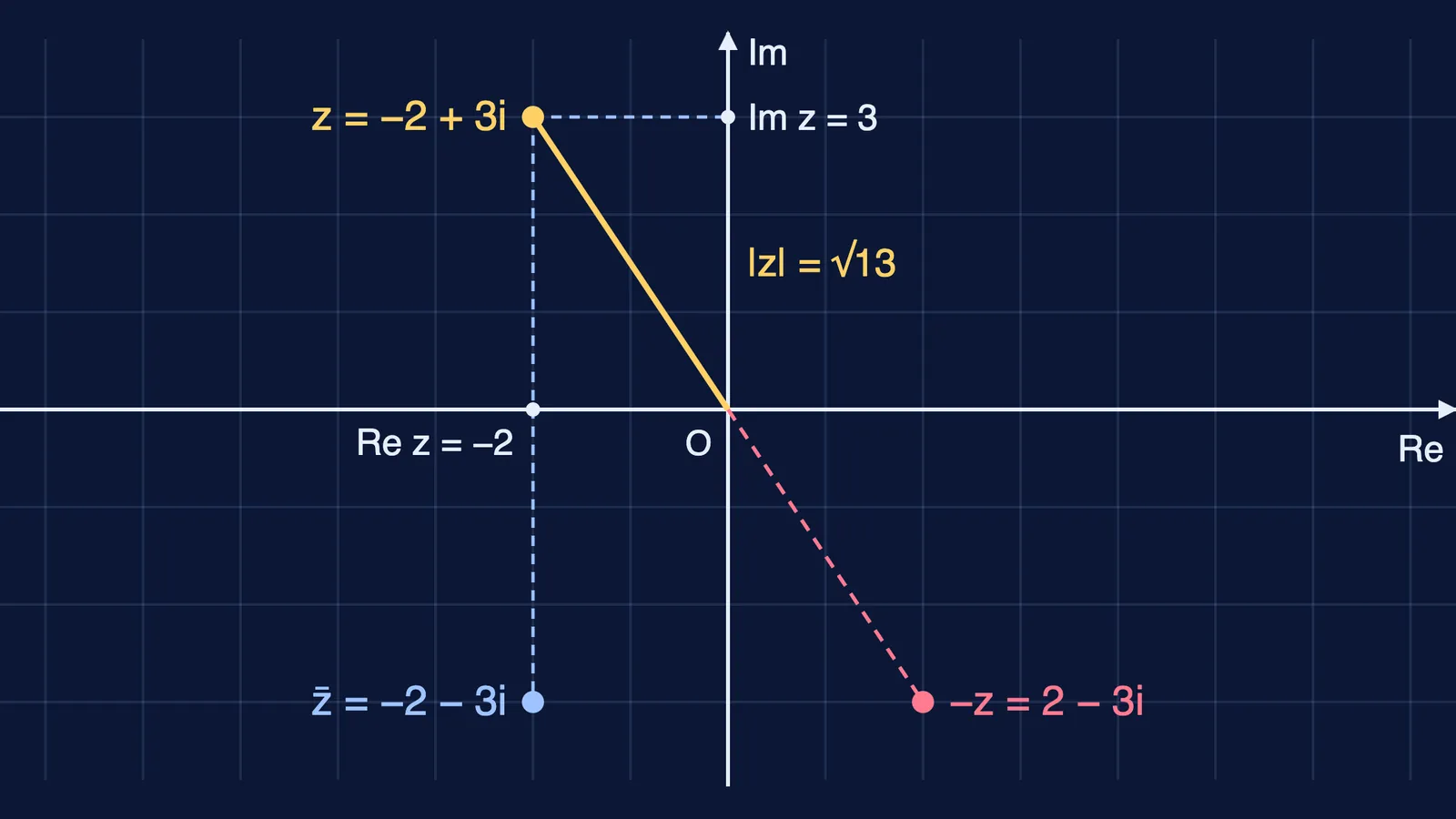
Real part (Re z): for z = a + ib, the number a. Example: for z = −2 + 3i, Re z = −2.
Imaginary part (Im z): for z = a + ib, the real number b. Example: Im(−2 + 3i) = 3. Don't confuse with: 3i; the imaginary part has no i in it.
Equality of complex numbers: a + ib = c + id exactly when a = c and b = d. Example: x + iy = 4 − 7i gives x = 4 and y = −7.
Algebra of complex numbers: which laws hold?
Let z₁ = a + ib and z₂ = c + id.
Sum: z₁ + z₂ = (a + c) + i(b + d). Example: (4 + i) + (1 − 3i) = 5 − 2i.
Difference: z₁ − z₂ = z₁ + (−z₂).
Product: z₁z₂ = (ac − bd) + i(ad + bc). Example: (1 + 2i)(3 − i) = 5 + 5i.
Quotient: for z₂ ≠ 0, z₁ ÷ z₂ means z₁ multiplied by the multiplicative inverse of z₂.
Closure law: a sum or product of complex numbers is complex.
Commutative law: z₁ + z₂ = z₂ + z₁ and z₁z₂ = z₂z₁.
Associative law: (z₁ + z₂) + z₃ = z₁ + (z₂ + z₃), and likewise for products.
Distributive law: z₁(z₂ + z₃) = z₁z₂ + z₁z₃.
Additive identity: the zero complex number 0 + i0, since z + 0 = z.
Additive inverse (negative): −z = −a + i(−b), so z + (−z) = 0. Example: the negative of −2 + 3i is 2 − 3i.
Multiplicative identity: 1 + i0, since z × 1 = z.
Multiplicative inverse (z⁻¹ or 1/z): for any non-zero z, z⁻¹ = (a − ib)/(a² + b²), so z × z⁻¹ = 1. Example: 1/(1 + i) = (1 − i)/2. Don't confuse with: the conjugate; they match only when |z| = 1.
Identities: rules such as z₁² − z₂² = (z₁ + z₂)(z₁ − z₂) hold for all complex numbers. Our complex numbers formulas sheet works through them.
Powers of i and square roots of negative numbers
Powers of i: they repeat in fours. For any integer k, i⁴ᵏ = 1, i⁴ᵏ⁺¹ = i, i⁴ᵏ⁺² = −1, i⁴ᵏ⁺³ = −i. Example: 103 = 4 × 25 + 3, so i¹⁰³ = −i. Negative powers follow the same cycle: i⁻¹ = −i, i⁻³ = i.
Square roots of a negative real number: for a > 0, −a has square roots √a i and −√a i; the symbol √−a means √a i. Example: √−9 = 3i.
The √a × √b rule: √a × √b = √(ab) holds unless a and b are both negative. Counter-example: √−4 × √−9 = 2i × 3i = −6, not √36 = 6.
What are the modulus and conjugate of a complex number?
Modulus (|z|): for z = a + ib, the non-negative real number √(a² + b²), its distance from the origin on the Argand plane. Example: |−2 + 3i| = √(4 + 9) = √13.
Conjugate (z̄): for z = a + ib, the number a − ib. Example: the conjugate of −2 + 3i is −2 − 3i. Don't confuse with: the additive inverse, which flips both signs.
z times its conjugate: zz̄ = |z|², a non-negative real. Example: (−2 + 3i)(−2 − 3i) = 13.
How is a complex number shown on the Argand plane?
Argand plane (complex plane): the XY-plane with x + iy placed at the point (x, y), so 2 + 4i sits at (2, 4).
Real axis: the x-axis; its points are numbers of the form a + i0.
Imaginary axis: the y-axis; its points are numbers of the form 0 + ib.
Conjugate as mirror image: x − iy sits at (x, −y), the reflection of (x, y) in the real axis.
How to learn these terms
Learn the three opposites together: plot one z, its conjugate and its negative, as in the diagram above.
Reduce any power of i by keeping the remainder of the exponent on division by 4.
Rewrite square roots of negatives as multiples of i before multiplying; that avoids the √a × √b trap.
Check each inverse by multiplying back to get 1.
Test yourself with our complex numbers assertion-reason questions for Class 11.
If a term still feels shaky, the Fermi Concept Library covers every concept in mathematics, each with its own lesson and its place in the map.