On this page
Chapter 19 of *Khel Praveen*, the new NCERT Physical Education and Well-being book for Class 9 (First Edition, April 2026), is a short chapter on four combat sports: judo, wrestling, taekwondo and boxing, giving each sport's history and its Olympic weight categories.
What does the Class 9 combat sports chapter cover?
The chapter sits in the book's Unit 5 (Sports), between Indigenous Martial Arts and Sport (Ch 18; the contents page prints it as "Indigenious") and Outdoor Sports (Ch 20). You can read it in the NCERT Unit 5 PDF.
Judo grew out of jiu-jitsu, an old Japanese fighting system. Professor Jigoro Kano started the first judo school in Tokyo in 1882, inside Eishoji, a Buddhist temple. Judo entered the Olympics at Tokyo 1964. Belt colours show a player's grade.
Wrestling has two Olympic styles, Freestyle and Greco-Roman, with the same rules except one. In Greco-Roman, a wrestler cannot go for the opponent's legs or use their own legs to trip or lift; in Freestyle, arms and legs are both allowed. Greco-Roman was part of the first modern Olympics (Athens, 1896), Freestyle arrived at St. Louis in 1904, and women's Freestyle at Athens in 2004. India also has Pehlwani, or Kushti, held in a clay or mud pit called an akhada.
Taekwondo is a Korean martial art that became an Olympic sport. Its name splits into Tae (foot, to step on), Kwon (fist, fight) and Do (the way). Early forms were Subak or Taekkyon. It took modern shape in the 1940s and 1950s, and the World Taekwondo Federation, founded in 1973, is now World Taekwondo (WT).
Boxing has roots in ancient Greece and Rome; the modern sport came from England, where the Marquess of Queensberry Rules of 1867 brought in gloves and rounds. The book names Mary Kom (six-time world champion, Olympic bronze), Vijender Singh (bronze in 2008, India's first Olympic medal in boxing) and Lovlina Borgohain (bronze, Tokyo 2020).
The chapter gives no techniques or full rulebook.
Why are combat sports played in weight categories?
The book gives two reasons: fairness between opponents and avoiding injuries. It links body weight to a person's inertia, mass and strength, so pairing people of similar weight keeps a bout even. This is a study summary of the textbook, not medical or safety advice; your PE teacher or coach decides what is safe in practice.
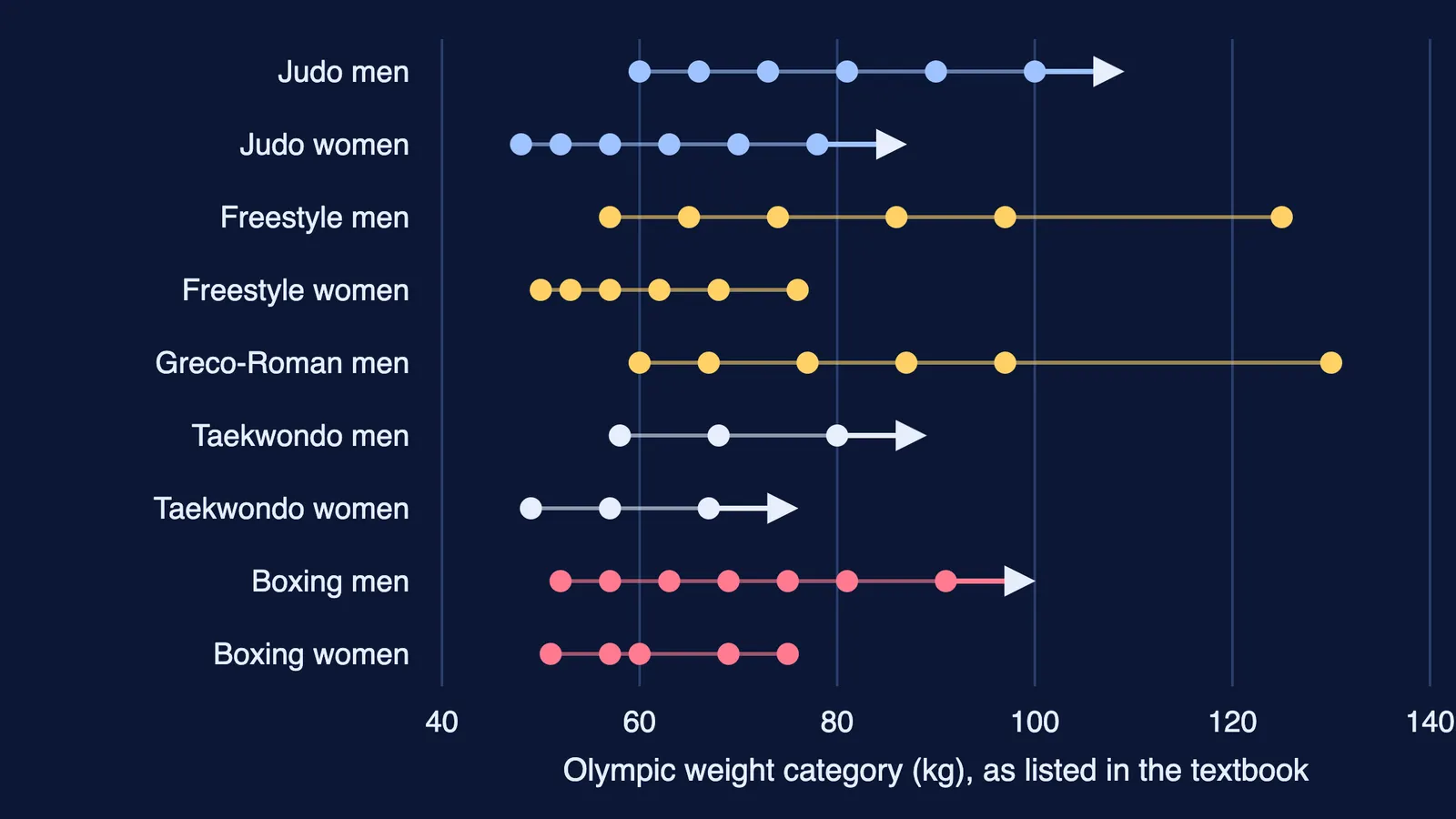
The Olympic categories listed in Khel Praveen, Chapter 19:
Judo: 7 for men (-60 to +100 kg), 7 for women (-48 to +78 kg).
Wrestling: 6 each for men's Freestyle (57 to 125 kg), women's Freestyle (50 to 76 kg) and Greco-Roman (60 to 130 kg).
Taekwondo: 4 each for men (58 to 80+ kg) and women (49 to 67+ kg).
Boxing: 8 for men (52 to +91 kg), 5 for women (51 to 75 kg).
How is this chapter marked in Class 9?
The subject is assessed in school out of 100 marks: 20 theory and 80 practical, according to the CBSE 2026-27 curriculum. In theory, every unit carries 2 marks of MCQ, objective or short-answer questions (2 marks × 8 units = 16 marks), plus 4 marks for a viva. No chapter has its own figure.
The curriculum numbers its units differently from the book. Judo, wrestling and taekwondo appear in its Unit 8, Sports, a 40-hour practical unit on fundamental skills. Boxing is in the book chapter but not on that list. If you choose a combat sport for your 30-mark sports file, this chapter helps mainly with the history section (for boxing, it also names three Indian boxers); the file also needs rules, skills, terminology and more.
Practice questions on combat sports
Marks are our suggestion; your school sets its own paper.
(1 mark) At which Olympic Games was judo first included?
(1 mark) Give the meaning of Tae, Kwon and Do.
(2 marks) State the one rule that separates Greco-Roman from Freestyle wrestling.
(2 marks) Give the two reasons the chapter offers for weight categories.
(2 marks) What did the 1867 Queensberry Rules introduce, and where?
(2 marks) Using the book's lists, how many Olympic wrestling categories are there, and how many are for women?
Answers: 1. Tokyo 1964. 2. Foot, fist, the way. 3. Greco-Roman allows no leg attacks and no tripping or lifting with the legs. 4. Fairness and avoiding injuries. 5. Gloves and rounds, in England. 6. 18 in all, 6 for women.
How should you revise combat sports?
One card per sport: origin, Olympic debut, one key fact.
Order the dates 1867, 1882, 1896, 1904, 1964, 1973, 2004, 2008 and 2020, and say what each marks.
Redraw the weight chart from memory and check it.
Next, read the Class 11 Olympism guide, BMI and body types in Class 11 PE or inertia in Class 12 biomechanics.
Not sure where to start? Fermi's AI tutor works out what you already know and builds a plan for the session.