On this page
Chapter 5 of NCERT's new Class 8 book, Exploring Society: India and Beyond, Part 2 (code hees2, First Edition June 2026), looks at citizenship in daily life. CBSE publishes no separate 2026-27 curriculum for Classes 6 to 8, so this chapter is assessed by the school.
What does Chapter 5 cover?
The chapter defines a citizen as a legal member of a country who can share in its decisions. A resident simply lives somewhere; a citizen has legal membership and can even live abroad. The book notes that two laws, the Citizenship Act of 1955 and the Citizenship (Amendment) Act of 2019, decide how citizenship is gained or lost.
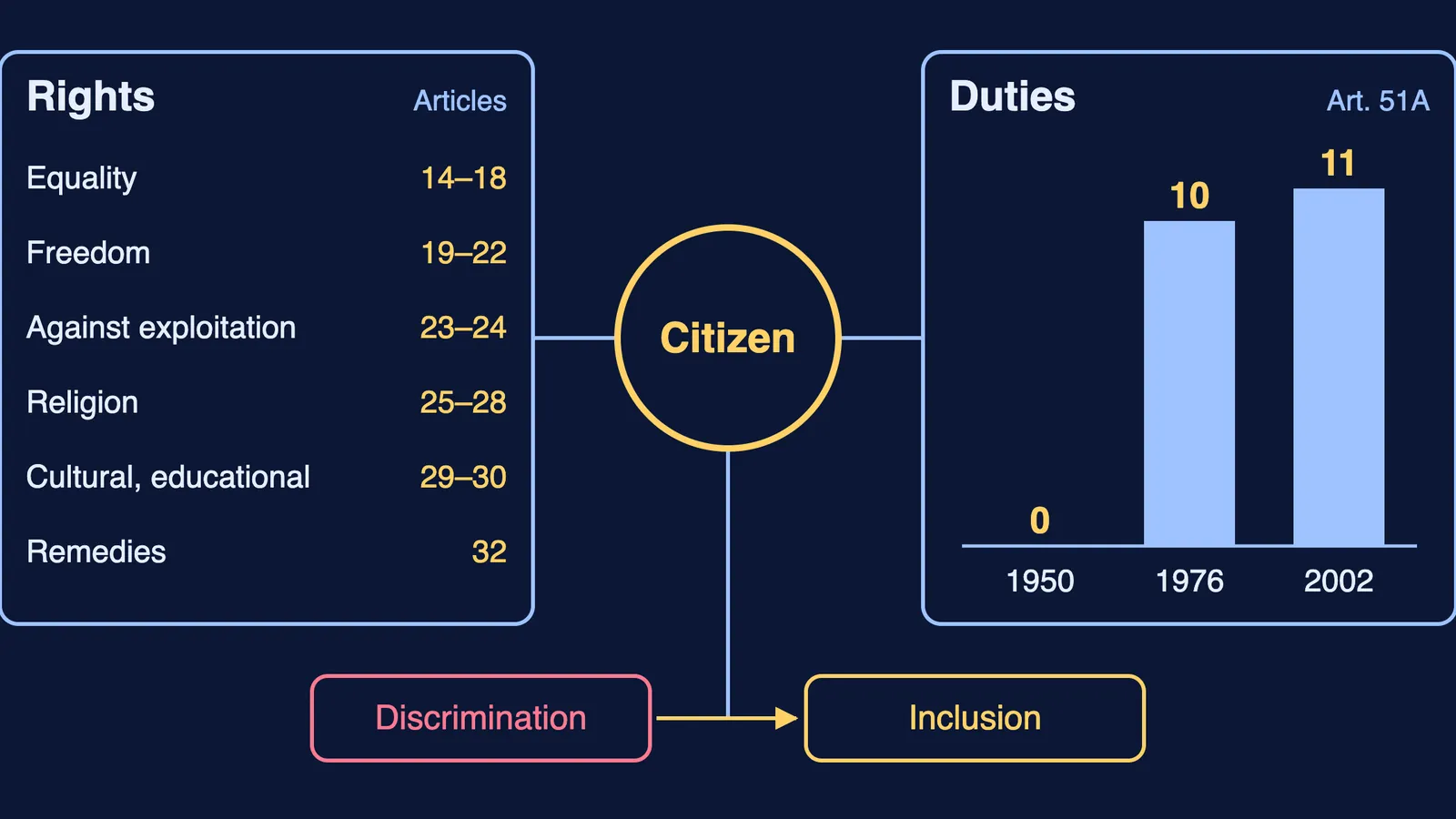
It builds on four ideas: rights (freedoms for a life of dignity), duties (responsibilities such as obeying laws and paying taxes), discrimination (unfair treatment because of identity) and inclusion (nobody left out).
What are the six Fundamental Rights in Class 8?
The Constitution lists six categories of Fundamental Rights, and courts can enforce them, the chapter explains.
Right to equality (Articles 14 to 18): equality before the law, no discrimination on grounds such as religion, caste or place of birth, an end to untouchability, and no special titles from the government except military or academic honours.
Right to freedom (Articles 19 to 22): speech, movement and peaceful assembly, within reasonable limits. The right to life (Article 21) means living with dignity; Article 21A gives free and compulsory education for ages 6 to 14.
Right against exploitation (Articles 23 and 24): no forced labour or trafficking; children under 14 generally cannot be employed. The book names the Childline 1098 helpline.
Right to freedom of religion (Articles 25 to 28): choose and practise a faith; nobody can be forced to follow or fund one.
Cultural and educational rights (Articles 29 and 30): communities can protect their language and script; religious and linguistic minorities can set up and manage their own schools.
Right to constitutional remedies (Article 32): go to the Supreme Court if a Fundamental Right is violated. Dr B.R. Ambedkar called it the heart and soul of the Constitution, the book notes.
The book contrasts equality (the same support for all) with equity (the support each person needs), citing the Beti Bachao Beti Padhao campaign.
What are Fundamental Duties and how many are there?
The Constitution had no Fundamental Duties in 1950; an amendment added 10 in Article 51A in 1976, and an 11th came in 2002, per the chapter. In brief: respect the Constitution, Flag and Anthem; follow the freedom struggle's ideals; protect unity; defend the nation; promote harmony and respect women; preserve heritage; protect nature and animals; build scientific temper; protect public property; strive for excellence; and, for parents or guardians, educate children aged 6 to 14.
How do rights and duties work together? A worked example
Every right has a matching duty, the chapter says. Try this four-step classroom method on our example.
*Situation:* A science club meets in a first-floor room. Priya, who uses crutches, cannot climb the stairs, so she stops coming.
Spot the problem: nobody said "no", yet Priya is left out. Exclusion like this is easy to miss.
Name the right: the book says the right to life includes support for children with disabilities to take part equally with others.
Name the matching duty: treat others with respect, and promote harmony among all people.
Suggest an inclusive fix: ask the teacher to move the club downstairs. One room for all is equality; a room Priya can reach gives her the support she needs (equity) and removes a barrier (inclusion).
What is the difference between discrimination and inclusion?
Discrimination means mistreating someone because of identity, such as caste, religion, disability, gender, appearance or economic background. It can be visible, like teasing, or invisible, like quietly leaving someone out of a project. The book recalls Savitribai Phule, who opened a school for girls in the mid-19th century, and Anandibai Joshi, who studied medicine despite opposition.
Inclusion, the book says, goes beyond reservations: braille books, ramps and classroom support help everyone feel accepted.
How does Chapter 5 connect to the rest of the book?
Chapter 5 sits in Theme D, Governance and Democracy, right after Chapter 4 on the judiciary. Our guide to the three levels of courts and judicial independence is from the older Class 8 book. See also key features of the Indian Constitution for Class 8 and understanding marginalisation.
Practice questions (mark values are our suggestion):
How does a resident differ from a citizen? Give an example. (2 marks)
Which Fundamental Right lets a person approach the Supreme Court, and under which Article? (1 mark)
When were Fundamental Duties added, and what did the 11th duty require? (3 marks)
A canteen serves students from richer families first. Which right is affected, which duty is ignored, and what fix would you suggest? (5 marks)
Give one example each of visible and invisible discrimination. (2 marks)
Not sure where to begin revising? Fermi's AI tutor works out what you already know and builds a plan for the session.