On this page
Eight original JEE Advanced-style questions, easy to hard, in four types: single correct, one or more correct, numerical and list match. Each has a solution and a trap: the most tempting wrong answer.
Which chemical thermodynamics topics does this JEE Advanced set cover?
The official JEE (Advanced) 2026 syllabus covers state functions, the first and second laws, pressure-volume work, enthalpy, heat capacity, Hess's law, entropy, Gibbs energy, and criteria of equilibrium and spontaneity; its equilibrium unit adds ΔG°. All eight stay inside it.
We follow Unit 5 of NCERT Class 11 Chemistry (Reprint 2026-27): ΔU = q + w (work done on the system), ΔS = q_rev/T, ΔG° = −RT ln K, R = 8.314 J K⁻¹ mol⁻¹. M and X are invented. New to the chapter? Start with our guide on how to prepare chemical thermodynamics for JEE Advanced.
How should you use this practice set?
Allow 30 minutes; commit to answers first.
Judge each option of a multi-correct question on its own; see how partial marking works in multiple-correct questions.
Easy: can you apply each law cleanly?
Q1 (easy, single correct). In kJ mol⁻¹: ΔfH°(H₂S, g) = −20.6, ΔfH°(S, g) = +277.2, H–H bond 436. The mean S–H bond enthalpy in H₂S is closest to
(A) 228 (B) 367 (C) 346 (D) 734
Answer: (B). Bond enthalpies refer to gaseous atoms. Atomising H₂S(g) reverses its formation (+20.6), splits H₂ (436) and vaporises S(s) (277.2): 733.8 for two S–H bonds, so 367. Trap: (A) skips atomising the sulphur.
Q2 (easy, one or more correct). 1.00 mol of a monatomic ideal gas (C_V,m = 3R/2) is heated in a rigid container from 300 K to 450 K. Which are correct?
(A) q = ΔU = +1.87 kJ (B) ΔH = +3.12 kJ (C) w = −1.25 kJ (D) ΔS = +5.06 J K⁻¹
Answer: (A), (B), (D). w = 0, so q = ΔU = 1.5R × 150 = 1871 J. ΔH = 2.5R × 150 = 3118 J. ΔS = 1.5R ln 1.5 = 5.06 J K⁻¹. Trap: (C) is the constant-pressure work.
Medium: can you link two quantities?
Q3 (medium, numerical). 1.00 mol of a monatomic ideal gas at 400 K and 4.00 bar expands adiabatically against a constant 1.00 bar until its pressure is 1.00 bar. Find ΔS of the gas in J K⁻¹ (two decimals).
Answer: 4.11. With q = 0: 1.5R(T₂ − 400) = −1.00(RT₂/1.00 − 400R/4.00), so T₂ = 280 K. ΔS = 2.5R ln(280/400) + R ln 4 = +4.11 J K⁻¹. Trap: 0. Only a reversible adiabatic change is isentropic.
Q4 (medium, single correct). A reaction has K = 4.00 at 300 K and 16.0 at 350 K. With both constant, ΔrH° (kJ mol⁻¹) and ΔrS° (J K⁻¹ mol⁻¹) are
(A) +10.5, +46.6 (B) +24.2, +80.7 (C) +24.2, +92.2 (D) −24.2, −69.2
Answer: (C). Subtract ΔrH° − TΔrS° = −RT ln K at the two temperatures: ln 4 = (ΔrH°/R)(1/300 − 1/350), so ΔrH° = +24.2 kJ mol⁻¹. Then ΔrG°(300 K) = −3.46 kJ mol⁻¹ and ΔrS° = (24 200 + 3460)/300 = +92.2. Trap: (B) sets ΔrG° to zero.
Q5 (medium, one or more correct). In an open, insulated flask, 1.00 mol of water at 360 K is mixed with 2.00 mol at 300 K (C_p,m = 75.3 J K⁻¹ mol⁻¹). Which are correct?
(A) The final temperature is 330 K. (B) ΔH of the water is zero. (C) ΔS_total ≈ +0.85 J K⁻¹. (D) The hot water loses as much entropy as the cold water gains.
Answer: (B), (C). 1(360 − T) = 2(T − 300), so T = 320 K; q_p = 0, so ΔH = 0. ΔS = 75.3[ln(320/360) + 2 ln(320/300)] = −8.87 + 9.72 = +0.85 J K⁻¹. Trap: (D); heat at a lower temperature carries more entropy.
Hard: can you choose the right path?
Q6 (hard, list match). An ideal gas; any heat exchanged is with surroundings at the gas's temperature.
List I: (P) reversible isothermal expansion; (Q) reversible adiabatic expansion; (R) adiabatic compression against a constant external pressure; (S) isothermal compression against a constant external pressure. List II: (1) ΔS_sys = 0, ΔS_total = 0; (2) ΔS_sys > 0, ΔS_total = 0; (3) ΔS_sys > 0, ΔS_surr = 0; (4) ΔS_sys < 0, ΔS_total > 0; (5) ΔS_sys < 0, ΔS_total = 0.
(A) P→2, Q→1, R→1, S→5 (B) P→3, Q→1, R→4, S→5 (C) P→2, Q→1, R→3, S→4 (D) P→2, Q→3, R→1, S→4
Answer: (C). P and Q are reversible: ΔS_total = 0, and only P absorbs heat. In R no heat flows, so the second law forces ΔS_sys > 0. In S the gas releases more heat than a reversible compression would, so ΔS_total > 0. Trap: (A) treats every adiabatic change as isentropic.
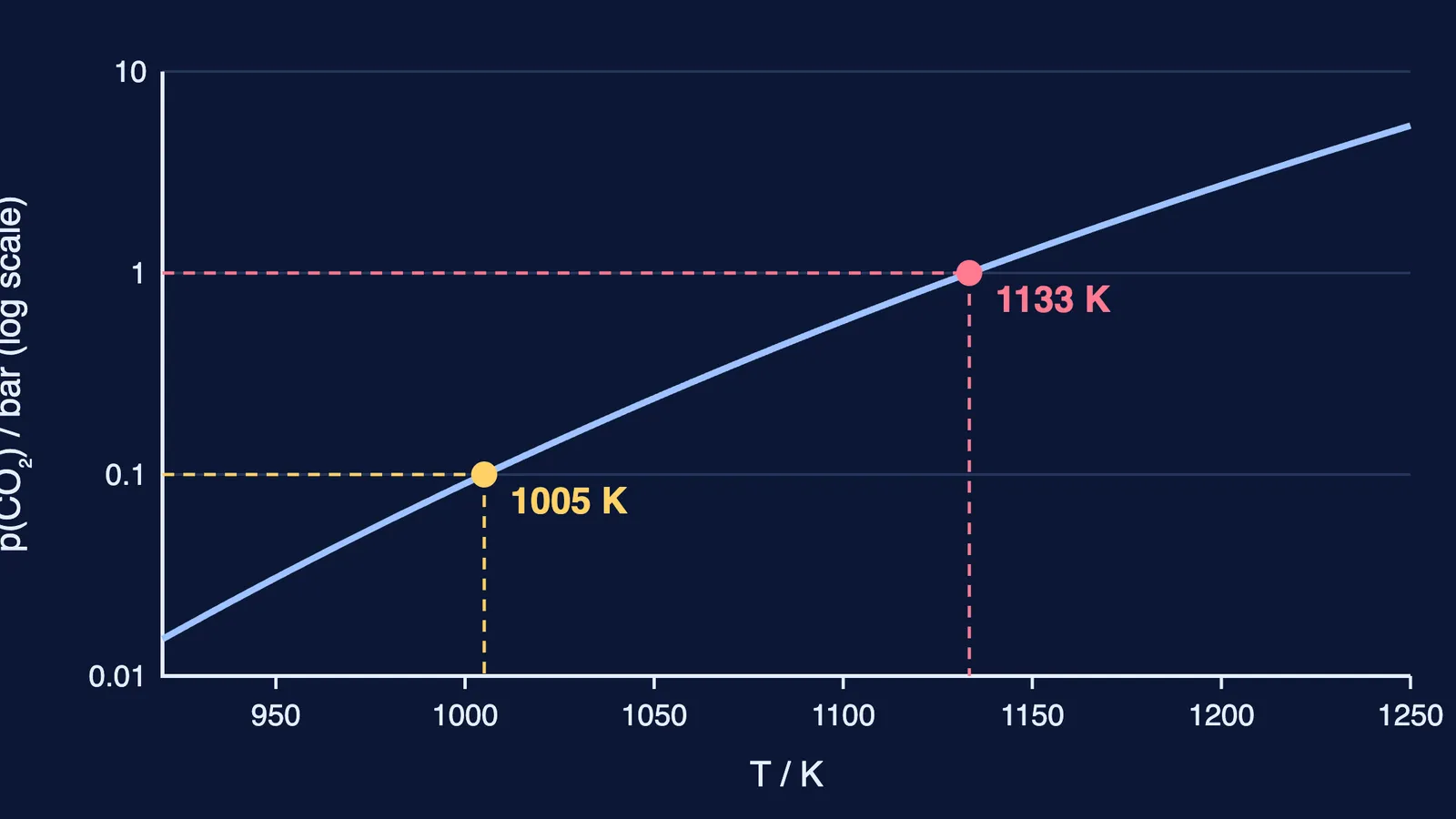
Q7 (hard, numerical). For MCO₃(s) ⇌ MO(s) + CO₂(g), ΔrH° = +170 kJ mol⁻¹ and ΔrS° = +150 J K⁻¹ mol⁻¹, both constant. At what temperature (nearest K) is the equilibrium CO₂ pressure 0.100 bar?
Answer: 1005. K = 0.100, so 170 000 − 150T = RT ln 10, giving T = 170 000/(150 + 19.14) = 1005 K. Trap: 1133 K = ΔrH°/ΔrS°, the 1 bar point; the graph above shows both.
Q8 (hard, one or more correct). X freezes at 250 K with ΔfusH = 10.0 kJ mol⁻¹; C_p,m is 130 (liquid) and 100 (solid) J K⁻¹ mol⁻¹. One mole of supercooled liquid X freezes at 230 K, surroundings at 230 K. Which are correct (entropies in J K⁻¹ mol⁻¹)?
(A) ΔS_sys = −37.5 (B) ΔS_surr = +43.5 (C) ΔS_total > 0, so freezing is spontaneous (D) ΔS_sys = −40.0, as ΔS = ΔH/T at any temperature
Answer: (A), (C). Reversible path: warm the liquid to 250 K, freeze, cool the solid. ΔH = −10 000 + (−30)(−20) = −9400 J mol⁻¹; ΔS_sys = −40.0 − 30 ln(230/250) = −37.5. ΔS_surr = 9400/230 = +40.9, so ΔS_total = +3.4. Trap: (B) uses the 250 K enthalpy.
What should you do after checking your answers?
Missed Q3, Q6 or Q8? Redo them, drawing a reversible path for each change. Missed Q4 or Q7? See our explainer on the temperature at which a reaction becomes spontaneous, the 1 bar case of Q7.
If one step keeps slipping, the Fermi Problem Library has worked problems with a step-by-step solver that explains the reasoning rather than printing an answer.