On this page
At JEE Advanced level, one question can make you track work, heat, entropy and Gibbs energy through a single process.
What is in the JEE Advanced chemical thermodynamics syllabus?
The official JEE (Advanced) 2026 syllabus lists: "Intensive and extensive properties, state functions, First law of thermodynamics; Internal energy, work (pressure-volume only) and heat; Enthalpy, heat capacity, standard state, Hess's law; Enthalpy of reaction, fusion and vaporization, and lattice enthalpy; Second law of thermodynamics; Entropy; Gibbs energy; Criteria of equilibrium and spontaneity." It notes the 2026 syllabus is unchanged from 2025. The 2027 syllabus has not been published yet (as of 19 November 2026).
JEE (Advanced) 2027 will be held on 23 May 2027 (Sunday), organised by IIT Delhi. To appear, you must be among the top 2,50,000 successful candidates in the B.E./B.Tech. paper of JEE (Main) 2027, among other criteria.
How is JEE Advanced thermodynamics different from JEE Main?
The JEE (Main) 2027 syllabus names more kinds of enthalpy and puts lattice enthalpy in its bonding unit. The Advanced list names two items the Main thermodynamics unit does not list by name: standard state, and criteria of equilibrium. It also limits work to pressure-volume. If you have finished our chemical thermodynamics guide for JEE Main, the gap is depth, not new chapters.
JEE (Advanced) 2026 had two compulsory papers of three hours each (2026 Information Brochure). The brochure said the marking scheme would be given in the paper's instructions at the time of the exam, so practise every format. Our post on how partial marking works in multiple-correct questions explains why one wrong option can cost more than a blank.
The habit that matters most: separate state functions (ΔU, ΔH, ΔS, ΔG) from path functions (q, w), and check one limiting case.
Worked examples at Advanced level
All numbers are our own; the substances are hypothetical. R = 8.314 J/(K mol).
1. One expansion, two paths. 2.00 mol of an ideal gas at 300 K expands isothermally from 4.00 bar to 1.00 bar, either reversibly (A) or against a constant 1.00 bar (B). On both paths ΔU = ΔH = 0 and ΔS of the gas = nR ln 4 = +23.05 J/K. Path A: w = −nRT ln 4 = −6915 J, q = +6915 J, ΔS of the surroundings = −23.05 J/K, so ΔS total = 0. Path B: w = −nRT(1 − 1/4) = −3741 J, q = +3741 J, ΔS of the surroundings = −12.47 J/K, so ΔS total = +10.58 J/K. Only the irreversible path creates entropy.
2. Lattice enthalpy from a cycle. By the NCERT Class 11 convention, lattice enthalpy is the enthalpy to split a mole of solid into gaseous ions (positive), and ΔsolH = ΔlatticeH + ΔhydH. For a hypothetical salt MX (all kJ/mol): ΔfH° = −480, sublimation of M = +150, ionisation of M = +420, half the X–X bond enthalpy = +80, electron gain enthalpy of X = −330. Hess's law: −480 = 150 + 420 + 80 − 330 + ΔH(lattice formation) = −800, so the lattice enthalpy is +800 kJ/mol. If the ions' hydration enthalpies sum to −770 kJ/mol, ΔsolH = +800 − 770 = +30 kJ/mol: endothermic. With ΔsolS = +110 J/(K mol), ΔsolG at 298 K = −2.78 kJ/mol: entropy drives dissolving down to about 273 K.
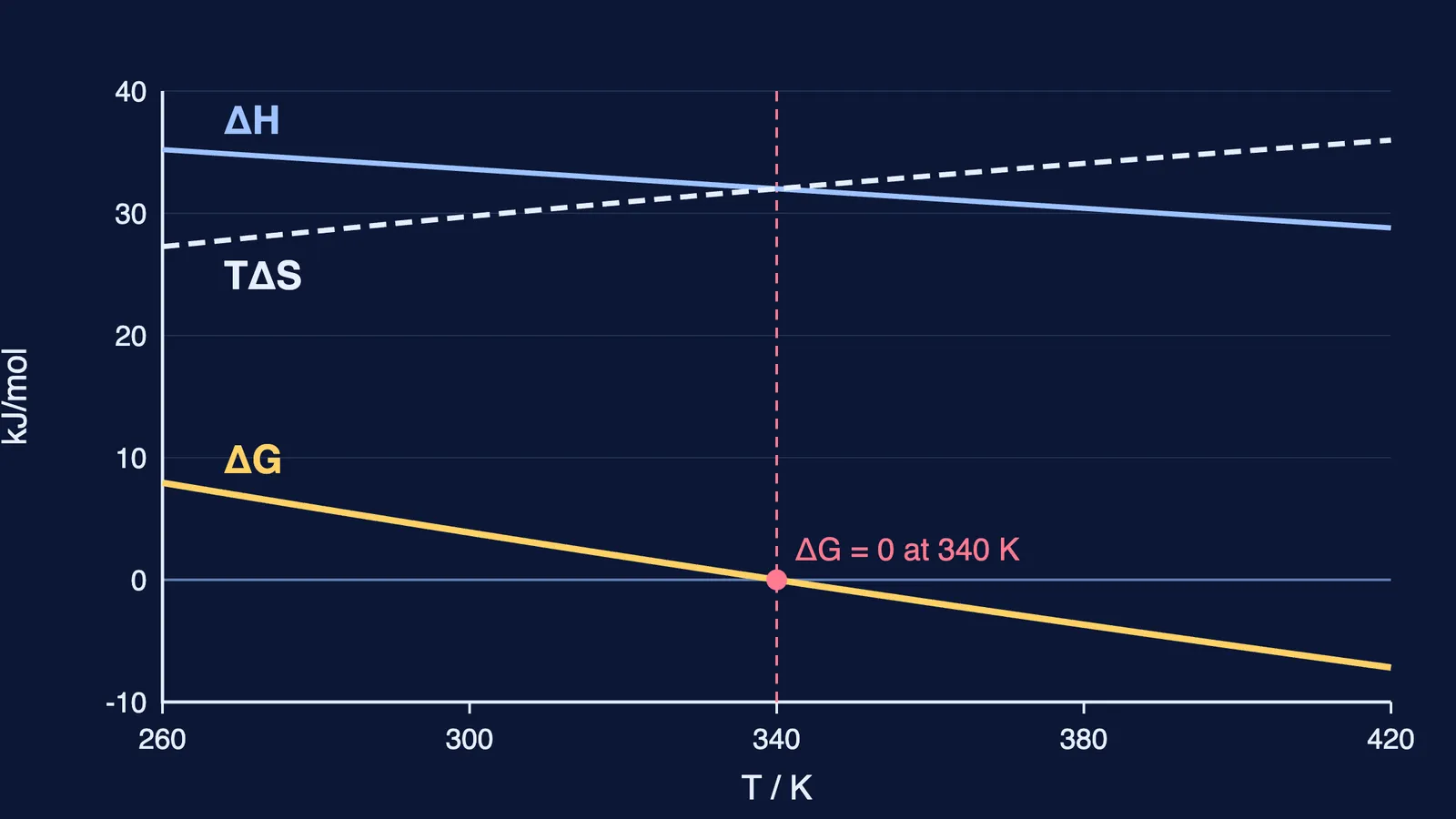
3. Where ΔG changes sign. A hypothetical liquid boils at 340 K under 1 bar, with ΔvapH° = 32.0 kJ/mol. At the boiling point ΔG° = 0, so ΔvapS° = 32000/340 = 94.1 J/(K mol). At 320 K, taking ΔH° and ΔS° as constant, ΔG° = +1.88 kJ/mol: vaporisation at 1 bar is not spontaneous. From ΔG° = −RT ln K, the vapour pressure is e^(−1882/(8.314 × 320)) = 0.493 bar. Check the shortcut: with heat capacities of 130 (liquid) and 90 (gas) J/(K mol), ΔH° = 32.8 kJ/mol and ΔS° = 96.5 J/(K mol), so ΔG° = +1.91 kJ/mol and p = 0.488 bar, about 1% lower.
Stuck on why a sign flips? The Fermi Problem Library has worked problems with a step-by-step solver that explains the reasoning rather than printing an answer.
How should you practise chemical thermodynamics for JEE Advanced?
Revise sign conventions with our Class 11 thermodynamics guide.
Week one: first law. Find w, q, ΔU and ΔH for reversible and irreversible paths of one change.
Week two: Hess's law cycles, including lattice and solution enthalpies, signs written at every step.
Week three: entropy and Gibbs energy. Find crossover temperatures, then link ΔG° to K.
Practice:
Repeat example 1, path B, in two stages: against 2.00 bar, then against 1.00 bar. Find w and ΔS total.
A reaction has ΔH° = −40.0 kJ/mol and ΔS° = −120 J/(K mol). Above what temperature is it non-spontaneous under standard conditions? Find K at 298 K.
In example 2, make the electron gain enthalpy −300 kJ/mol. Find the lattice enthalpy.
Answers: w = −4988 J and ΔS total = +6.42 J/K; 333 K and K = 5.54; +830 kJ/mol.