On this page
Chemical Bonding and Molecular Structure is Unit 4 of the NCERT Class 11 Chemistry textbook, Part 1 (reprint 2026-27). The CBSE Class XI Chemistry syllabus for 2026-27 covers the whole unit, from the Kossel-Lewis approach to hydrogen bonding. The terms below follow that order. For shapes, worked examples and a revision plan, see our Chemical Bonding Class 11 chapter guide.
What holds atoms together in a molecule?
Chemical bond: the attractive force that keeps atoms or ions together in a substance.
Octet rule: atoms tend to lose, gain or share valence electrons until they have eight in the outer shell. Example: Cl₂, where each chlorine shares one electron.
Lewis dot structure: a drawing of a molecule showing shared pairs as bonds and unshared electrons as dots. Example: H₂O with two O–H bonds and two lone pairs on oxygen.
Ionic (electrovalent) bond: the electrostatic pull between oppositely charged ions formed by electron transfer. Example: Na⁺Cl⁻.
Covalent bond: a bond formed by sharing one, two or three electron pairs (single, double, triple). Example: the double bonds in CO₂.
Lone pair: a valence electron pair on an atom that is not shared in a bond. Don't confuse with: bond pair, which is shared between two atoms.
Formal charge: valence electrons in the free atom minus lone-pair electrons minus half the shared electrons. The structure with the smallest formal charges is usually the most stable.
Incomplete and expanded octet: fewer than eight electrons round the central atom (BCl₃) or more than eight (PCl₅, SF₆). With odd-electron molecules such as NO, these are the octet rule's three exceptions.
Lattice enthalpy: the energy needed to pull one mole of an ionic solid completely apart into gaseous ions.
What are bond parameters?
Bond length: the equilibrium distance between the nuclei of two bonded atoms.
Covalent radius: half the distance between two identical atoms joined by a covalent bond. Don't confuse with: van der Waals radius, half the distance between identical atoms in neighbouring molecules, which is larger.
Bond angle: the angle at a central atom between two of its bonds, measured between the orbitals carrying the bonding pairs. Example: H–O–H in water.
Bond enthalpy: the energy needed to break one mole of a given bond in the gas phase; the NCERT chapter gives 435.8 kJ mol⁻¹ for H–H.
Bond order: in Lewis terms, the number of bonds between two atoms. Higher bond order means higher bond enthalpy and shorter bond length.
Isoelectronic species: molecules or ions with the same number of electrons; NCERT notes they have identical bond orders. Example: N₂, CO and NO⁺ all have bond order 3.
Resonance: describing a molecule with several Lewis structures (canonical forms) when no single one fits; the real molecule is the resonance hybrid. Example: both O–O bonds in O₃ have the same length.
Polar covalent bond: a shared pair pulled towards the more electronegative atom. Example: H–F. Don't confuse with: non-polar covalent bond, as in H₂ or Cl₂.
Dipole moment (μ): charge multiplied by the distance between the centres of positive and negative charge, in debye (D). It is a vector, so NCERT lists 1.85 D for bent H₂O but 0 for linear CO₂.
Fajans' rules: a small, highly charged cation and a large anion give an ionic bond more covalent character.
How do VSEPR and hybridisation predict a molecule's shape?
VSEPR theory: electron pairs round a central atom spread out to keep repulsion lowest, which fixes the shape.
Lone pair repulsion order: lone pair–lone pair > lone pair–bond pair > bond pair–bond pair, which is why NH₃ and H₂O angles shrink below the tetrahedral value.
Valence bond theory and orbital overlap: a covalent bond forms when half-filled orbitals of two atoms overlap and their electrons pair up.
Sigma (σ) bond: end-to-end overlap along the line joining the nuclei; the stronger kind.
Pi (π) bond: sideways overlap of parallel p orbitals, above and below that line. Don't confuse with: sigma; a double or triple bond is usually one σ plus π bonds (NCERT's C₂ is an exception).
Hybridisation: mixing orbitals of similar energy on one atom into a new set of equivalent hybrid orbitals.
sp, sp², sp³, sp³d, sp³d²: hybrid sets giving linear (BeCl₂), trigonal planar (BCl₃), tetrahedral (CH₄), trigonal bipyramidal (PCl₅) and octahedral (SF₆) shapes.
Axial vs equatorial bonds: in PCl₅, three equatorial bonds are 120° apart in one plane and two axial bonds sit at 90° to it; the axial ones are slightly longer, per the NCERT text.
What is molecular orbital theory in Class 11?
LCAO: building molecular orbitals by adding or subtracting the wave functions of atomic orbitals.
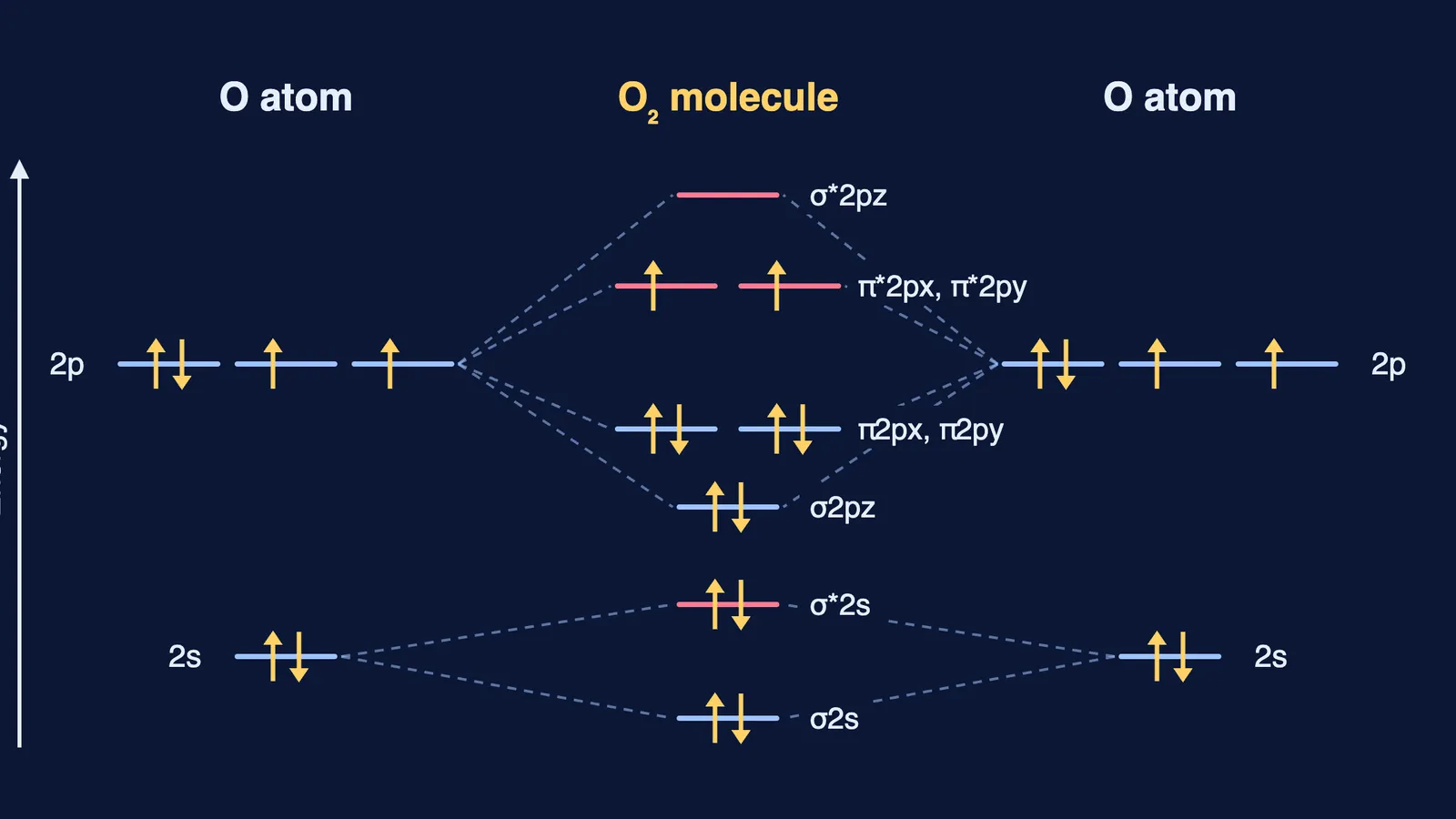
Bonding molecular orbital: formed by addition; lower in energy and it holds the atoms together. Example: σ2s.
**Antibonding molecular orbital (*)**: formed by subtraction; higher in energy and it weakens the bond. Example: σ*2s.
MO bond order: half of (electrons in bonding orbitals minus electrons in antibonding orbitals). Positive means a stable molecule.
Paramagnetic vs diamagnetic: one or more singly occupied orbitals make a substance attracted by a magnetic field; all paired makes it weakly repelled. Example: O₂, with 10 bonding and 6 antibonding electrons, has bond order 2 and two unpaired π* electrons, as worked in the NCERT chapter.
What is hydrogen bonding?
Hydrogen bond: the attraction between a hydrogen atom bonded to F, O or N and a second F, O or N atom, usually in another molecule; weaker than a covalent bond.
Intermolecular hydrogen bond: between separate molecules. Example: HF chains, water.
Intramolecular hydrogen bond: within one molecule. Example: o-nitrophenol.
How to learn these terms
Learn the mix-ups as pairs: sigma vs pi, bonding vs antibonding, covalent vs van der Waals radius, inter vs intramolecular, paramagnetic vs diamagnetic.
Draw the O₂ energy-level diagram from memory, fill 16 electrons, then compute bond order and spot the unpaired pair.
Make one table of hybridisation, shape and example (sp to sp³d²) and fill it in without looking.
Practise using the terms in context with our chemical bonding case study questions.
If a term feels abstract, the Fermi Concept Library covers every concept in chemistry, each with its own lesson and its place in the map.