On this page
What do these case-study questions on chemical bonding cover?
Class 11 exams are set by your school, so treat these as case-based practice inside Unit 4 of the CBSE Chemistry curriculum for 2026-27: Lewis structures, bond parameters, VSEPR, hybridisation, molecular orbital theory and hydrogen bonding.
Every fact below matches the NCERT chapter Chemical Bonding and Molecular Structure (Reprint 2026-27); the scenarios are our own. For the theory, read our Class 11 guide to chemical bonding.
Case 1: Why are both bonds in ozone the same length?
Ananya is building a ball-and-stick model of ozone, O₃, for a science exhibition in Pune. Her Lewis structure has a double bond on one side of the central oxygen and a single bond on the other, so she cuts one short and one long stick. Her teacher hands her a data card from the NCERT chapter: a normal O=O bond is 121 pm, a normal O–O single bond is 148 pm, and both oxygen-oxygen bonds in ozone are measured at 128 pm.
(i) How many valence electrons go into the Lewis structure of O₃? (a) 12 (b) 16 (c) 18 (d) 24
(ii) In Ananya's structure, how many lone pairs does the whole molecule carry, and how many sit on the central oxygen?
(iii) Why are both bonds 128 pm, a value between 121 pm and 148 pm?
(iv) Her friend says ozone "flips back and forth between the two structures". Correct this, and give the bond order of each O–O bond in the real molecule.
Answers.
(i) (c) 18. Each oxygen brings 6 valence electrons, and 3 × 6 = 18.
(ii) Six in all, one of them on the central oxygen. The three bonds use 6 of the 18 electrons, and the other 12 make 6 lone pairs: one on the central atom, two on the double-bonded oxygen and three on the single-bonded oxygen.
(iii) No single Lewis structure fits the data. Ozone is a resonance hybrid of two canonical structures, so both bonds are equal and intermediate in length.
(iv) NCERT is clear that canonical forms have no real existence and the molecule does not spend time in each. Averaging a single and a double bond gives a bond order of (1 + 2)/2 = 1.5 for each bond, so Ananya should cut two equal sticks.
Case 2: Two bottles, one shape, different polarity
A Jaipur college lab keeps bottles of chloroform, CHCl₃, and carbon tetrachloride, CCl₄. A trainee copies their dipole moments from the NCERT table onto the labels: CHCl₃, 1.04 D; CCl₄, 0 D. Both are listed as tetrahedral. Since CCl₄ has four polar C–Cl bonds and CHCl₃ only three, the trainee expects CCl₄ to be more polar.
(i) What is the hybridisation of the carbon atom in CCl₄? (a) sp (b) sp² (c) sp³ (d) sp³d
(ii) State the shape of CCl₄ and its Cl–C–Cl bond angle.
(iii) Convert the dipole moment of CHCl₃ to coulomb metres.
(iv) Explain why CCl₄ has zero dipole moment while CHCl₃ does not, even though both are tetrahedral.
Answers.
(i) (c) sp³. Carbon forms four sigma bonds and has no lone pair.
(ii) Tetrahedral, with bond angles of 109.5°.
(iii) 1 D = 3.33564 × 10⁻³⁰ C m, so 1.04 × 3.33564 × 10⁻³⁰ = 3.47 × 10⁻³⁰ C m.
(iv) The molecular dipole is the vector sum of the bond dipoles. In CCl₄ the four identical C–Cl bond dipoles point to the corners of a regular tetrahedron and cancel. In CHCl₃ one corner holds a hydrogen, so the bond dipoles are no longer identical and do not cancel.
Case 3: Why does liquid oxygen behave differently near a magnet?
A Lucknow hospital trains staff on its liquid oxygen and liquid nitrogen tanks. The engineer explains that oxygen is paramagnetic and nitrogen is diamagnetic, so only oxygen is pulled into a magnetic field. She writes the NCERT data on the board: N₂ has a bond enthalpy of 945 kJ mol⁻¹ and a bond length of 110 pm; O₂ has 498 kJ mol⁻¹ and 121 pm. A trainee asks why nitrogen holds together more strongly, and what happens if N₂ loses one electron to form N₂⁺.
(i) Which species has the same bond order as N₂? (a) O₂ (b) F₂ (c) C₂ (d) NO⁺
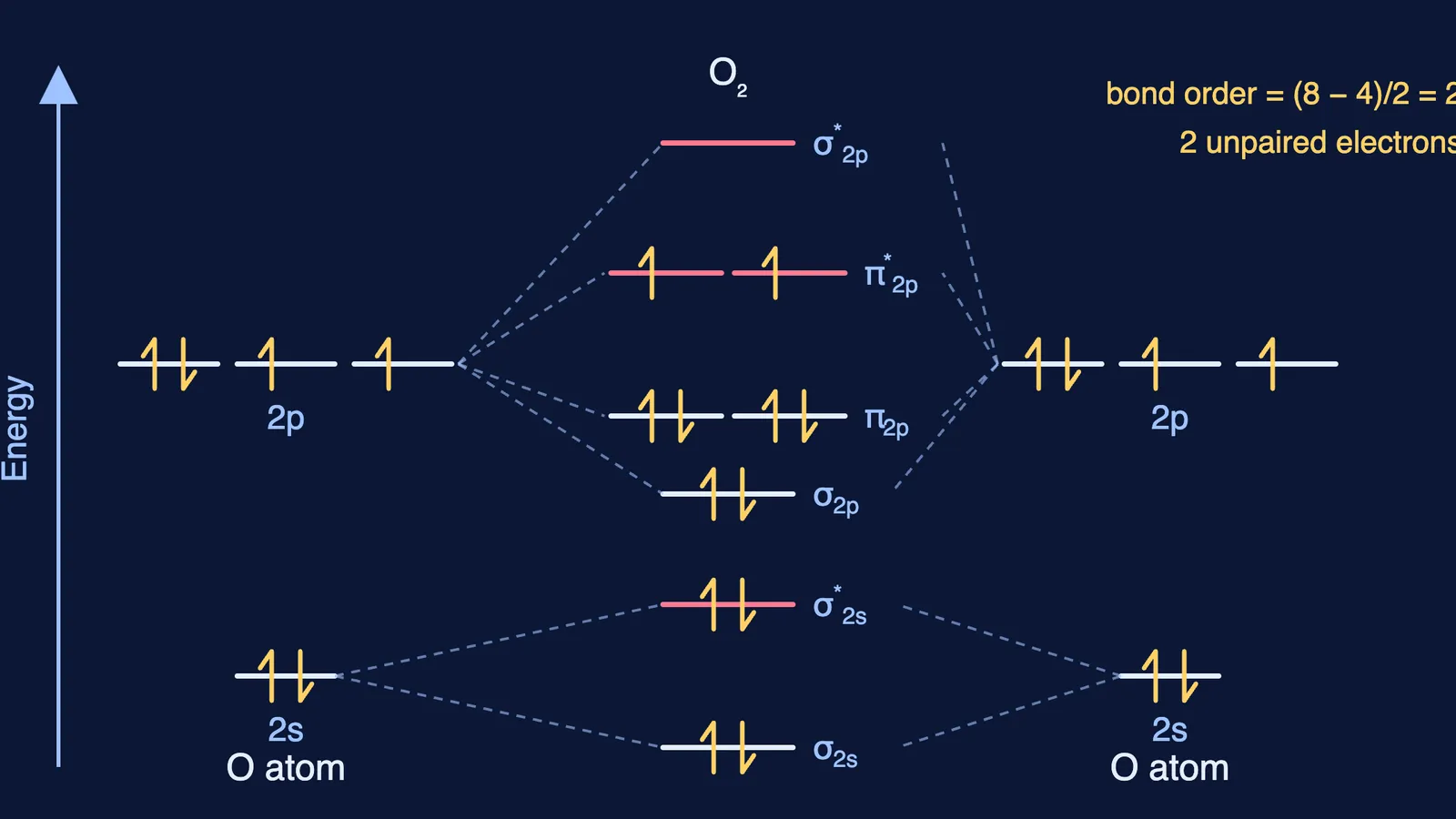
(ii) How many unpaired electrons does O₂ have, and in which molecular orbitals?
(iii) The N₂ bond enthalpy is about how many times that of O₂? Use bond order to explain the gap and the bond lengths.
(iv) Predict the bond order and magnetic behaviour of N₂⁺. Will its bond be longer or shorter than in N₂?
Answers.
(i) (d) NO⁺. N₂ has 10 bonding and 4 antibonding electrons, so its bond order is ½(10 − 4) = 3. NO⁺ has the same 14 electrons, and NCERT notes that isoelectronic N₂, CO and NO⁺ all have bond order 3. O₂ and C₂ have 2, F₂ has 1.
(ii) Two, one each in π*2pₓ and π*2pᵧ.
(iii) 945 ÷ 498 ≈ 1.9. O₂ has 10 bonding and 6 antibonding electrons, a bond order of ½(10 − 6) = 2, against 3 for N₂. Higher bond order means a stronger, shorter bond: 945 against 498 kJ mol⁻¹, 110 against 121 pm.
(iv) N₂⁺ has 13 electrons. For N₂, NCERT places σ2p_z above the π2p pair, so the electron leaves σ2p_z, a bonding orbital. That gives 9 bonding and 4 antibonding electrons: bond order ½(9 − 4) = 2.5. One electron is now unpaired, so N₂⁺ is paramagnetic. A lower bond order than 3 means its bond is longer than in N₂.
How to attack case-study questions on chemical bonding
Count electrons first: valence electrons for Lewis structures, total electrons for MO configurations.
Account for every valence electron: bonding pairs plus lone pairs must add up to the total you counted.
For shapes, count bond pairs and lone pairs on the central atom before you name a geometry.
In MO questions, check the energy order: σ2p_z sits above π2p for B₂, C₂ and N₂, and below it for O₂ and F₂.
Our guide to case-based questions covers pacing, and the assertion-reason set on chemical bonding tests the same ideas another way. If resonance or MO filling still feels shaky, the Fermi Concept Library has every concept in chemistry, each with its own lesson and its place in the map.