On this page
These ten original items cover chemical bonding and molecular structure, Unit 3 of the NEET (UG) 2026 syllabus and Unit 4 of NCERT Class 11 Chemistry Part I. Every statement was checked against the 2026-27 reprint of that chapter. For the chapter plan, see our guide to preparing chemical bonding for NEET.
How do you answer assertion-reason questions?
Work in three steps:
Is the Assertion true on its own?
Is the Reason true on its own?
Only if both are true: is R the direct cause of A?
Our assertion-reason strategy post has more step-3 examples.
Keys for Q1 to Q6:
(A) Both A and R are true and R is the correct explanation of A.
(B) Both A and R are true but R is NOT the correct explanation of A.
(C) A is true but R is false.
(D) A is false but R is true.
Keys for Q7 to Q10:
(A) Both statements are correct.
(B) Both statements are incorrect.
(C) Statement I is correct, Statement II is incorrect.
(D) Statement I is incorrect, Statement II is correct.
Assertion-reason questions on chemical bonding
Answer facts come from NCERT Class 11 Chemistry, Unit 4: Tables 4.5 to 4.8, section 4.5.5 and sections 4.7 to 4.8 with Fig. 4.21.
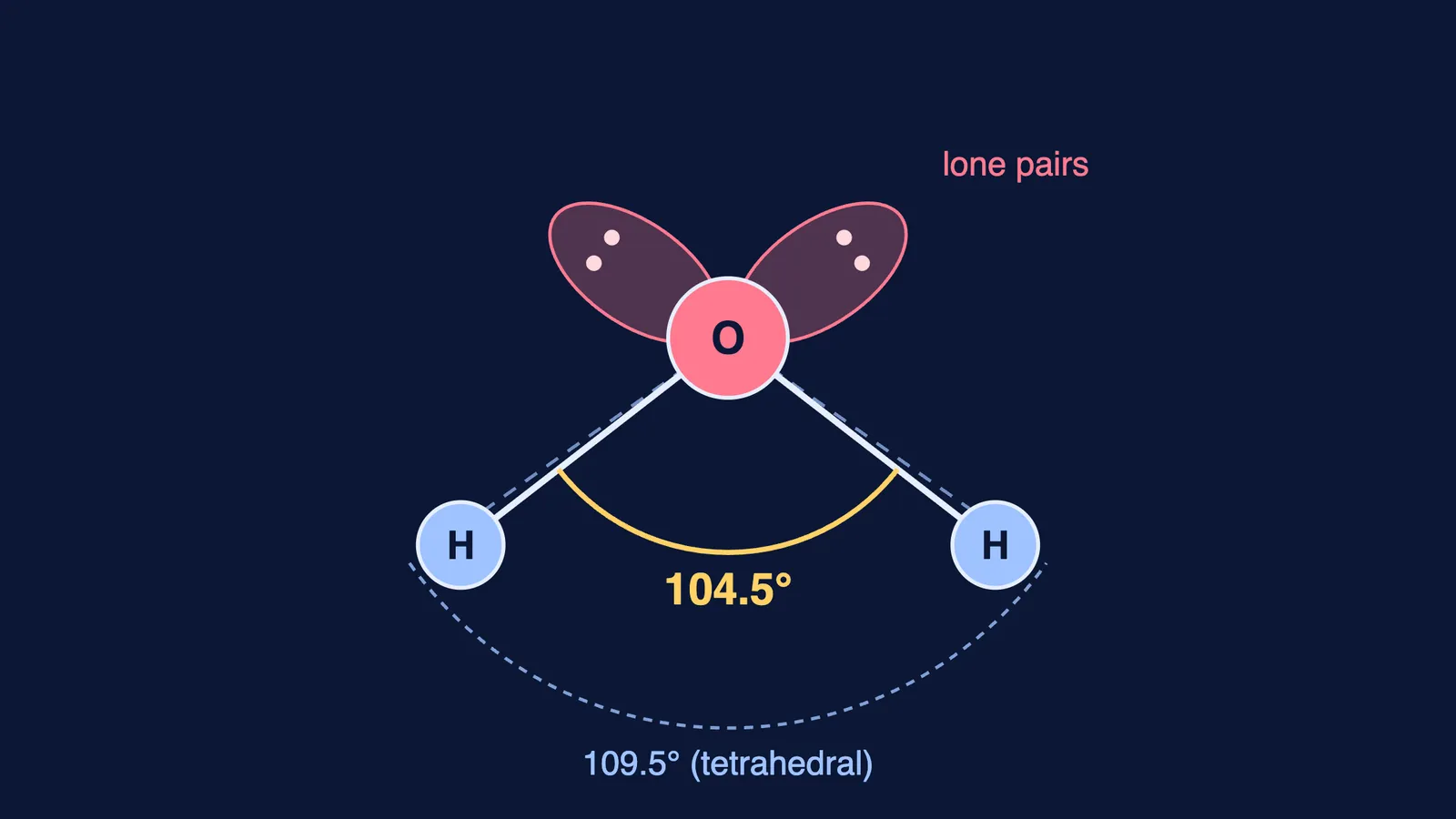
Q1 (easy). Assertion (A): The H–O–H bond angle in water is 104.5°, smaller than the tetrahedral angle of 109.5°. Reason (R): Repulsion decreases in the order lone pair–lone pair > lone pair–bond pair > bond pair–bond pair.
Answer: (A). Both are true. The two lone pairs on oxygen repel the bond pairs more than bond pairs repel each other, squeezing the angle to 104.5°; NCERT gives exactly this reason.
Trap: citing sp3 hybridisation, which alone predicts 109.5°.
Q2 (easy). Assertion (A): CO2 has zero dipole moment. Reason (R): Each C=O bond is polar because oxygen is more electronegative than carbon.
Answer: (B). Both are true, but polar bonds cannot explain a zero dipole. CO2 is linear, so its two equal bond dipoles point in opposite directions and cancel.
Trap: picking (A) because R sounds related. The shape does the cancelling.
Q3 (medium). Assertion (A): O2 is paramagnetic. Reason (R): O2 has an even number of electrons, so all its electrons are paired.
Answer: (C). A is true: O2 has one electron each in π*2px and π*2py, so two are unpaired. R is false: 16 is even, but an even count does not force pairing when two orbitals share the same energy.
Trap: trusting the Lewis structure, which shows every electron paired.
Q4 (medium). Assertion (A): A pi bond is stronger than a sigma bond between the same two atoms. Reason (R): In a sigma bond, the orbitals overlap along the internuclear axis to a larger extent than in the sideways overlap of a pi bond.
Answer: (D). A is false, R is true. Strength depends on the extent of overlap, so the sigma bond is stronger; R actually proves A wrong.
Trap: a double bond is stronger than a single bond because it adds a pi bond to the sigma bond, not because pi is stronger.
Q5 (hard). Assertion (A): B2 is paramagnetic. Reason (R): For B2, C2 and N2, the σ2pz molecular orbital lies higher in energy than the π2px and π2py orbitals.
Answer: (A). Both are true. B2's last two valence electrons enter the two equal-energy π2p orbitals singly. If σ2pz were lower, they would pair there and B2 would be diamagnetic, so this order is the direct cause.
Trap: applying the O2 orbital order to B2.
Q6 (hard). Assertion (A): N2 is diamagnetic. Reason (R): The bond order of N2 is 3.
Answer: (B). Both are true, but bond order says nothing about pairing. N2 is diamagnetic because every orbital it occupies holds two electrons.
Trap: linking a whole-number bond order with paired electrons. B2 (bond order 1) and O2 (bond order 2) are both paramagnetic.
Statement I and Statement II questions on chemical bonding
Judge each statement on its own; there is no "because" step.
Q7 (easy). Statement I: The nitrogen atom in NH3 is sp3 hybridised. Statement II: NH3 is a trigonal planar molecule.
Answer: (C). Statement I is correct: three bond pairs and one lone pair occupy sp3 orbitals. Statement II is incorrect: the lone pair makes NH3 trigonal pyramidal, with a bond angle of 107°.
Trap: counting only bonded atoms. BF3, with no lone pair, is trigonal planar; NH3 is not.
Q8 (medium). Statement I: The bond order of He2+ is zero. Statement II: The He2 molecule does not exist because its bond order is zero.
Answer: (D). Statement I is incorrect: He2+ is (σ1s)2(σ*1s)1, so its bond order is ½(2 − 1) = 0.5. Statement II is correct: He2's bond order is ½(2 − 2) = 0.
Trap: copying He2's answer.
Q9 (medium). Statement I: The three equatorial P–Cl bonds of PCl5 are separated from one another by 120°. Statement II: Each axial P–Cl bond in PCl5 is slightly longer than each equatorial P–Cl bond.
Answer: (A). Both are correct. Axial bond pairs suffer more repulsion from the equatorial bond pairs, so axial bonds are slightly longer and weaker, which NCERT links to PCl5's reactivity.
Trap: assuming all five bonds are equal because the molecule looks symmetric.
Q10 (hard). Statement I: ClF3 is a trigonal planar molecule. Statement II: SF4 is a square planar molecule.
Answer: (B). Both are incorrect. ClF3 (three bond pairs, two lone pairs in equatorial positions) is T-shaped. SF4 (four bond pairs, one lone pair) is see-saw; square planar is XeF4, with two lone pairs.
Trap: naming the shape from bonded atoms. Count all electron pairs, place lone pairs where they repel least, then name the shape.
How should you use this set?
Cover the answers and write your key for all ten, with one line on why.
Wrong on whether a statement is true? That is a fact gap: reread the NCERT section. Wrong only between (A) and (B)? That is an explanation gap: find the textbook's own reason.
Then try our chemical bonding NEET practice set.
If a trap exposes a concept gap, such as why lone pairs repel more, the Fermi Concept Library has a lesson for every concept in chemistry, each with its place in the map.