On this page
Chapter 5 of the NCERT book *Politics in India since Independence* runs from Nehru's death in 1964 to the 1972 state elections. Every historical fact below is from the NCERT chapter (Reprint 2026-27); marks are from CBSE, and every judgement is NCERT's.
How many marks is this chapter worth in 2026-27?
The CBSE 2026-27 Political Science curriculum lists "Challenges to and Restoration of the Congress System" as chapter 5 of Part B, with 4 marks allotted. Its topics: succession, the 1967 election, the Congress split and the 1971 election.
The 2026-27 sample paper draws two items from it: a 1-mark statement question on politics after 1967, and a 2-mark question on the economy before the 1967 election.
How did the succession after Nehru happen?
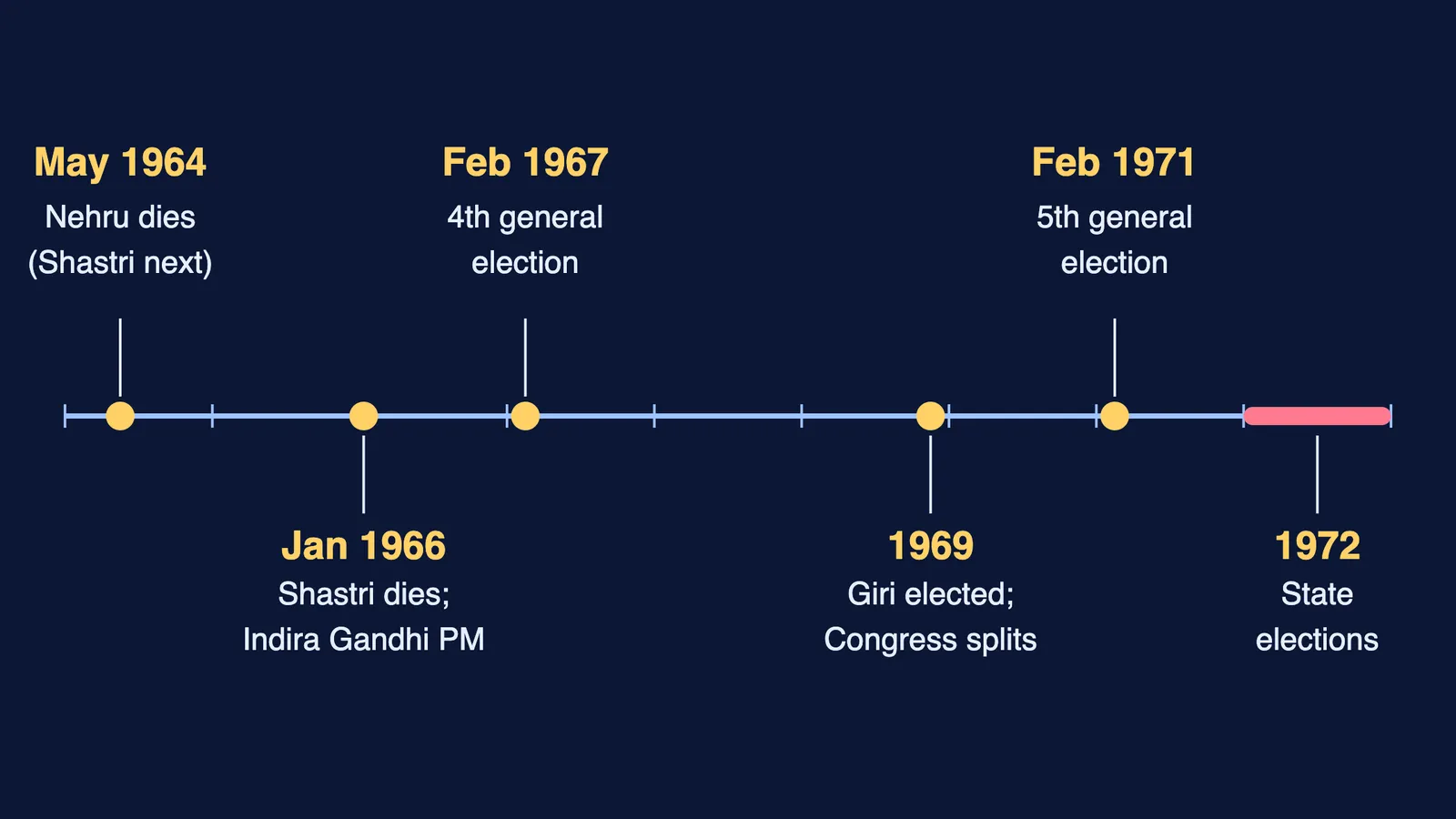
May 1964: Nehru died. Congress president K. Kamaraj found a consensus for Lal Bahadur Shastri, who was chosen unanimously.
1964-66: Shastri faced a food crisis and the 1965 war with Pakistan; his slogan was "Jai Jawan Jai Kisan".
11 January 1966: Shastri died in Tashkent, where he had gone to sign an agreement with Pakistan.
1966: Indira Gandhi defeated Morarji Desai in a secret ballot of Congress MPs, winning more than two-thirds of them.
NCERT says this peaceful 1966 handover was seen as a sign of democratic maturity.
Why is 1967 called a landmark election?
NCERT lists the context: failed monsoons, drought, food shortage, falling foreign exchange reserves and rising military spending. After devaluation, one US dollar cost more than Rs 7, up from under Rs 5. Price rise led to protests, bandhs and hartals.
NCERT explains that opposition parties saw their divided votes keeping the Congress in power, so they formed anti-Congress fronts or shared seats. Socialist leader Ram Manohar Lohia named this strategy non-Congressism.
The fourth general election was held in February 1967. According to the textbook:
Congress kept a Lok Sabha majority, with its lowest seats and vote share since 1952.
Half of Indira Gandhi's cabinet ministers lost their seats; senior leaders Kamaraj and S.K. Patil also lost.
In Madras, the DMK became the first non-Congress party to win a majority on its own in any state.
Eight other states got coalitions called SVD (Samyukt Vidhayak Dal) governments.
Defection means an elected member leaving their party for another. NCERT tells of Gaya Lal, a Haryana MLA who changed parties three times in a fortnight in 1967, which gave rise to the phrase "Aya Ram, Gaya Ram".
Why did the Congress split in 1969?
The Syndicate was the informal name for the Congress leaders who controlled the party organisation, including Kamaraj, S. Nijalingappa, N. Sanjeeva Reddy, S.K. Patil and Atulya Ghosh. NCERT says Indira Gandhi turned a power struggle into an ideological one.
May 1967: the Congress Working Committee adopted a Ten Point Programme, including social control of banks and land reforms.
1969: after President Zakir Hussain's death, the Syndicate made Sanjeeva Reddy the official candidate. Indira Gandhi encouraged Vice-President V.V. Giri to stand as an independent and called for a "conscience vote". Fourteen leading private banks were nationalised, and Morarji Desai left the government.
Result: Giri won. Nijalingappa expelled the Prime Minister, and by November 1969 there were two parties: Congress (Organisation), the "Old Congress", and Congress (Requisitionists), the "New Congress".
Abolishing the privy purse, the allowance promised to former princely rulers, failed in 1970; the Constitution was amended after the 1971 election.
How did the 1971 election restore the Congress?
In December 1970 the government recommended dissolving the Lok Sabha, and the fifth general election was held in February 1971. The main opposition parties other than the communists formed a Grand Alliance (SSP, PSP, Jana Sangh, Swatantra and BKD). The Congress(R) allied with the CPI and campaigned on Garibi Hatao.
NCERT reports that the Congress(R)-CPI combine won 375 Lok Sabha seats with 48.4 per cent of votes, and the Congress(R) alone 352 seats with about 44 per cent. The Congress(O) won 16, and the Grand Alliance fewer than 60. NCERT adds that after the 1971 war it swept every state assembly election in 1972.
Practice questions and a three-day plan
Our own questions, in sample-paper formats.
(1 mark) Arrange in order: Ten Point Programme, Shastri's death, fifth general election, Nehru's death.
(2 marks) What did "Aya Ram, Gaya Ram" describe? Give NCERT's example.
(4 marks) Compare the Congress(O) and Congress(R) on leadership, origin and 1971 result.
(6 marks) Using four features, explain NCERT's argument that the Congress system came back in a changed form under Indira Gandhi.
Day 1: recall the six dates in the diagram. Day 2: questions 1-3. Day 3: question 4, timed.
Read this after the era of one-party dominance, then see the 1971 war in India's external relations and the later story in recent developments in Indian politics.
For your STEM subjects, Fermi's AI tutor can work out what you already know and build a plan for the session.