On this page
These eight NEET-UG Biology questions were written for this set; none is copied or reworded from NCERT, the exemplar or past papers. They climb from spotting which cell has which part to counting microtubules.
What does NEET test from Cell: The Unit of Life?
The NEET (UG)-2026 syllabus from the National Medical Commission lists cell theory, prokaryotic and eukaryotic cells, the endomembrane system, ribosomes, plastids, the cytoskeleton, cilia, flagella, centrioles and the nucleus under Biology Unit 3. Every fact in this set is checked against Chapter 8 of NCERT Class 11 Biology, Reprint 2026-27. If the chapter is new to you, read our guide on how to prepare Cell: The Unit of Life for NEET first, and keep the list of cell organelles and their functions, one line each open for quick checks.
How should you use this practice set?
Cover each answer and give yourself about a minute.
Read the trap line even when you got it right.
Write every trap that caught you on one page and reread it before a test.
Easy: do you know which cell has which part?
All three answers are direct statements in sections 8.3 to 8.5 of NCERT Chapter 8.
Q1 (easy). Which structure is present in both a Mycoplasma cell and a human liver cell?
(A) Cell wall (B) Mitochondria (C) Ribosomes (D) Nuclear envelope
Answer: (C). NCERT says ribosomes are non-membrane bound organelles found in all cells, prokaryotic and eukaryotic. Trap: (A) feels safe because most prokaryotes have a wall, but NCERT names Mycoplasma as the exception.
Q2 (easy). A student lists three organelles whose functions NCERT treats as coordinated with the ER. Which list is fully correct?
(A) Golgi complex, lysosomes, vacuoles (B) Golgi complex, peroxisomes, lysosomes (C) Lysosomes, mitochondria, vacuoles (D) Vacuoles, chloroplasts, Golgi complex
Answer: (A). NCERT's endomembrane system is the ER, Golgi complex, lysosomes and vacuoles; mitochondria, chloroplasts and peroxisomes are left out because their functions are not coordinated with these. Trap: (B) looks right because peroxisomes, like lysosomes, are small membrane-bound vesicles, but NCERT excludes them.
Q3 (easy). One bacterium in a culture survives an antibiotic that kills the rest. The resistance comes from a small circular DNA molecule outside its genomic DNA. What is this DNA called?
(A) Mesosome (B) Plasmid (C) Nucleoid (D) Chromatophore
Answer: (B). NCERT calls these small circular DNA molecules plasmids and gives antibiotic resistance as one trait they confer. Trap: (A) helps in DNA replication and distribution, but a mesosome is an infolding of the plasma membrane, not DNA.
Medium: can you apply the numbers and the routes?
Use the ribosome values, the membrane composition and the Golgi route from sections 8.5.1, 8.5.3 and 8.5.6 of NCERT Chapter 8.
Q4 (medium). Which statement about the ribosomes of a mesophyll cell in a pea leaf is correct?
(A) All its ribosomes are 80S (B) Ribosomes in the cytoplasm and on the RER are 80S; those in mitochondria and chloroplasts are 70S (C) Cytoplasmic ribosomes are 70S; organelle ribosomes are 80S (D) Its mitochondria and chloroplasts have no ribosomes
Answer: (B). NCERT gives 70S ribosomes in the mitochondrial matrix and in chloroplasts, and 80S in the eukaryotic cytoplasm. Trap: (A) treats the whole cell as eukaryotic, forgetting that both organelles carry their own 70S ribosomes.
Q5 (medium). NCERT gives the human erythrocyte membrane as about 52% protein and 40% lipid. What is its approximate protein to lipid ratio by mass?
(A) 0.77 : 1 (B) 1.3 : 1 (C) 1.2 : 1 (D) 0.52 : 1
Answer: (B). 52 / 40 = 1.3. Trap: (A) divides the wrong way round (40 / 52), giving lipid to protein.
Q6 (medium). A cell secretes a protein made on its rough ER. Put the steps of its route in order: (i) leaves from the trans face (ii) vesicle fuses with the cis face (iii) synthesis by ribosomes on the RER (iv) modification while moving through the Golgi cisternae.
(A) iii, i, iv, ii (B) iii, ii, iv, i (C) ii, iii, iv, i (D) iii, iv, ii, i
Answer: (B). NCERT says vesicles from the ER fuse with the cis, or forming, face and move towards the maturing face, and proteins are modified in the cisternae before release from the trans face. Trap: (A) sends material in through the trans face; that face is the exit.
Hard: can you count structures and judge statements?
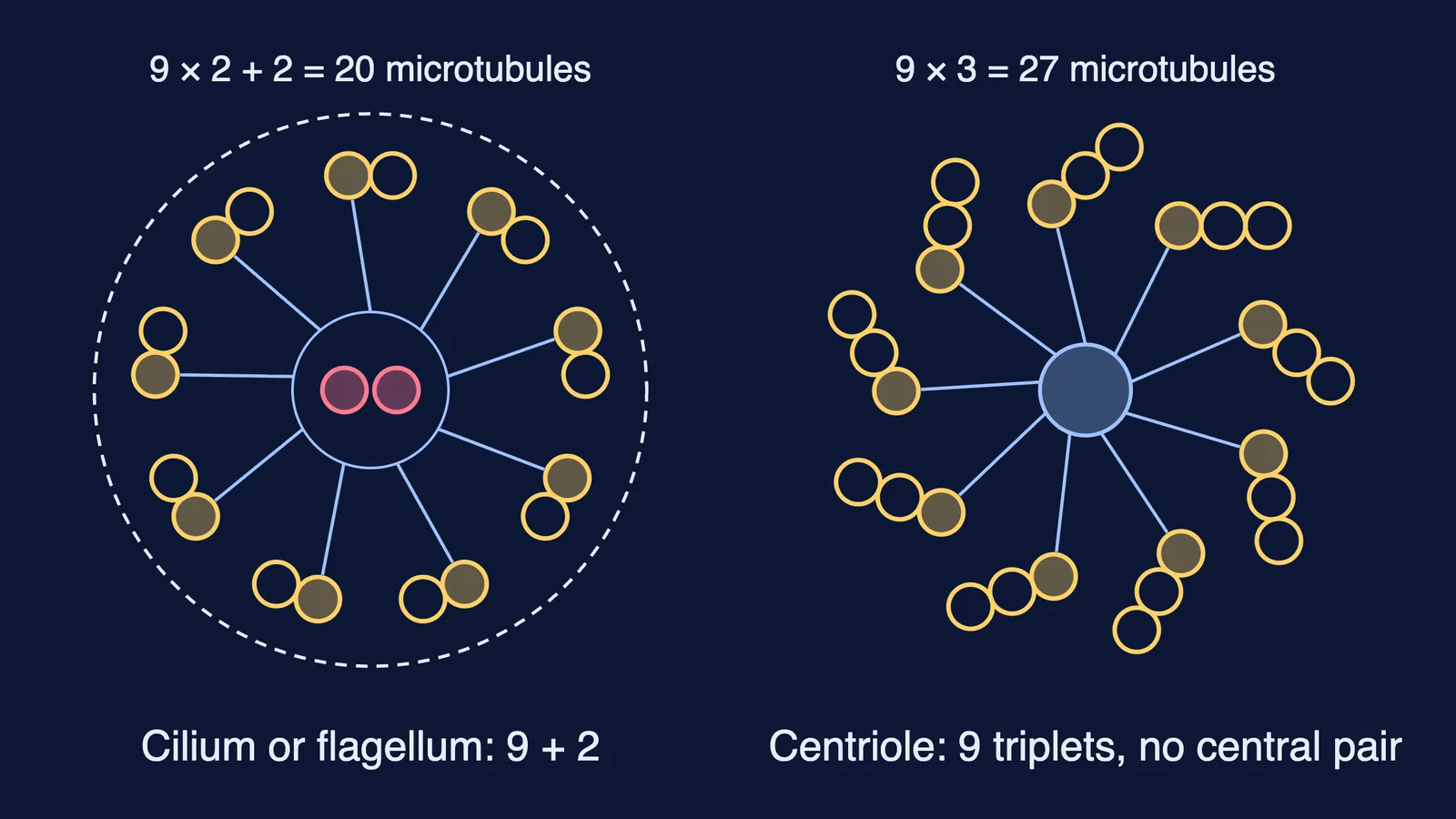
Both rely on the exact wording of NCERT Chapter 8. The hero diagram above shows the two cross-sections in Q7.
Q7 (hard). How many microtubules would you count in a cross-section through the axoneme of one cilium, and through one centriole?
(A) 20 and 27 (B) 11 and 9 (C) 20 and 29 (D) 18 and 27
Answer: (A). The axoneme has nine peripheral doublets and a central pair: 9 x 2 + 2 = 20. A centriole has nine peripheral triplets around a proteinaceous hub: 9 x 3 = 27. Trap: (C) gives the centriole a central pair as well; its centre is the protein hub, not microtubules.
Q8 (hard). How many of these statements are correct?
(i) The nucleolus is enclosed by a single membrane.
(ii) The middle lamella is mainly calcium pectate.
(iii) The inner chloroplast membrane is less permeable than the outer one.
(iv) Mitochondria divide by fission.
(v) Lysosomal hydrolases are most active at alkaline pH.
(A) Two (B) Three (C) Four (D) Five
Answer: (B). Statements (ii), (iii) and (iv) match NCERT. The nucleolus is not membrane bound, and lysosomal enzymes work best at acidic pH. Trap: (C) usually comes from accepting (i), because the nucleolus sits inside the membrane-bound nucleus.
What should you do after this set?
Score yourself out of eight, and for every miss reread the NCERT line the solution quotes. If you want the theory and board-style questions together, the Class 11 guide to Cell: The Unit of Life covers them. For more practice, the Fermi Problem Library has worked problems with a step-by-step solver that explains the reasoning rather than printing an answer.
Then try Q7 again for a basal body, which NCERT describes as a centriole-like structure formed by the centrioles.