On this page
Theory first? Read our Work, Energy, and Simple Machines Class 9 chapter guide.
What does the chapter expect you to apply?
Chapter 7 of Exploration, the new NCERT Class 9 Science book, defines work by a constant force as W = F × s, in joules (1 J = 1 N × 1 m). Work done on an object equals the change in its energy. Kinetic energy is ½mv², potential energy is mgh, and with gravity alone acting their sum stays constant. Power is P = W/t, in watts. For a pulley, inclined plane or lever, mechanical advantage (MA) is load ÷ effort; a machine lowers the force, never the work. The CBSE Class IX Science curriculum for 2026-27 lists all of these. Take g = 10 m s⁻², as the chapter's examples do.
Case 1: A bucket at a village well in Rajasthan
Meera draws water from a village well near Barmer, pulling down on a rope over a fixed pulley. The bucket full of water has a mass of 12 kg. The water surface is 15 m below the pulley, and she raises the bucket at a steady speed in 30 s. Ignore friction and the rope's mass.
(i) The mechanical advantage of Meera's fixed pulley is: (a) 0.5 (b) 1 (c) 2 (d) it depends on the depth of the well
(ii) If the pulley does not reduce the force, why does Meera use it?
(iii) What effort does Meera apply, and how much work does she do to raise the bucket 15 m?
(iv) Find her power. Her brother raises the same full bucket through the same height in 20 s. Compare the work he does and his power.
Answers.
(i) (b). Effort equals load, so MA = 1.
(ii) It changes the direction of the effort. Pulling down is easier than lifting up.
(iii) Effort = load = mg = 12 kg × 10 m s⁻² = 120 N. Work = 120 N × 15 m = 1800 J, which is the bucket's gain in potential energy, mgh.
(iv) P = 1800 J ÷ 30 s = 60 W. Her brother does the same 1800 J, so P = 1800 ÷ 20 = 90 W.
Case 2: The handle of a village hand pump
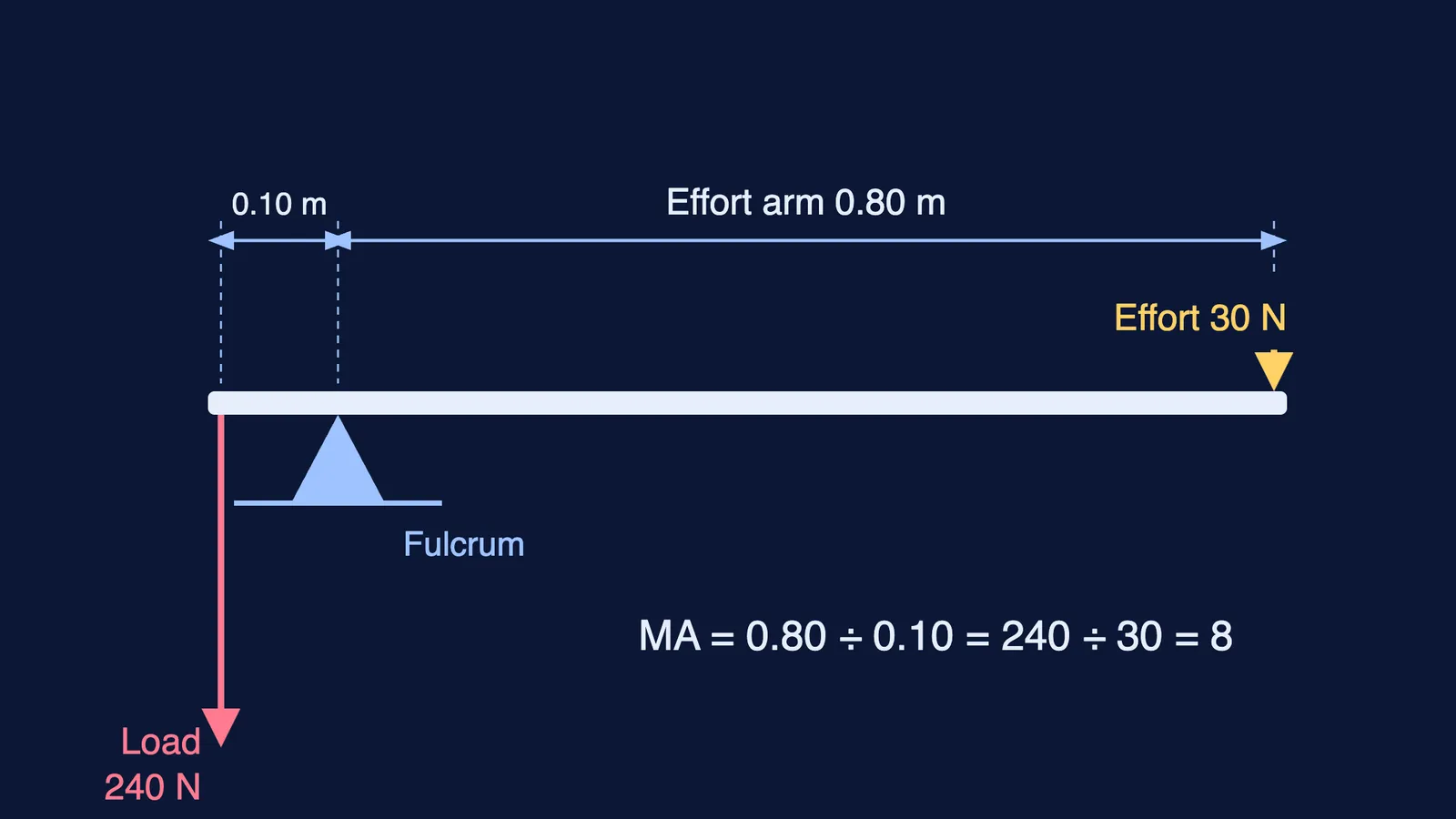
A village hand pump in Bihar has an iron handle that turns about a pin. Ravi pushes down on the long end; the short end lifts the pump rod, which (with the water above the plunger) pulls down on the handle with 240 N. The pin is 0.80 m from Ravi's hand and 0.10 m from the point where the rod is attached. Ignore friction and the weight of the handle.
(i) The pin of the hand pump is its: (a) load (b) effort (c) fulcrum (d) load arm
(ii) Find the mechanical advantage of the handle.
(iii) What effort must Ravi apply to just balance the load?
(iv) In one stroke Ravi's hand moves down 0.40 m. How far does the rod rise? Show that the work done at both ends is the same.
Answers.
(i) (c). The handle turns about the pin, so the pin is the fulcrum. With the fulcrum between effort and load, this is a Class I lever.
(ii) MA = effort arm ÷ load arm = 0.80 m ÷ 0.10 m = 8.
(iii) Effort × effort arm = load × load arm, so effort = 240 N × 0.10 m ÷ 0.80 m = 30 N, one-eighth of the load.
(iv) Both ends turn through the same angle about the pin, so each moves in proportion to its distance from it: rod rise = 0.40 m × 0.10 m ÷ 0.80 m = 0.05 m. Work by Ravi = 30 × 0.40 = 12 J; work on the rod = 240 × 0.05 = 12 J.
Case 3: Freewheeling down a hill road in Shimla
Tanvi freewheels her bicycle down a straight hill road in Shimla. She and her cycle have a total mass of 50 kg. At the top she is already moving at 5 m s⁻¹. The road runs 200 m along the slope and drops 10 m in height. At the bottom her speed is 13 m s⁻¹.
(i) As Tanvi rolls downhill, her potential energy: (a) increases while her kinetic energy decreases (b) decreases while her kinetic energy increases (c) and kinetic energy both stay constant (d) and kinetic energy both increase
(ii) With zero height at the bottom, find her kinetic and potential energy at the top.
(iii) Without friction and air resistance, what would her speed at the bottom be?
(iv) Her actual speed is 13 m s⁻¹. How much energy is lost, and what average resistive force along the road accounts for it?
Answers.
(i) (b). Gravity does positive work on her, turning potential energy into kinetic energy.
(ii) K = ½ × 50 kg × (5 m s⁻¹)² = 625 J. U = mgh = 50 × 10 × 10 = 5000 J.
(iii) Mechanical energy is conserved: total = 625 + 5000 = 5625 J = ½ × 50 × v². So v² = 225 and v = 15 m s⁻¹.
(iv) Actual K at the bottom = ½ × 50 × 13² = 4225 J. Energy lost = 5625 − 4225 = 1400 J, taken by friction and air resistance. Average resistive force = 1400 J ÷ 200 m = 7 N, acting opposite to her motion.
How to attack case-study questions on work, energy and simple machines?
Name the force and the object it acts on, then check whether the displacement is along it, against it or at right angles.
Use g = 10 m s⁻² unless told otherwise, and keep units on every line.
For speeds after a drop, use energy: start energy = end energy + what friction took.
For a machine, find MA two ways (load ÷ effort and a distance ratio) and check that the work matches at both ends.
For a "why" part, use the chapter's words: a fixed pulley changes direction; a ramp or lever trades force for distance.
Keep the key terms of this chapter and the chapter's formulas with examples beside you. If a step keeps slipping, the Fermi Problem Library has worked problems with a step-by-step solver that explains the reasoning rather than printing an answer.