On this page
What do these Tissues in Action case studies cover?
Tissues in Action is Chapter 3 of the new NCERT Class 9 book, Exploration. The NCERT chapter text defines a tissue as a group of cells, similar in structure, that work together to perform a specific function. The CBSE 2026-27 Class IX Science curriculum lists plant and animal tissues, joints and care of the musculoskeletal system for this chapter.
The scenarios and numbers are our own. For theory, see our Tissues in Action Class 9 chapter guide and the Tissues in Action key terms.
Case 1: Why does red ink climb a balsam stem?
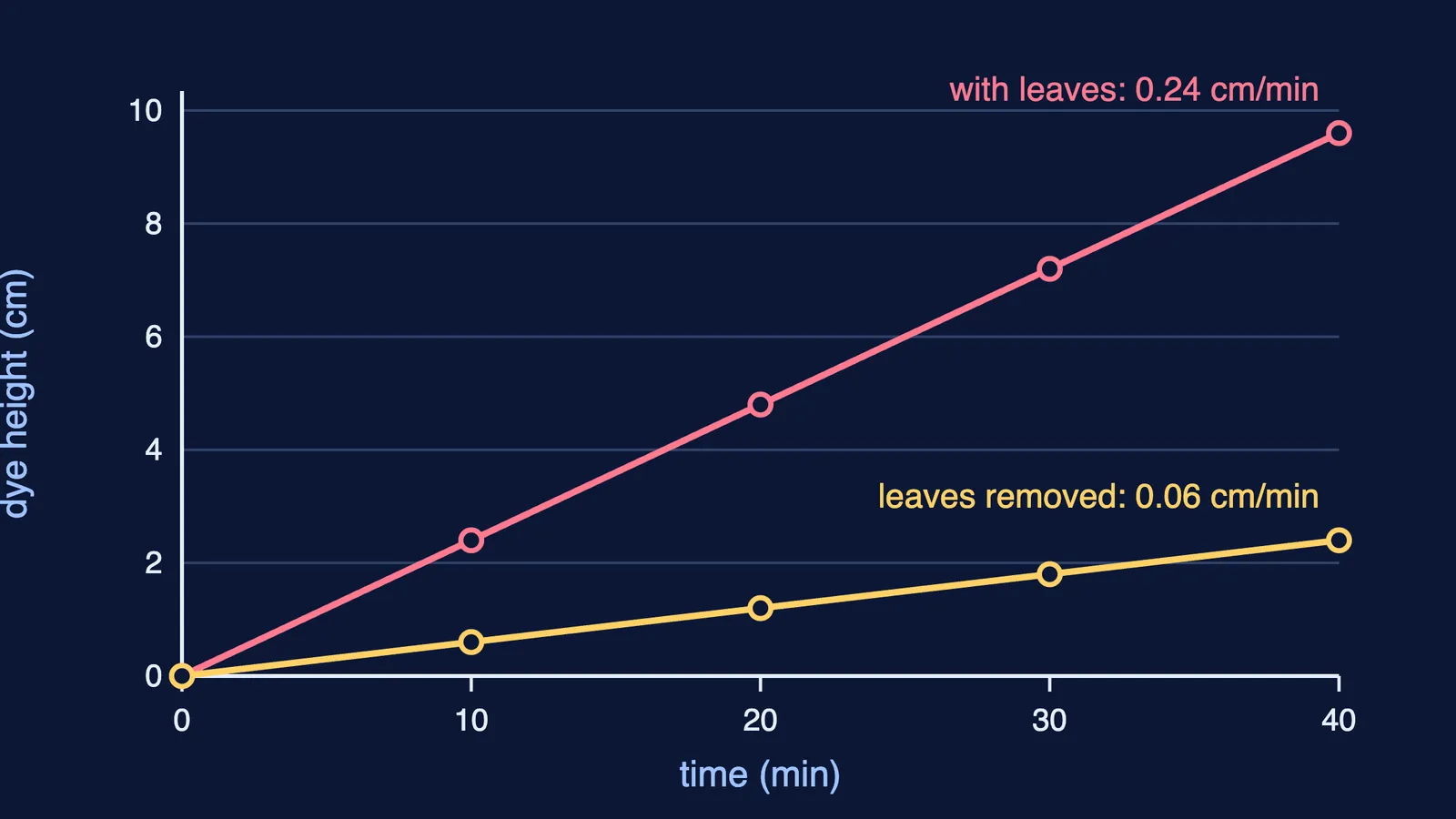
Ritika in Bhopal cuts two equal shoots from a white-flowered balsam (gulmehendi) plant. She keeps all the leaves on Shoot A and removes every leaf from Shoot B, then stands both in beakers of water mixed with red ink on a sunny window sill. The stems are thin enough to see through, so every 10 minutes she marks how high the red colour has risen. After 40 minutes the red front is at 9.6 cm in Shoot A but only 2.4 cm in Shoot B. A thin slice across Shoot A shows red only in small separate patches.
(i) The red ink travels up the stem through: (a) phloem (b) xylem (c) epidermis (d) collenchyma
(ii) Find the average speed of the red front in Shoot A, in mm per minute.
(iii) How many times faster did the dye rise in Shoot A than in Shoot B, and why?
(iv) Ritika coats every leaf of a third shoot, on both sides, with petroleum jelly and repeats the test. Predict the result.
Answers.
(i) (b) Xylem, which carries water and minerals up from the roots; the red patches are its strands.
(ii) 9.6 cm ÷ 40 min = 0.24 cm/min = 2.4 mm/min.
(iii) Shoot B: 2.4 ÷ 40 = 0.06 cm/min, so Shoot A was 0.24 ÷ 0.06 = 4 times faster. Water lost through the stomata of leaves in transpiration creates a pull in the xylem; with no leaves there is little pull.
(iv) The jelly blocks the stomata, so transpiration nearly stops and the dye rises slowly, near Shoot B's rate.
Case 2: What happened to Simran's knee at kabaddi practice?
At kabaddi practice in Sonipat, 15-year-old raider Simran is tackled and slides on the mud court. Her knee is scraped through the outer skin and bleeds, but the bleeding stops on its own in about four minutes. Two days later the scrape is red and slightly swollen, with a little pus. Her knee was pushed sideways, so a physiotherapist checks it. The knee bends and straightens normally and does not give way sideways; the strong bands joining her thigh bone to her shin bone are not torn.
(i) The knee is an example of which joint? (a) ball and socket (b) pivot (c) hinge (d) fixed
(ii) Which component of blood stopped the bleeding?
(iii) Explain the redness, swelling and pus, and why unbroken skin normally prevents them.
(iv) Name the "strong bands" and say how her knee would behave if they had torn. What could she not do if, instead, a tendon of the thigh muscle that straightens the knee had torn?
Answers.
(i) (c) Hinge: like the elbow, it bends and straightens in one direction only.
(ii) Platelets, which help blood clot at the site of an injury.
(iii) Skin is epithelium of many cell layers, with flat, tightly packed outer cells that keep microbes out. The scrape broke this barrier, microbes entered, and white blood cells collected there, causing inflammation and pus.
(iv) Ligaments connect bone to bone, limit movement and help prevent dislocation; torn, the knee could move beyond its normal limit. A tendon passes a muscle's pull to the bone, so with that tendon torn the knee would stay stable but she could not straighten it herself.
Case 3: How does one lab grow thousands of banana plants?
A plant tissue-culture unit in Maharashtra receives an order for banana plantlets. Technicians cut 30 shoot tips, each 2 to 3 mm long, from healthy suckers and place each on a jelly-like nutrient medium with sugar and growth chemicals, under controlled light and temperature. Each tip first grows into one shoot. Then, every 6 weeks, each shoot is divided on fresh medium and becomes 4 shoots on average. After 4 cycles the shoots go onto a rooting medium and then to a shade-net house, where 90% survive.
(i) The shoot tip is chosen because it contains: (a) lateral meristem (b) apical meristem (c) sclerenchyma (d) cork
(ii) Give two features of the cells in this tissue that suit rapid division.
(iii) How many shoots are there after 4 cycles, after how many weeks, and how many plants survive?
(iv) A trainee suggests using pieces of mature leaf, whose cells no longer divide. Using totipotency, explain whether this could work and why the lab still prefers shoot tips.
Answers.
(i) (b) Apical meristem, the growth zone at root and shoot tips.
(ii) Any two: small cells with thin walls, a large prominent nucleus, dense cytoplasm, vacuoles generally absent, tight packing.
(iii) 30 × 4⁴ = 30 × 256 = 7,680 shoots after 4 × 6 = 24 weeks; 7,680 × 0.9 = 6,912 plants survive.
(iv) Leaf cells are permanent tissue that lost the ability to divide during differentiation. But some mature plant cells are totipotent: given nutrients and growth chemicals they can dedifferentiate, divide and redifferentiate into a whole plant, as F. C. Steward showed with carrot phloem cells in 1958. Shoot tips skip that step because their cells already divide.
How should you attack case-study questions?
Translate everyday words into tissue names: "bands joining bone to bone" is a ligament, "tip of the shoot" is apical meristem.
In plant transport, fix direction and cargo: water and minerals go up in xylem, food moves in phloem.
Link structure to function: thin flat cells for exchange, many layers for protection.
For "what if" parts, ask whether the cells can still divide (meristematic) or have differentiated (permanent).
In numericals, show units and each step.
Our guide on how to answer case-based questions, covers timing and answer length. If a term here stumps you, the Fermi Concept Library covers every concept in biology, each with its own lesson and its place in the map.