On this page
Three original cases, easy to hard, for the 2026-27 session. New to the chapter? Read our Class 9 sound waves chapter guide first.
What do sound waves case-study questions test?
Every case stays inside Chapter 10, Sound Waves: Characteristics and Applications of Exploration, the new NCERT Class 9 science textbook, and the sound topics listed in the CBSE 2026-27 Class IX science curriculum: wave characteristics, graphs, speed, perception, echo, reverberation and echolocation. Treat them as case-based practice.
Four facts from the chapter carry most of the working:
Frequency and time period are related by ν = 1/T, and speed, wavelength and frequency by v = λν (NCERT Chapter 10).
The speed of sound in dry air is about 331 m/s at 0 °C and nearly 344 m/s at 22 °C; in steel the chapter's table gives about 5000 m/s.
Two sounds must reach you at least 0.1 s apart to be heard separately, so an echo needs a reflecting surface at least about 17 m away.
Reflections arriving less than 0.05 s apart cause reverberation; sound above 20 kHz is ultrasonic.
Case 1: The dhol at a Ganeshotsav procession
At a Ganeshotsav procession in Pune, a dhol player keeps a steady beat on a stretched drum head. Riya, a Class 9 student, films the drum head with a high-speed camera at 960 frames per second and counts 270 complete oscillations in 1.5 s while one stroke rings out. Her friend Kabir stands 86 m down the road. Take the speed of sound in the 22 °C evening air as 344 m/s. Yet the air near the drum does not rush towards Kabir.
(i) The sound of the dhol is produced by: (a) the stick moving through air (b) the vibrating drum head (c) air flowing out of the drum (d) the player's hands
(ii) Is the sound wave reaching Kabir longitudinal or transverse, and what actually travels to him?
(iii) Find the frequency and the time period of the drum head's vibration.
(iv) Find the wavelength of this sound in air and how long it takes to reach Kabir.
Answers.
(i) (b). Sound is produced by vibrating objects; here the drum head vibrates.
(ii) Longitudinal: air particles vibrate back and forth parallel to the direction of travel. The compressions and rarefactions, and the energy they carry, travel to Kabir; the air particles only oscillate about their mean positions.
(iii) ν = 270 ÷ 1.5 s = 180 Hz. T = 1/ν = 1/180 s ≈ 0.0056 s.
(iv) λ = v/ν = 344 ÷ 180 ≈ 1.91 m. Time = 86 m ÷ 344 m/s = 0.25 s.
Case 2: The echo at a Sahyadri viewpoint
A trekking group at a Sahyadri viewpoint faces a bare basalt cliff across a valley. The air is at about 22 °C (speed of sound 344 m/s). Meera claps once, and a sound-recording app on her phone shows the echo arriving 1.25 s after the clap. Later, sheltering in a bare stone rest-house hall, Meera claps and hears no separate echo, only a booming sound that dies away. The far wall is 6 m from her.
(i) An echo is heard because sound undergoes: (a) refraction (b) reflection (c) absorption (d) vibration
(ii) How far is the cliff from Meera?
(iii) What is the minimum distance from a reflecting surface for a distinct echo on this day?
(iv) Explain, with a calculation, why the hall gives a booming sound instead of an echo, and how the group could reduce it.
Answers.
(i) (b). An echo is sound reflected from a hard, distant surface.
(ii) The sound goes to the cliff and back: distance = (344 × 1.25) ÷ 2 = 215 m.
(iii) Sound must take at least 0.1 s for the round trip: (344 × 0.1) ÷ 2 = 17.2 m.
(iv) The reflection from the far wall returns after (2 × 6) ÷ 344 ≈ 0.035 s. That is under 0.1 s, so it cannot be heard separately, and repeated reflections under 0.05 s apart make the sound persist: reverberation. Hanging blankets or tarpaulins (soft, porous surfaces) absorb sound and reduce it.
Case 3: Checking a steel plate with ultrasound
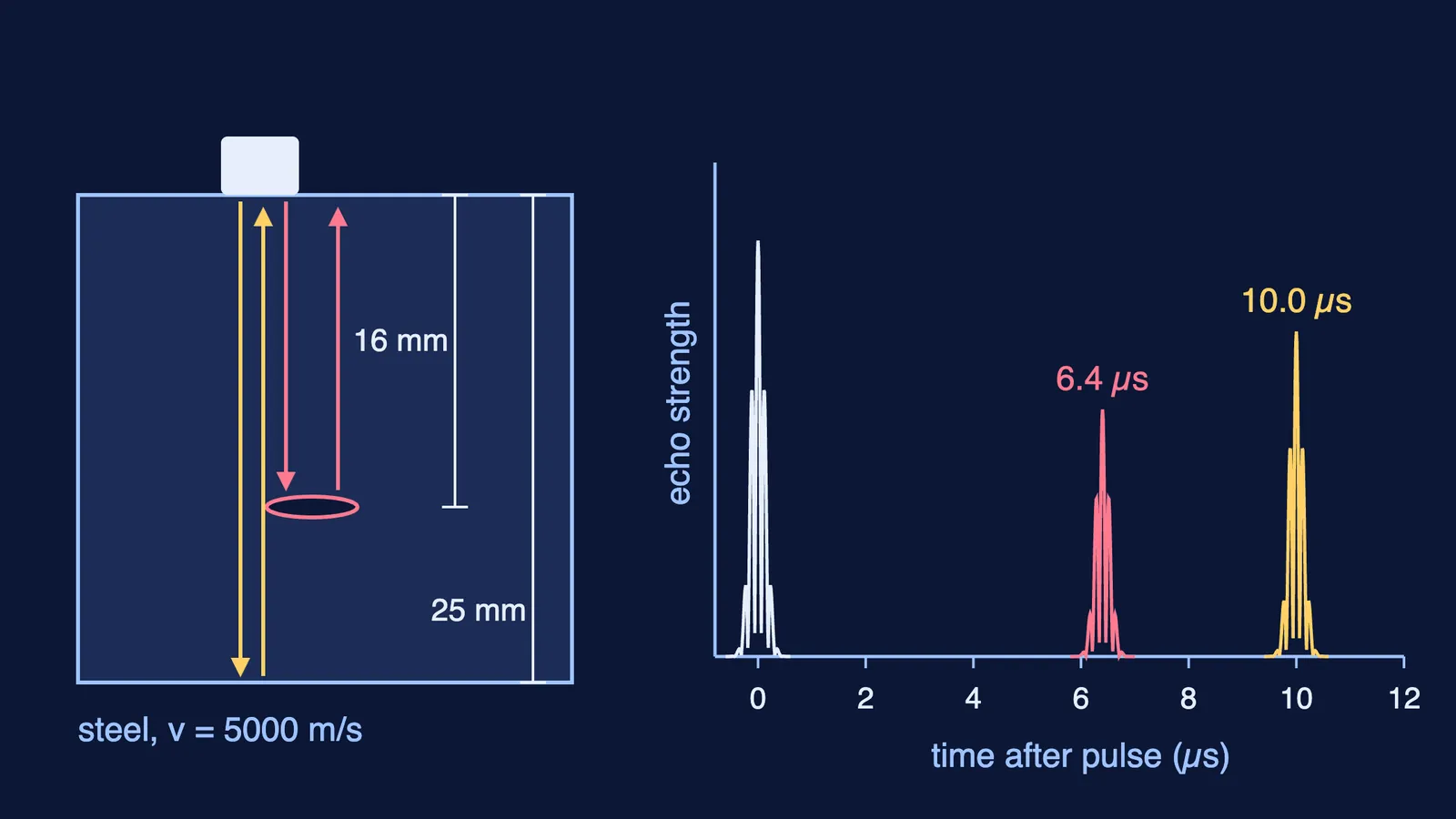
A Jamshedpur workshop tests steel plates for a bridge. An inspector's probe sends a short 4 MHz pulse straight down into the steel and records echoes. The echo from the plate's back face returns 10.0 µs after the pulse (1 µs = 0.000001 s). On one plate, a weaker echo also appears at 6.4 µs: something inside reflected part of the pulse early. Take the speed of sound in this steel as 5000 m/s.
(i) A 4 MHz sound wave is: (a) infrasonic (b) in the human audible range (c) ultrasonic (d) not a mechanical wave
(ii) Find the wavelength of the pulse in the steel.
(iii) How thick is the plate?
(iv) How deep is the flaw, and would the echo times change if the inspector switched to a 5 MHz probe?
Answers.
(i) (c). 4 MHz = 4,000,000 Hz, far above 20 kHz, so it is ultrasonic (and still a mechanical wave).
(ii) λ = v/ν = 5000 ÷ 4,000,000 = 0.00125 m = 1.25 mm.
(iii) Thickness = (5000 × 10.0 × 10⁻⁶) ÷ 2 = 0.025 m = 25 mm.
(iv) Depth = (5000 × 6.4 × 10⁻⁶) ÷ 2 = 0.016 m = 16 mm, so the flaw sits 9 mm above the back face. The echo times stay the same: speed depends on the medium, not the frequency. Only the wavelength changes, to 5000 ÷ 5,000,000 = 1 mm.
How do you attack case-study questions on sound?
List the given values and convert kHz, MHz and µs to Hz and s first.
Decide whether the question needs ν = 1/T, v = λν or distance = speed × time; many parts need two of them in a row.
In any echo, sonar or ultrasound part, halve the round trip.
For echo versus reverberation, compute the delay and compare it with 0.1 s and 0.05 s.
In "what travels" questions, the answer is the disturbance and its energy, never the particles of the medium.
For quick revision, see our Class 9 sound formulas sheet, and for exam technique read how to answer case-based questions. If compressions and rarefactions are hard to picture, the Fermi Simulation Lab has interactive simulations for ideas that are easier to see than to read.