On this page
Reproduction is Chapter 11, "Reproduction: How Life Continues", in the new NCERT Class 9 science book Exploration (2026), and the CBSE 2026-27 Class IX curriculum asks you to compare asexual and sexual reproduction, tell ovule from seed and ovary from fruit, and explain how sexual reproduction brings in variation. Below are three original practice cases, easiest first; try each part before reading the answers. If you need the chapter first, start with our Reproduction Class 9 chapter guide.
Case 1: How can one pomegranate plant give hundreds of copies?
Kavita, a nursery owner near Solapur, wants many copies of one pomegranate plant that gives large, sweet fruit. She cuts 250 stem pieces from it, each about 20 cm long, plants them in moist soil with compost and waters them daily. After four weeks, 205 of the 250 cuttings have formed roots and fresh leaves; the rest have dried up. Buyers have already ordered 1,000 rooted plants for next year. One buyer also wants a variety that is both sweet and resistant to a leaf disease.
(i) Growing new plants from stem pieces is an example of: (a) pollination (b) vegetative propagation (c) spore formation (d) fertilisation.
(ii) Which type of cell division builds the new roots and shoots of each cutting?
(iii) What percentage of cuttings rooted? At the same rate, how many cuttings must Kavita plant to get 1,000 rooted plants?
(iv) Can more cuttings from her sweet plant give the buyer a sweet and disease-resistant variety? Explain.
Answers.
(i) (b) vegetative propagation: new plants grow from a vegetative part of one parent.
(ii) Mitosis, which gives daughter cells with the same chromosomes as the parent cell, so every rooted cutting is a clone of the sweet plant.
(iii) 205 ÷ 250 × 100 = 82%. Cuttings needed = 1,000 ÷ 0.82 = 1,219.5, so she must plant at least 1,220.
(iv) No. Cuttings copy one parent exactly, so they cannot add a character the parent lacks. A new combination needs sexual reproduction: cross-pollinating the sweet plant with a disease-resistant one (artificial hybridisation) and then selecting offspring that carry both characters.
Case 2: How do bees change a mustard harvest?
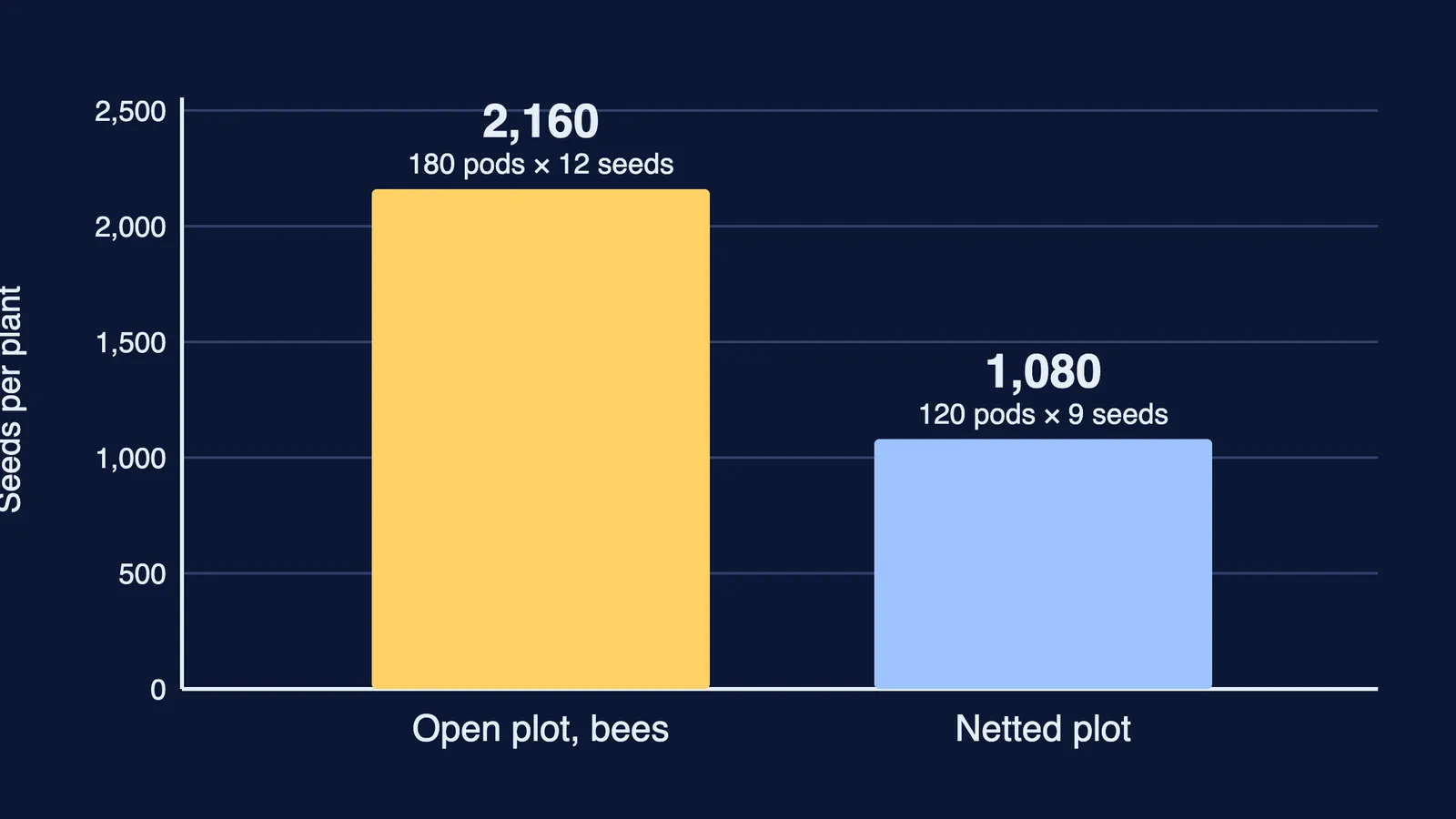
Meena grows mustard (sarson) on two equal plots in Rajasthan. Just before flowering she covers Plot B with fine nylon net that keeps out insects; Plot A stays open, with two bee boxes at its edge. At harvest she checks 20 plants from each plot. Open-plot plants carry an average of 180 pods with 12 seeds per pod; netted-plot plants carry 120 pods with 9 seeds per pod.
(i) In Plot A, the bees act as: (a) decomposers (b) pollinators (c) seed dispersers (d) parasites.
(ii) A mustard pod is a fruit. Which part of the flower became the pod, and which parts became the seeds inside it?
(iii) Find the average number of seeds per plant in each plot. By what percentage is the open plot's yield per plant higher?
(iv) Why did the netted plants still form some pods, and why did they form fewer?
Answers.
(i) (b) pollinators: they carry pollen from anthers to stigmas.
(ii) The ovary became the pod (fruit); the ovules, each with a fertilised egg, became the seeds.
(iii) Open: 180 × 12 = 2,160 seeds per plant. Netted: 120 × 9 = 1,080 seeds per plant. Increase = (2,160 − 1,080) ÷ 1,080 × 100 = 100%, so the open plot gives twice the seeds per plant.
(iv) The net stops insects, not pollen already inside a flower, so self-pollination still placed some pollen on stigmas, and those ovules were fertilised. Without bees, less pollen reached stigmas and little cross-pollination took place, so fewer flowers set pods and fewer ovules per pod became seeds.
Case 3: Why do gametes differ, and who decides sex?
In a school science club, Arjun models gamete formation with a made-up organism that has 4 pairs of chromosomes. Each pair has one card for the mother's chromosome and one for the father's, and he forms "gametes" by picking one card from every pair at random. After 40 picks he has found 14 different gametes. At home, an aunt says a couple with three daughters should "expect a son next" and blames the mother for having no boy.
(i) The cell division Arjun is modelling is: (a) mitosis (b) budding (c) meiosis (d) fertilisation.
(ii) How many cards does each of his "gametes" hold, and how many chromosomes does a human egg carry?
(iii) How many different gametes can his model make? How many can a human make from 23 pairs of chromosomes by this random sorting alone?
(iv) Use the chapter to answer the aunt on both points.
Answers.
(i) (c) meiosis, which halves the chromosome number to form gametes.
(ii) 4 cards, one from each pair. A human egg carries 23 chromosomes, half of the 46 in body cells.
(iii) Each pair offers 2 choices, so 2 × 2 × 2 × 2 = 2⁴ = 16; Arjun has 2 still to find. For humans, 2²³ = 8,388,608 combinations, which is why siblings differ from each other.
(iv) Every egg carries an X chromosome, so the mother cannot decide the sex. The father is XY, so meiosis puts X in half his sperm and Y in the other half; the sperm that fertilises the egg decides. Each pregnancy is a fresh event, so the chance of a boy is still about one in two, whatever happened before.
How do you answer case-study questions on reproduction?
Read the four sub-questions before the passage, so you know what to mark.
Name the process in chapter words first: vegetative propagation, pollination, fertilisation, meiosis. The right term is half the answer.
For plant cases, track one line: pollen to stigma, pollen tube, fusion with the egg, ovule to seed, ovary to fruit.
For numbers, write the formula, the substitution and a unit.
For "explain" parts, link the cause to the effect: one parent gives clones; two parents and meiosis give variation.
For revision, read Reproduction Class 9 key terms, explained simply and our sexual vs asexual reproduction table. If one idea such as meiosis still will not click, the Fermi Concept Library has every concept in biology, each with its own lesson.