On this page
The new NCERT science book for Class 9, *Exploration* (first edition, April 2026), is the textbook for the 2026-27 session, and its Chapter 11 is "Reproduction: How Life Continues". Here is what it teaches, three worked examples and the mistakes that cost marks. Facts come from the Chapter 11 PDF and the contents page.
How much is Chapter 11 worth in CBSE 2026-27?
In the CBSE Class IX Science curriculum for 2026-27, Unit I, World of Living, covers Chapters 2, 3, 11 and 12 and carries 27 of the 80 theory marks. Its learning outcomes ask you to compare asexual and sexual reproduction, tell an ovule from a seed and an ovary from a fruit, explain pollination and fertilisation, and explain how sexual reproduction creates variation. For the bigger picture, see where Class 9 marks matter and where they don't.
What is the difference between asexual and sexual reproduction?
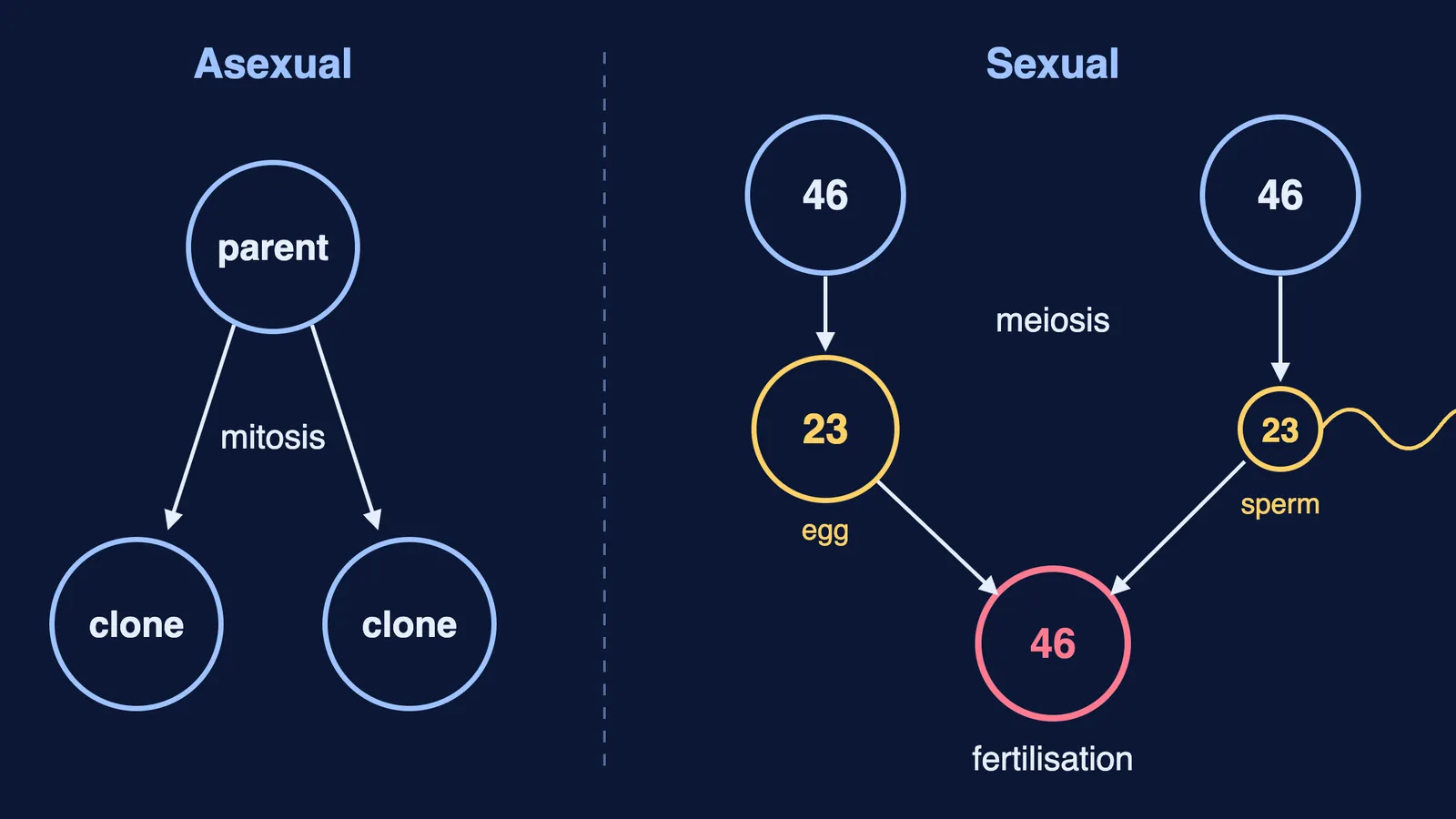
Asexual reproduction needs one parent, and the offspring are identical copies called clones. The reason is mitosis, a cell division that gives two daughter cells with the same chromosomes as the parent. The chapter's examples include budding in yeast and hydra, spore formation in bread mould, and vegetative propagation in potato, ginger, sugarcane and Bryophyllum. Farmers use it through cutting, grafting, layering and tissue culture.
Sexual reproduction needs two parents. Each parent makes gametes by meiosis, which halves the chromosome number. The gametes join in a new mix, so children differ from their parents and each other, and that variation helps a species cope with change. For a side-by-side list, see sexual vs asexual reproduction differences.
How do pollination and fertilisation turn a flower into a seed?
A complete flower has sepals, petals, stamens and a pistil. The anther of the stamen makes pollen; the pistil has a stigma, a style and an ovary holding ovules, each with an egg cell. Pollination is the transfer of pollen from an anther to a stigma. It is self-pollination if the pollen lands on the same flower or another flower of the same plant, and cross-pollination if it comes from a different plant of the same kind. Wind carries pollen for wheat and maize, water for Vallisneria, insects for sunflower and birds such as sunbirds for the coral tree.
Fertilisation comes next: a pollen tube grows down the style, a male gamete travels through it and fuses with the egg, and the zygote grows into an embryo. The ovule becomes the seed and the ovary becomes the fruit. For what happens inside a pollen grain, see vegetative vs generative cells in pollen.
What does the chapter teach about human reproduction?
Per the chapter, testes make sperm in the scrotum, which keeps them slightly cooler than the body, and ovaries make eggs. Human body cells have 46 chromosomes and gametes have 23. The zygote forms in the oviduct and divides on its way to the uterus, then implants in the thickened lining. If the egg is not fertilised, the lining is shed as menstruation, which usually lasts 3 to 7 days. The cycle typically repeats every 21 to 35 days, often around 28. Pregnancy lasts about nine months in three trimesters. The chapter also covers menstrual hygiene, contraception, infections and India's legal ban on prenatal sex determination. For questions about your own health, talk to a parent, a doctor or your school nurse.
Worked examples: counting chromosomes and pollen
1. The chromosome count. A body cell has 46; meiosis gives sperm and eggs 23 each. Fertilisation gives a zygote 23 + 23 = 46, and mitosis keeps every later cell at 46. Without the halving, the count would go 92, then 184; meiosis prevents that doubling.
2. Why siblings differ. The chapter's bead activity uses 3 pairs, giving 2 × 2 × 2 = 8 combinations. With 23 pairs, the same rule gives 2 multiplied by itself 23 times: 8,388,608 kinds of gamete from chromosome sorting alone.
3. Pollen per seed. Using Table 11.3 in the chapter, a wind-pollinated grass such as maize releases 5,00,000 to 10,00,000 pollen grains per flower for 50 to 200 seeds: at least 2,500 grains per seed. An insect-pollinated plant such as sunflower releases 20,000 to 40,000 grains for 800 to 1,000 seeds: about 20 to 50 grains per seed. Wind wastes most pollen, so wind-pollinated plants make so much.
Which mistakes cost marks, and how should you revise?
Mixing up pollination (pollen reaches the stigma) with fertilisation (gametes fuse).
Swapping the pairs: the ovule becomes the seed, the ovary becomes the fruit.
Forgetting that pollen from another flower on the same plant is still self-pollination.
Saying gametes form by mitosis; they form by meiosis.
Treating day 14 as a fixed rule for ovulation; it belongs to the typical 28-day cycle, and the chapter gives 21 to 35 days.
To revise, label a flower and pistil, write the pollen-to-fruit path as a flowchart, sketch both human systems and a 28-day timeline, then explain the chromosome count aloud without notes. If one idea keeps slipping, such as mitosis versus meiosis, the Fermi Concept Library covers every concept in biology, each with its own lesson, so you can fill that gap before moving on.