On this page
Remember one line: the vegetative cell builds the road, and the generative cell makes the travellers. Here is what each cell looks like, why some pollen is shed with two cells and some with three, and a diagram to copy.
What are the vegetative and generative cells in a pollen grain?
A pollen grain is the male gametophyte of a flowering plant, and a mature grain contains two cells, the vegetative cell and the generative cell, according to the NCERT Class 12 Biology chapter on sexual reproduction in flowering plants. Each grain develops from a microspore, which the same chapter says forms by meiosis, so both cells are haploid.
NCERT describes them like this:
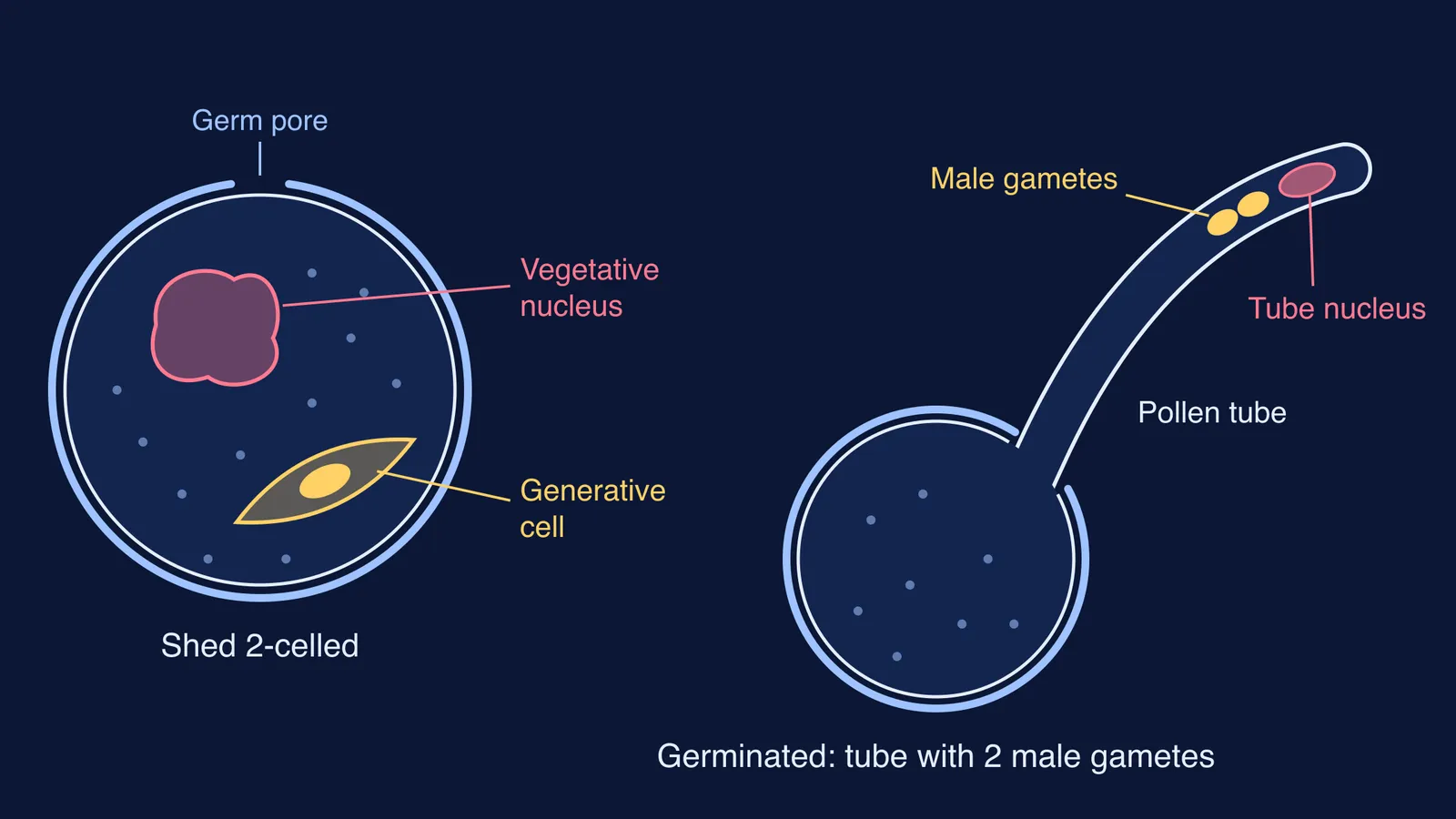
Vegetative cell: bigger, with abundant food reserve and a large, irregularly shaped nucleus.
Generative cell: small and spindle shaped, with dense cytoplasm and a nucleus; it floats in the cytoplasm of the vegetative cell.
So the generative cell sits inside the vegetative cell, not beside it. A review by Borg, Brownfield and Twell in the Journal of Experimental Botany (2009) describes how this happens: an unequal division called pollen mitosis I produces a small germ cell, which is then engulfed within the cytoplasm of the larger vegetative cell.
Which cell forms the pollen tube and which forms the male gametes?
The vegetative cell forms the pollen tube, and the generative cell divides into the two male gametes. The same Journal of Experimental Botany review says the vegetative cell nurtures the germ cell and gives rise to the pollen tube after pollination, while the germ cell goes through a second division, pollen mitosis II, to make twin sperm cells.
On a compatible stigma, the grain germinates and the tube comes out through one of the germ pores, then grows through the stigma and style to the ovary and enters the ovule through the micropyle (NCERT, Chapter 1). NCERT's Figure 1.12 shows the vegetative nucleus and both male gametes inside the tube as it enters a synergid. For how the tube finds its way, read our explainer on chemotropism and pollen tube growth.
What is the difference between 2-celled and 3-celled pollen?
It comes down to when the generative cell divides. Both facts below are from NCERT's chapter:
2-celled pollen: shed with one vegetative cell and one generative cell. NCERT says pollen is shed at this stage in over 60 per cent of angiosperms. The generative cell divides into the two male gametes later, as the tube grows in the stigma.
3-celled pollen: the generative cell divides by mitosis before shedding, so the tube carries the two male gametes from the beginning.
A larger dataset points the same way. In a 2014 study in the American Journal of Botany covering 2,511 species, Williams, Taylor and O'Meara found that 70 per cent had bicellular (2-celled) pollen. The 2009 review gives one example of each: Arabidopsis thaliana sheds 3-celled pollen, and Lilium longiflorum sheds 2-celled pollen.
For your exam, quote NCERT's "over 60 per cent". Either way, the tube delivers two male gametes: one goes into the egg and the other into the central cell. We go deeper in 2-celled vs 3-celled pollen and in how microsporogenesis makes a pollen grain.
How do you draw a labelled pollen grain diagram?
Six steps, following NCERT's description and its Figure 1.5:
Draw a large circle and a second circle just inside it. Label the outer line exine (made of sporopollenin) and the inner line intine (cellulose and pectin).
Leave a gap in the outer line only. Label it germ pore, where sporopollenin is absent.
Draw a big, irregular blob in the upper half. Label it vegetative nucleus.
Draw a small lens-shaped spindle in the lower half with a dot inside. Label it generative cell. Keep it well inside the grain.
Add a few dots in the cytoplasm to show the food reserve of the vegetative cell.
Write "2-celled stage" underneath. For a 3-celled grain, replace the spindle with two small male gametes.
Can you answer these five questions?
Which cell has the large, irregular nucleus? (Vegetative.)
Which cell divides to give two male gametes, and by what division? (Generative, by mitosis.)
In 2-celled pollen, where does that division happen? (In the pollen tube, as it grows in the stigma.)
What does a 3-celled grain contain? (One vegetative cell and two male gametes.)
What is the ploidy of both cells? (Haploid.)
If one of these keeps catching you, the Fermi Concept Library has every concept in biology, each with its own lesson and its place in the map, so you can see where pollen sits on the way to fertilisation. And if drawing is the hard part, Fermi's AI tutor can draw the figure with you and check your understanding as it goes.
Draw the grain once from memory tonight, then check it against the six steps above.