

On this page
Understanding how angiosperms (flowering plants) shed pollen is a key part of botany and a frequent topic in biology exams like NEET-UG. When the anther matures and bursts, the pollen grains it releases are not all at the same stage of development. The timing of one crucial cell division decides whether the pollen lands on the stigma with two cells or three.
What is the 2-celled stage of pollen shed?
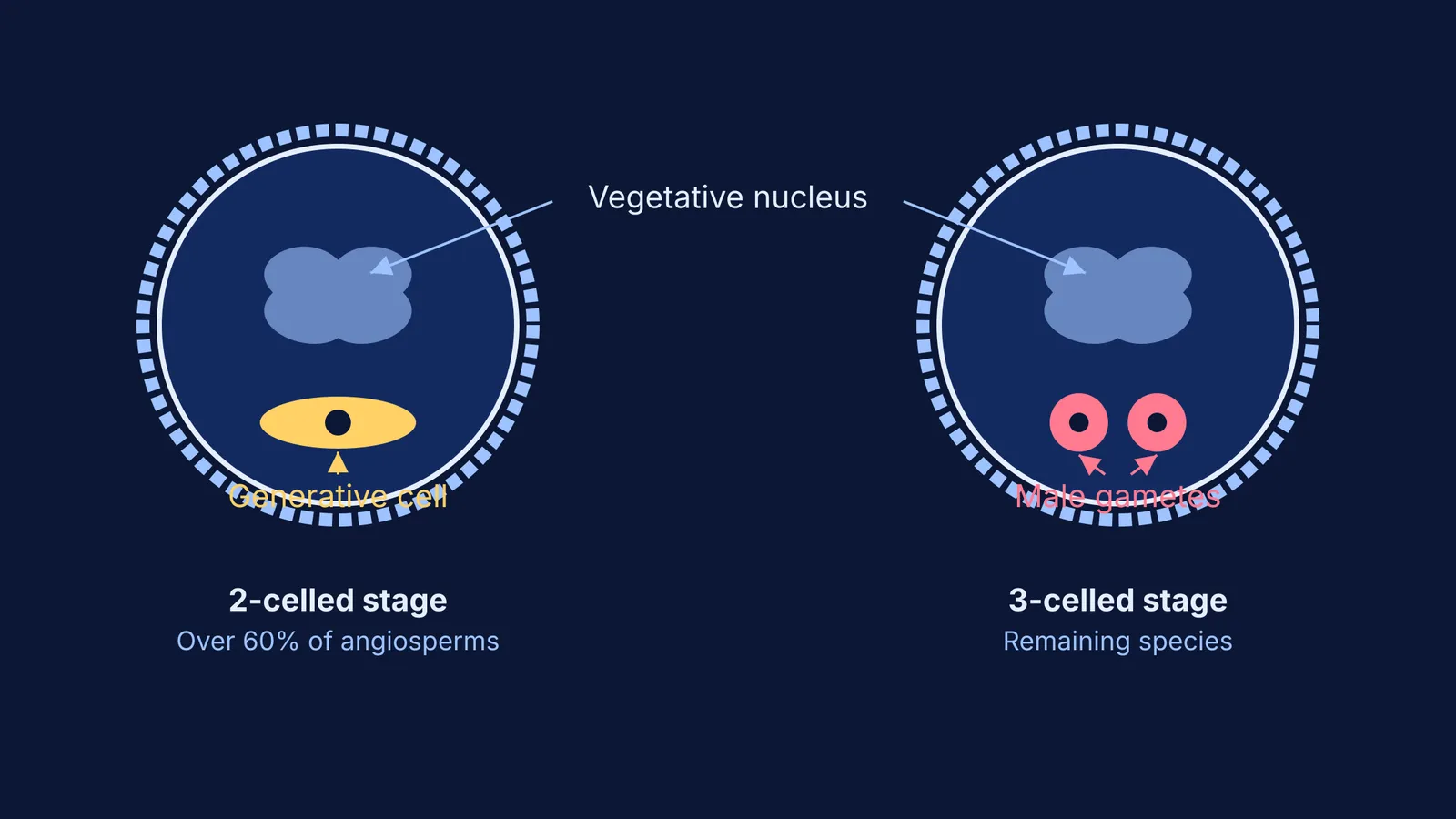
A mature pollen grain is essentially a male gametophyte. In over 60% of angiosperms, pollen grains are shed at this 2-celled stage (NCERT).
At this stage, the pollen grain contains exactly two cells with distinct roles:
The vegetative cell: This is the larger of the two and is not directly involved in fusion. Instead, it acts as the life support and transport system for the male gametes. It contains abundant food reserves and a large, irregularly shaped nucleus that directs the growth of the pollen tube.
The generative cell: This cell is entirely focused on reproduction. It is a smaller, spindle-shaped cell that floats within the cytoplasm of the vegetative cell. It has dense cytoplasm and a prominent nucleus.
When pollen is shed at the 2-celled stage, the generative cell has not yet completed its final division. It only divides into two male gametes later, as the pollen tube grows through the tissues of the stigma and style. This journey is the final step in microsporogenesis and the structure of a pollen grain.
What is the 3-celled stage?
In the remaining species, the developmental timing shifts forward. In these species, the generative cell divides mitotically to form two male gametes before the pollen is shed (NCERT).
This means the pollen grain is released at the 3-celled stage. It consists of:
One vegetative cell.
Two male gametes (sperm cells).
Because the two male gametes are already formed before the pollen even leaves the anther, these pollen grains are "ready to go". Once they land on the stigma, the vegetative cell forms a tube, and the two male gametes simply travel down it. This pre-packaged state is essential for the later process of double fertilisation, which was first described in detail by Sergei Nawaschin and the two sperm cells of the lily. The female counterpart to this male preparation is megasporogenesis and how the 7-celled, 8-nucleate embryo sac forms.
Why do some plants shed at 3 cells?
The 3-celled stage is generally considered an evolutionarily derived trait. A broad phylogenetic study found that tricellular lineages make up about 30% of angiosperm species, and this trait has evolved independently multiple times (Williams et al., 2014).
Major crops like wheat, rice, and maize (all members of the grass family, Poaceae) shed pollen at the 3-celled stage. Tricellular pollen often germinates rapidly on the stigma, which is a strong advantage for plants that need to complete their reproductive cycle quickly. However, the same study showed that bicellular (2-celled) lineages have a 1.8-fold higher diversification rate than tricellular lineages, which explains why the 2-celled state remains the most common strategy across the plant kingdom (Williams et al., 2014).
How can you track the generative cell for exams?
If you are preparing for biology exams, the difference between these two stages is a classic test question. The core confusion usually revolves around *where* the generative cell divides.
Here is a practical checklist to ensure you do not mix them up during a test:
Count the cells: 2-celled means 1 vegetative + 1 generative. 3-celled means 1 vegetative + 2 male gametes.
Identify the percentage: If a question asks for the majority, remember that over 60% of angiosperms use the 2-celled stage (NCERT).
Locate the male gametes: If the pollen is 2-celled when shed, there are no male gametes yet—they form later. If it is 3-celled, the male gametes are already present.
Watch the terminology: Many students lose marks by assuming that 2-celled pollen contains one vegetative cell and one male gamete. This is incorrect. The generative cell is the precursor to the male gametes, not a gamete itself.
If you find yourself struggling to visualise how these cells divide and travel, the Fermi Concept Library can help you map out the entire process of plant reproduction step by step. Rather than just memorising the percentages, you can explore the underlying biology and see exactly how the pollen tube delivers its payload to the ovary. Furthermore, when you encounter complex multiple-choice questions on these topics, the Fermi Problem Library has worked problems with a step-by-step solver that explains the reasoning rather than just printing an answer.


