On this page
Chapter 11 of the new NCERT Class 9 science book *Exploration* (first edition, April 2026) is "Reproduction: How Life Continues". Here are its key terms by topic, in our own words, checked against the Chapter 11 PDF. For the full chapter walkthrough, read our guide to Reproduction for Class 9.
What are asexual and sexual reproduction?
Reproduction: the process by which living things make new individuals of their own kind, so life carries on. Example: a mango tree dies, but its seeds grow into new mango plants.
Asexual reproduction: one parent makes offspring that are genetically identical copies of it, called clones. Example: yeast, hydra, bread mould, potato.
Sexual reproduction: two parents each give genetic material to the offspring, so the young are a mix of both. Example: flowering plants, frogs, humans.
Variation: small differences between parents, offspring and siblings, created by sexual reproduction. It helps some individuals cope when the environment changes.
What are the methods of asexual reproduction?
Vegetative propagation: a new plant grows from a stem, root or leaf instead of a seed. Example: potato, ginger, plantlets on a Bryophyllum leaf. Cuttings (stem pieces planted in soil) use the same idea.
Grafting: a stem piece from one plant is fitted into a slit on a rooted plant so the two grow as one. Example: a yellow rose stem grafted onto a wild rose.
Layering: a flexible twig is bent and buried while still attached to the parent; once it roots, it is cut free. Example: lemon.
Tissue culture: many plantlets are grown from a small piece of a plant, such as the shoot tip, in a lab. Example: healthy banana plantlets for farmers.
Budding: a small outgrowth (bud) forms on the parent, grows and separates to live on its own. Example: hydra, yeast.
Spore: a tiny, light, usually single-celled unit that drifts in air and grows into a new individual where it finds moisture and food. Example: spores in the round sac at the tip of bread mould (Rhizopus) threads (hyphae).
How do mitosis and meiosis differ?
Chromosome: a thread-like structure in the nucleus that carries genetic information. Human body cells have 46, in 23 pairs.
Mitosis: cell division that makes two daughter cells with the same chromosomes as the parent cell. It is behind asexual reproduction.
Meiosis: cell division that halves the chromosome number and makes gametes. Don't confuse with: mitosis, which keeps the number the same.
Diploid and haploid: a diploid cell has the full set of chromosome pairs; a haploid cell has one chromosome from each pair. Example: a human skin cell (46) is diploid; a sperm (23) is haploid.
Gamete: a reproductive cell with half the usual chromosome number, made by meiosis. Example: sperm and egg in animals; in plants, the pollen grain carries the male gametes and each ovule holds an egg cell.
What happens between pollination and fertilisation in a flower?
Stamen: the male part of the flower, a filament topped by an anther that makes pollen grains.
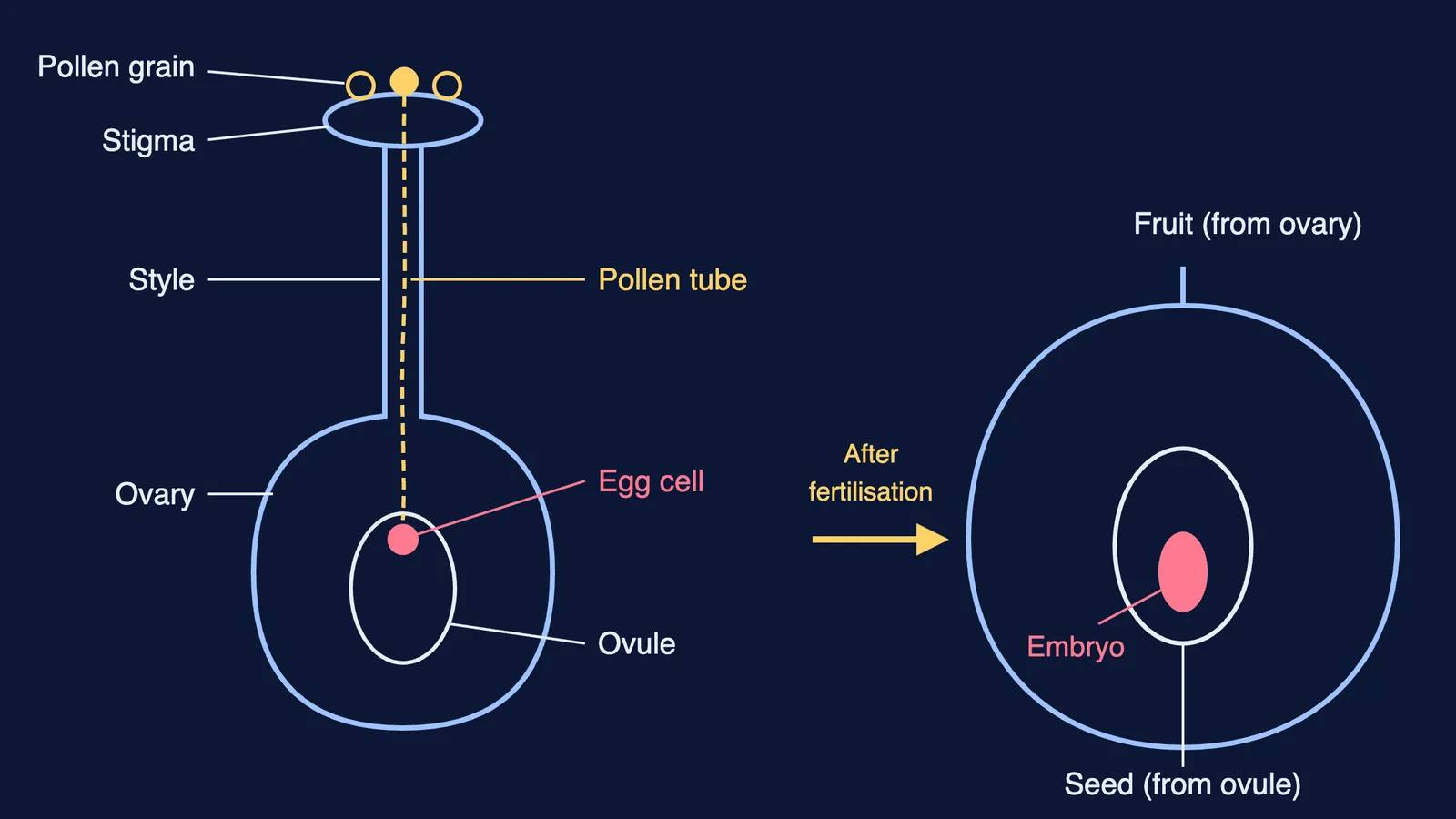
Pistil: the female part, made of the stigma (the tip that receives pollen), the style (the tube) and the ovary (the swollen base).
Ovule: a structure inside the ovary that holds an egg cell. Don't confuse with: ovary, the part that holds the ovules.
Pollination: the transfer of pollen from an anther to a stigma.
Self-pollination: pollen reaches the stigma of the same flower or another flower on the same plant. Don't confuse with: cross-pollination, where pollen comes from a different plant of the same kind.
Pollinator: the agent that carries pollen. Example: wind for wheat and maize, water for Vallisneria, bees for sunflower, sunbirds for the coral tree. If you want to go further, our NEET-level guide to adaptations of wind- and water-pollinated flowers goes beyond this chapter.
Pollen tube: a tube that grows from a pollen grain down the style, carrying the male gamete to the ovule.
Fertilisation: the fusion of a male and a female gamete. Don't confuse with: pollination, which only moves pollen and comes first.
Zygote and embryo: the zygote is the fertilised egg; it divides and develops into an embryo.
Seed and fruit: after fertilisation the ovule becomes the seed and the ovary becomes the fruit.
Seed dispersal: the spreading of seeds away from the parent plant by wind, water or animals. Example: the light, hairy seeds of madar (calotropis) and dandelion drift on the wind.
How does reproduction work in animals and humans?
These terms come from sections 11.3 to 11.5 of the chapter.
External and internal fertilisation: external happens outside the body in water (frogs, most fish); internal happens inside the female (reptiles, birds, mammals).
Testes and scrotum: the testes make sperm and a hormone; the scrotum holds them slightly cooler than the body.
Oviduct (fallopian tube): the tube joining each ovary to the uterus, where fertilisation usually happens.
Uterus and cervix: the uterus is the bag-like organ where the foetus (the developing baby from about the ninth week) grows; the cervix is its narrow opening into the vagina.
Gametogenesis: making gametes by meiosis in the testes and ovaries.
Ovulation: the release of a mature egg from an ovary, usually once a month after puberty.
Implantation: the zygote divides by mitosis as it travels to the uterus, then embeds in the thick inner lining, where it is nourished; this marks the start of pregnancy.
Menstruation: if no egg is fertilised, the lining is shed with some blood, usually over 3 to 7 days.
Contraception: methods that prevent pregnancy, such as condoms, oral pills and the Copper-T (an intra-uterine device). Condoms also reduce the spread of sexually transmitted infections (STIs).
For questions about your own health, talk to a parent, doctor or school nurse.
How to learn these terms
Learn the pairs together: mitosis and meiosis, pollination and fertilisation, ovule and ovary, self- and cross-pollination.
Draw and label the pistil from memory, then draw the fruit and mark what each part becomes.
Count chromosomes at each step: body cell 46, gamete 23, zygote 46.
If one term still will not stick, open it in the Fermi Concept Library, where every biology concept has its own lesson.