On this page
What do these Ray Optics case studies cover?
The CBSE 2026-27 Physics sample paper has two case study-based questions of four marks each in Section D, and calculators are not allowed, so every number here works by hand.
The cases stay inside the Ray Optics and Optical Instruments list in the CBSE 2026-27 Class 12 Physics syllabus. Facts were checked against NCERT Class 12 Physics Part II, Chapter 9, Ray Optics and Optical Instruments (Reprint 2026-27). For the full chapter plan, read our Ray Optics Class 12 board exam guide.
Case 1: How big does a shop's security mirror show you?
A jewellery shop in Jaipur has a convex security mirror in one corner, with a radius of curvature of 60 cm. A customer 150 cm tall stands 120 cm in front of it. Later she walks to 30 cm from it. The shopkeeper claims that if she comes close enough, her image will become taller than she is. Use the Cartesian sign convention.
(i) The image formed by a convex mirror of a real object is always: (a) real, inverted, diminished (b) virtual, erect, diminished (c) virtual, erect, enlarged (d) real, erect, same size
(ii) What is the focal length of the mirror, with its sign?
(iii) Find the position and height of her image when she is 120 cm away.
(iv) Find the image height at 30 cm, and say whether the shopkeeper is right.
Answers.
(i) (b) virtual, erect, diminished.
(ii) f = R/2 = +30 cm.
(iii) 1/v = 1/f − 1/u = 1/30 + 1/120 = 5/120, so v = +24 cm (behind the mirror). m = −v/u = −24/(−120) = +0.2, so the image is 0.2 × 150 = 30 cm tall and erect.
(iv) 1/v = 1/30 + 1/30, so v = +15 cm and m = 0.5: the image is 75 cm tall. The shopkeeper is wrong: m = 30/(30 + |u|) is always less than 1, so the image grows but stays smaller than her.
Case 2: Why does a prism periscope need total internal reflection?
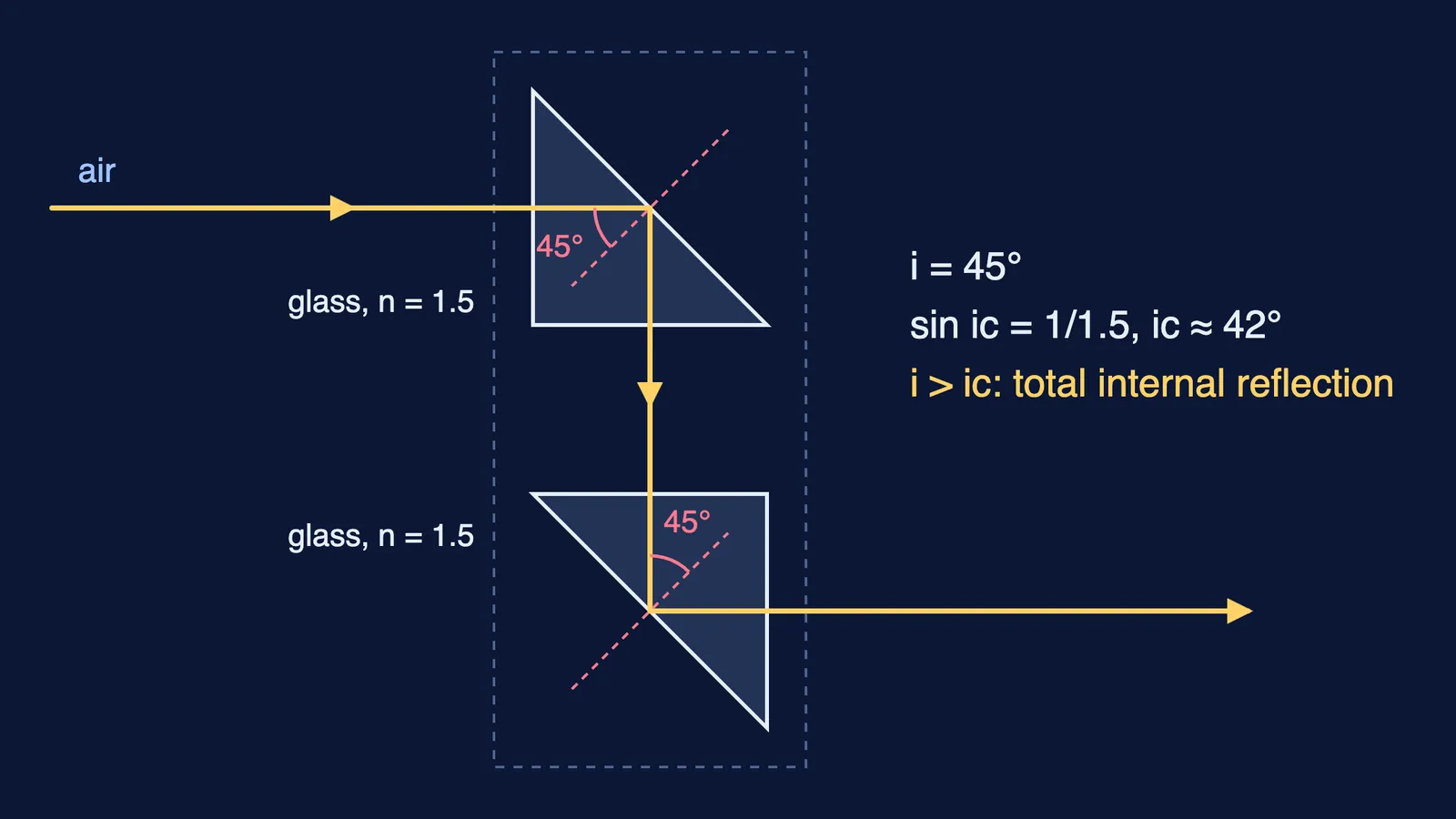
For a science fair in Bhopal, Kabir builds a periscope from two right-angled isosceles glass prisms (angles 90°, 45°, 45°) of refractive index 1.5. Light enters each prism normal to one short face, strikes the slanted face and turns through 90°. Take sin 42° ≈ 0.67 and sin 45° ≈ 0.71. He then rests the slanted face of a spare prism on water (refractive index 4/3) in a tray and sends light in the same way.
(i) Total internal reflection can happen only when light travels: (a) from a rarer to a denser medium (b) from a denser to a rarer medium at an angle greater than the critical angle (c) along the normal (d) through any two media at any angle
(ii) Find the critical angle for the glass-air surface.
(iii) What is the angle of incidence on the slanted face? What value must the refractive index of the prism glass exceed for the periscope to work in air?
(iv) Explain, with numbers, why the face resting on water no longer totally reflects the light.
Answers.
(i) (b).
(ii) sin ic = 1/n = 1/1.5 = 2/3 ≈ 0.67, so ic ≈ 42°.
(iii) The ray enters along the normal, so it is not bent, and it meets the slanted face at 45°. As 45° > 42°, it is totally reflected. For any glass, the condition is sin 45° > 1/n, so n > 1/sin 45° = √2 ≈ 1.41.
(iv) Now the second medium is water: sin ic = (4/3)/1.5 = 8/9 ≈ 0.89. This is greater than sin 45° ≈ 0.71, so ic > 45° (about 63°). The angle of incidence is still 45°, less than ic, so total internal reflection fails and much of the light refracts into the water.
Case 3: Can a school club build its own telescope?
An astronomy club in Pune builds a refracting telescope from two thin convex lenses with powers +1.25 D and +20 D. They view a distant water tank in normal adjustment (final image at infinity). The weaker lens is equiconvex, made of glass of refractive index 1.5. Later they want more magnification, so they replace the eyepiece with two spare thin lenses of +20 D and +30 D placed in contact.
(i) Which lens should be the objective? (a) the +20 D lens, as it bends light more (b) the +1.25 D lens, as it has the longer focal length (c) either, since the magnification is the same (d) neither, a telescope needs a concave objective
(ii) Find the magnifying power and the length of the tube.
(iii) Find the radius of curvature of each face of the objective.
(iv) Find the new magnifying power and the new tube length with the combined eyepiece.
Answers.
(i) (b). The objective of a telescope has a large focal length, and m = fo/fe.
(ii) fo = 1/1.25 m = 80 cm and fe = 1/20 m = 5 cm. So m = fo/fe = 80/5 = 16, and the tube length is fo + fe = 85 cm. The image is inverted.
(iii) Lens maker's formula with R1 = +R and R2 = −R: 1/f = (1.5 − 1)(1/R + 1/R) = 1/R. So R = f = 80 cm.
(iv) Powers in contact add: P = 20 + 30 = +50 D, so fe = 1/50 m = 2 cm. Then m = 80/2 = 40, and the tube shortens to 80 + 2 = 82 cm.
How to attack case-study questions
Signs first. Write u, v, f and R with signs before substituting.
Convert dioptres at once. f in metres is 1/P, so +20 D means 5 cm.
Name the two media for total internal reflection. The critical angle changes when air becomes water, as in Case 2 (iv).
Use ratios when one thing changes. In Case 3 (iv), only fe changes, so m scales as 1/fe.
If ray paths are hard to picture, the Fermi Simulation Lab has interactive simulations for the ideas that are easier to see than to read. For more practice in this format, try our Wave Optics case study questions, and read how to handle case-based questions in board exams.