On this page
Here are three original practice cases for Chapter 3, Plant Kingdom, in CBSE Class 11 Biology. Every answer matches the rationalised NCERT Class 11 Biology Chapter 3 text (Reprint 2026-27), and the chapter sits in Unit I of the CBSE 2026-27 Class XI Biology syllabus. Class 11 papers are set by schools, so treat these as case-based practice, not a paper forecast. Revise the chapter first with our Plant Kingdom Class 11 guide to the five plant groups.
Case 1: Which seaweed made the swimming cells?
A Madurai biology club visits a seaweed drying yard on the Tamil Nadu coast. One mat holds red, branched Gracilaria, sold to a factory that extracts a jelly-like product; another holds olive-brown Sargassum. The owner says 250 kg of freshly harvested Gracilaria dries down to 30 kg on the mats. Back at school, a student reports pear-shaped swimming cells with two unequal, side-attached flagella in a seaweed sample.
(i) The red colour of Gracilaria is due to: (a) fucoxanthin (b) r-phycoerythrin (c) chlorophyll b (d) carotene.
(ii) Name the commercial product obtained from Gracilaria that is used to grow microbes.
(iii) What percentage of the fresh weight of Gracilaria is lost as water on drying?
(iv) Could the swimming cells have come from Gracilaria? Give a reason.
Answers.
(i) (b) r-phycoerythrin, the predominant pigment of red algae.
(ii) Agar, also obtained from Gelidium.
(iii) Water lost = 250 − 30 = 220 kg. Percentage = 220 ÷ 250 × 100 = 88%.
(iv) No. Red algae have no flagella; their spores and gametes are non-motile. Pear-shaped swimming cells with two unequal, laterally attached flagella mark brown algae, the group that includes Sargassum.
Case 2: Why did the moss wall stop making capsules?
After the monsoon, a shaded school wall in Shillong turns green with a mat of tiny leafy moss shoots, some topped by a thin brown stalk and capsule. Weeks into the dry season, no new capsules appear. A small fern grows in a crack nearby. Ria, a Class 11 student, is told the leafy moss cells have 12 chromosomes.
(i) The leafy green shoots on the wall are: (a) the diploid sporophyte (b) the haploid gametophyte (c) the protonema (d) a prothallus.
(ii) How does the brown stalk with its capsule get its food?
(iii) How many chromosomes would Ria expect in a cell of the capsule wall, and in a spore released from the capsule?
(iv) Why do both the moss and the fern need damp places? State one way the fern's main plant body differs from the moss's.
Answers.
(i) (b). The main bryophyte body is haploid and produces gametes.
(ii) The stalk and capsule are the sporophyte, which stays attached to the photosynthetic gametophyte and derives nourishment from it.
(iii) Gametophyte cells have n = 12, so the zygote and the sporophyte built from it have 2n = 24. A capsule wall cell has 24. Spores form by meiosis, so a spore has 12.
(iv) In both, antherozoids need water to reach the archegonium, so capsules stop forming once the wall dries; the fern's prothallus also needs cool, damp, shady places. The fern's main body is a diploid sporophyte with true roots, stem and leaves carrying xylem and phloem.
Case 3: Why is Salvinia not a gymnosperm?
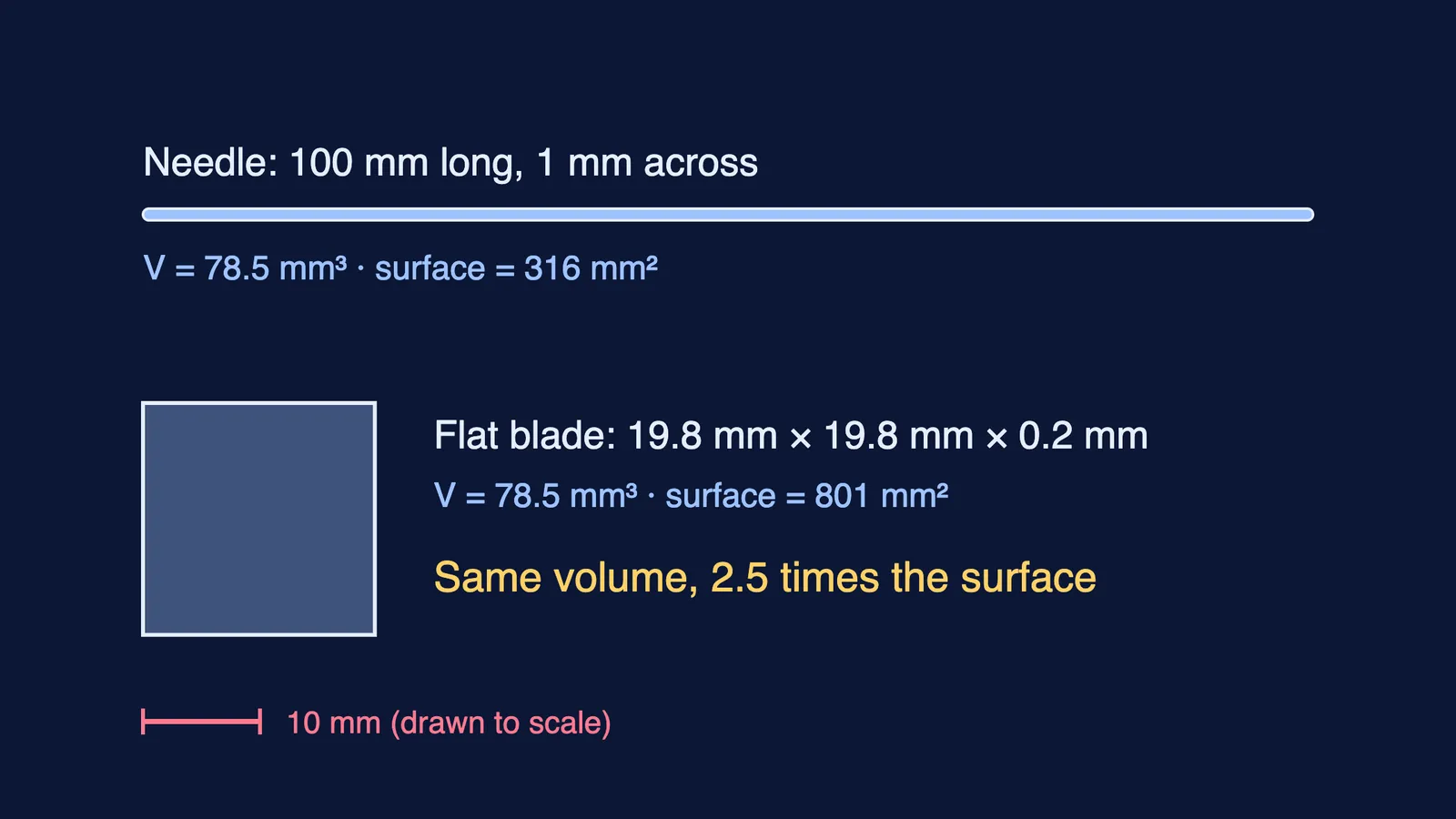
A Shimla nursery grows Pinus, a potted Cycas and Salvinia in a pond. One pine tree carries both male and female cones; a repotted Cycas shows small specialised roots near the surface. A female pine cone has 60 ovules. The class models a pine needle as a cylinder 100 mm long and 1 mm across, and compares it with a flat square blade 0.2 mm thick holding the same volume.
(i) The small specialised roots of Cycas are associated with: (a) mycorrhizal fungi (b) N2-fixing cyanobacteria (c) Rhizobium (d) red algae.
(ii) With one megaspore mother cell per ovule, how many megaspores form in this cone, and how many female gametophytes develop?
(iii) Compare the surface area of the needle and a square blade of equal volume. What does it suggest?
(iv) A student argues that Salvinia should be grouped with the pine because both make two kinds of spores. Evaluate this argument.
Answers.
(i) (b). These coralloid roots of Cycas are associated with N2-fixing cyanobacteria; Pinus roots instead form mycorrhiza with fungi.
(ii) Meiosis gives 4 megaspores per mother cell: 60 × 4 = 240. One megaspore per ovule develops into a female gametophyte: 60.
(iii) Needle: volume = π × 0.5² × 100 = 78.5 mm³; surface = 2π × 0.5 × 100 + 2π × 0.5² = 315.7 mm². Blade: area of each face = 78.5 ÷ 0.2 = 392.7 mm², a square of side 19.8 mm; surface = 2 × 392.7 + 4 × 19.8 × 0.2 = 801.2 mm². The blade has about 2.5 times the surface, so needle-like leaves cut the surface that loses water; thick cuticle and sunken stomata help too.
(iv) Wrong. Salvinia is a heterosporous pteridophyte: its male gametes still need water to reach the archegonium, and it makes no seeds. In the pine, the female gametophyte stays inside the ovule on the sporophyte, air-borne pollen sends a pollen tube to the archegonia, and the ovules become naked seeds.
How to attack case-study questions on Plant Kingdom?
Underline every colour, pigment, flagella pattern, root type or cone arrangement in the passage; in this chapter those clues decide the group.
For ploidy, label the main body first: gametophyte (n) in bryophytes, sporophyte (2n) in pteridophytes and seed plants. Meiosis makes spores.
Learn the algae as a grid of pigment, stored food, cell wall and flagella.
For "evaluate the claim" parts, give the verdict first, then two features that settle it.
Show every numerical step with units. Our post on how to read and answer case-based questions covers the general method, and the Biological Classification Class 11 guide shows where cyanobacteria and fungi sit in the five-kingdom system.
If heterospory or protonema still feels shaky, the Fermi Concept Library has a lesson for every concept in biology, each with its place in the map.