On this page
What do these Patterns in Life case studies cover?
Chapter 12 of the new NCERT Class 9 science book Exploration, Patterns in Life: Diversity and Classification, sorts life into five kingdoms using four criteria: cell type, cell wall, number of cells and mode of nutrition. The CBSE Class IX Science curriculum for 2026-27 lists five kingdoms, the major divisions of plants and animals, and binomial nomenclature among the key concepts of its Diversity unit.
These three cases are practice in the case-based style; the scenarios and numbers are ours, the facts are the chapter's. For the theory, read our Patterns in Life class 9 chapter guide.
Case 1: A mushroom shed in Odisha
A women's self-help group near Cuttack starts growing oyster mushrooms in a dark, damp shed. They fill 12 bags, each with 2 kg of soaked paddy straw mixed with mushroom spawn, and keep them away from sunlight. In three weeks, white threads spread through the straw. Two bags turn mouldy and are thrown away; the other 10 bags give 9.6 kg of fresh mushrooms. Used straw goes to the village biogas plant, which runs on cattle dung.
(i) In which kingdom is the oyster mushroom placed? (a) Plantae (b) Fungi (c) Protista (d) Monera
(ii) What are the white threads, and what is their network called?
(iii) Wheat cannot grow in this dark shed, but mushrooms can. Why?
(iv) Find the average yield per healthy bag and per kg of straw in the healthy bags. Then name the kingdom of the microbes that make biogas from dung, and give one way their cells differ from mushroom cells.
Answers.
(i) (b) Fungi: eukaryotes with a cell wall made of chitin that do not make their own food.
(ii) Fine nutrient-absorbing filaments; together they form the mycelium.
(iii) Mushrooms are heterotrophic saprophytes. They absorb nutrients from dead matter like straw, so they need no light for photosynthesis.
(iv) 9.6 kg ÷ 10 bags = 0.96 kg per bag; 9.6 kg ÷ 20 kg of straw = 0.48 kg per kg. Biogas comes from bacteria (Monera), which are prokaryotes with no true nucleus; fungal cells are eukaryotic, with a membrane-bound nucleus.
Case 2: Why does moss vanish up the slope?
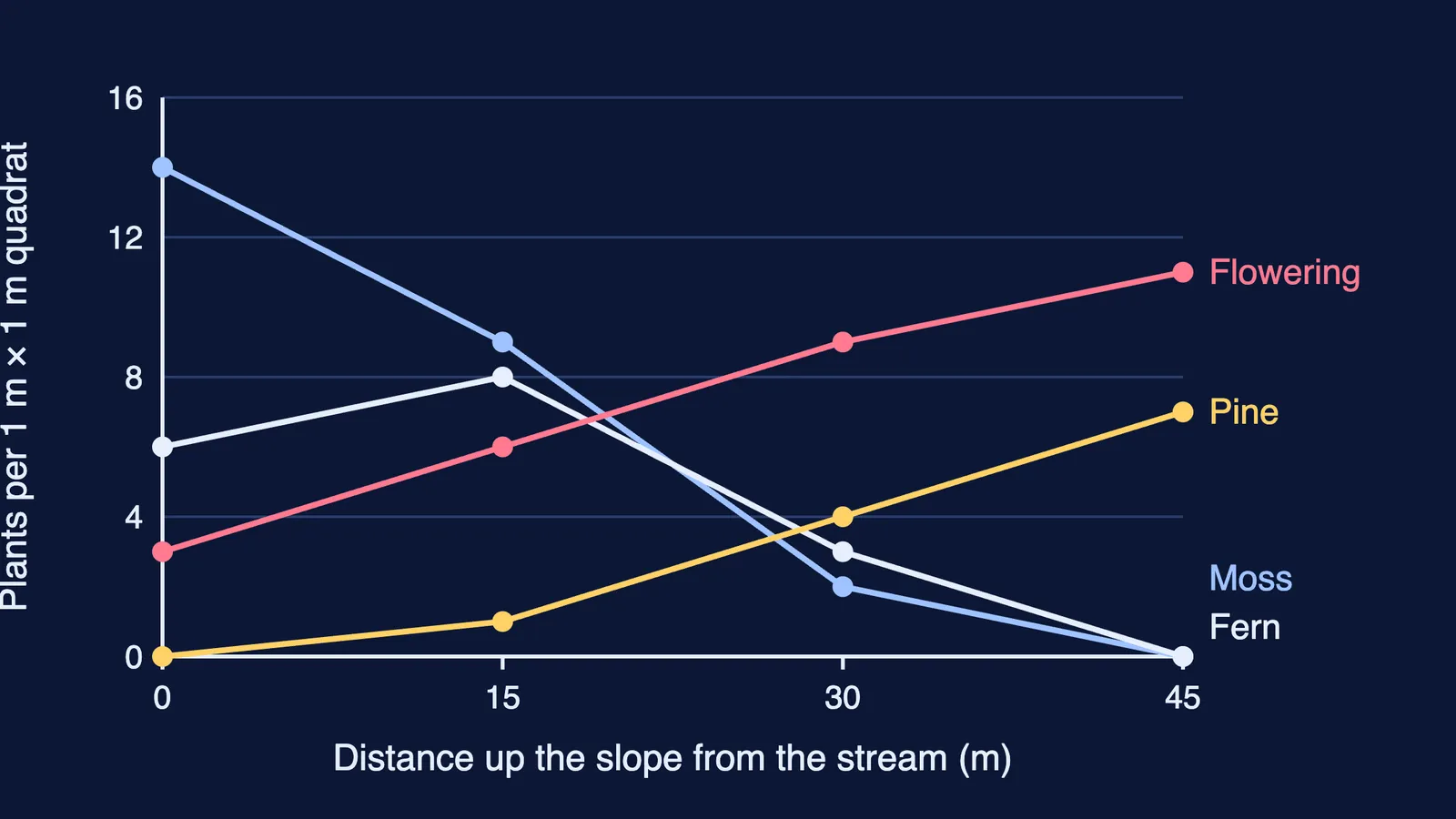
Near Darjeeling, Class 9 students place a 1 m × 1 m square frame at four points: at a shaded stream edge (0 m), then 15 m, 30 m and 45 m up the slope towards a dry, sunny ridge. They count moss mats, ferns, pine seedlings and small flowering plants in each square. Moss: 14, 9, 2, 0. Ferns: 6, 8, 3, 0. Pine seedlings: 0, 1, 4, 7. Flowering plants: 3, 6, 9, 11.
(i) Which group in the survey has true roots, stems and leaves but produces no seeds? (a) moss (b) fern (c) pine (d) flowering plant
(ii) Why are moss mats most common at the stream edge?
(iii) Ferns and pines both have xylem and phloem. Why do pine seedlings grow at 45 m while ferns do not?
(iv) What percentage of the plants counted are seed plants at 0 m and at 45 m? Which feature of flowering plants helps them spread to new places?
Answers.
(i) (b) Fern. Pteridophytes have true roots, stems, leaves and vascular tissue, but no seeds.
(ii) Mosses are bryophytes. They lack vascular tissue and need water for reproduction, because male reproductive cells must swim to female cells, so they stay in moist, shady places.
(iii) Ferns still need aquatic conditions for reproduction. Pines are gymnosperms: fertilisation needs no water, seeds protect the embryo with stored food, and needle-like leaves reduce water loss.
(iv) At 0 m: (0 + 3) ÷ 23 = 13%. At 45 m: (7 + 11) ÷ 18 = 100%. Flowering plants (angiosperms) produce fruits, which help spread seeds to new locations.
Case 3: Counting animals on a rocky shore
At low tide on a rocky shore near Ratnagiri, a nature club records animals for two hours. A: fixed to rock, body full of pores, no tissues (12 seen). B: soft, with tentacles around a single opening, only in pools (20). C: star-shaped, spiny skin, hard internal skeleton (5). D: jointed legs and a hard outer covering, often on exposed dry rock (18). E: soft body with a muscular foot inside a shell (25). F: small fish with fins and a backbone (10). One member calls C a chordate because it has an internal skeleton.
(i) Animal C belongs to: (a) Mollusca (b) Echinodermata (c) Arthropoda (d) Chordata
(ii) Arrange A, B and D in order of increasing level of body organisation, naming each level.
(iii) Is the club member right about C? Explain using the criterion that separates chordates from non-chordates.
(iv) What percentage of the animals counted are chordates, and what percentage have a hard outer covering (an exoskeleton or a shell)? Why can D stay on exposed rock while B stays in pools?
Answers.
(i) (b) Echinodermata: spiny skin and an internal skeleton made of calcium carbonate.
(ii) A, sponge (cellular level) → B, cnidarian (tissue level) → D, arthropod (organ system level).
(iii) No. Animals are split into chordates and non-chordates by the notochord, not by any skeleton. Echinoderms lack a notochord; only F, a vertebrate with a backbone, is a chordate.
(iv) Total = 12 + 20 + 5 + 18 + 25 + 10 = 90. Chordates: 10 ÷ 90 = 11.1%. Hard outer covering (D's exoskeleton, E's shell): 43 ÷ 90 = 47.8%. D's external skeleton reduces water loss and protects it; B has no such covering.
How to attack case-study questions
Sort first by the four kingdom criteria: cell type, cell wall, unicellular or multicellular, mode of nutrition.
For plants, ask two questions in order: is there vascular tissue, and does reproduction need water?
For animals, check the notochord before anything else; a hard skeleton alone proves nothing.
Show the arithmetic for every percentage, then link it to a feature.
Use the chapter's exact terms: saprophyte, mycelium, notochord.
To revise the vocabulary, see our Patterns in Life class 9 key terms; for answering technique, see our guide to case-based questions in board exams. If a criterion still blurs, the Fermi Concept Library has a lesson for every concept in biology.