On this page
What do morphology case studies test in Class 11?
The CBSE 2026-27 Biology curriculum lists Chapter 5 as the morphology of root, stem, leaf, inflorescence, flower, fruit and seed, plus a description of family Solanaceae. Every fact below comes from NCERT Class 11 Biology Chapter 5 (Reprint 2026-27), and all the scenarios and numbers are original.
Class 11 exams are set by schools, so treat these as case-based practice. For the whole chapter, see our Morphology of Flowering Plants Class 11 guide.
Case 1: A leaf survey on a Kochi campus
For a herbarium project, Meera tags three twigs on her school campus. The guava twig has 6 nodes and 12 leaves, with the two leaves at each node facing each other. The Alstonia twig has 4 nodes and 20 leaves. The china rose twig has 9 nodes and 9 leaves, one per node, on alternate sides. She also presses a maize leaf whose veins run side by side and whose base wraps around the stem, and a neem leaf with 11 leaflets on one central axis. In the breeze, leaves on long, thin, flexible petioles keep fluttering.
(i) The phyllotaxy of the Alstonia twig is (a) alternate (b) opposite (c) whorled (d) imbricate
(ii) What is the central axis of the neem leaf called, and what does it represent?
(iii) Name the venation of the maize leaf, and say what its leaf base shows about the plant.
(iv) Give two ways the fluttering petioles help the leaf.
Answers.
(i) (c) whorled. 20 ÷ 4 = 5 leaves per node, and more than two leaves at a node form a whorl. Imbricate is aestivation, not phyllotaxy.
(ii) The rachis. It represents the midrib of the leaf, so neem is pinnately compound.
(iii) Parallel venation. A leaf base that expands into a sheath around the stem is typical of monocotyledons.
(iv) Fluttering cools the leaf and brings fresh air to its surface.
Case 2: A mustard field near Bharatpur
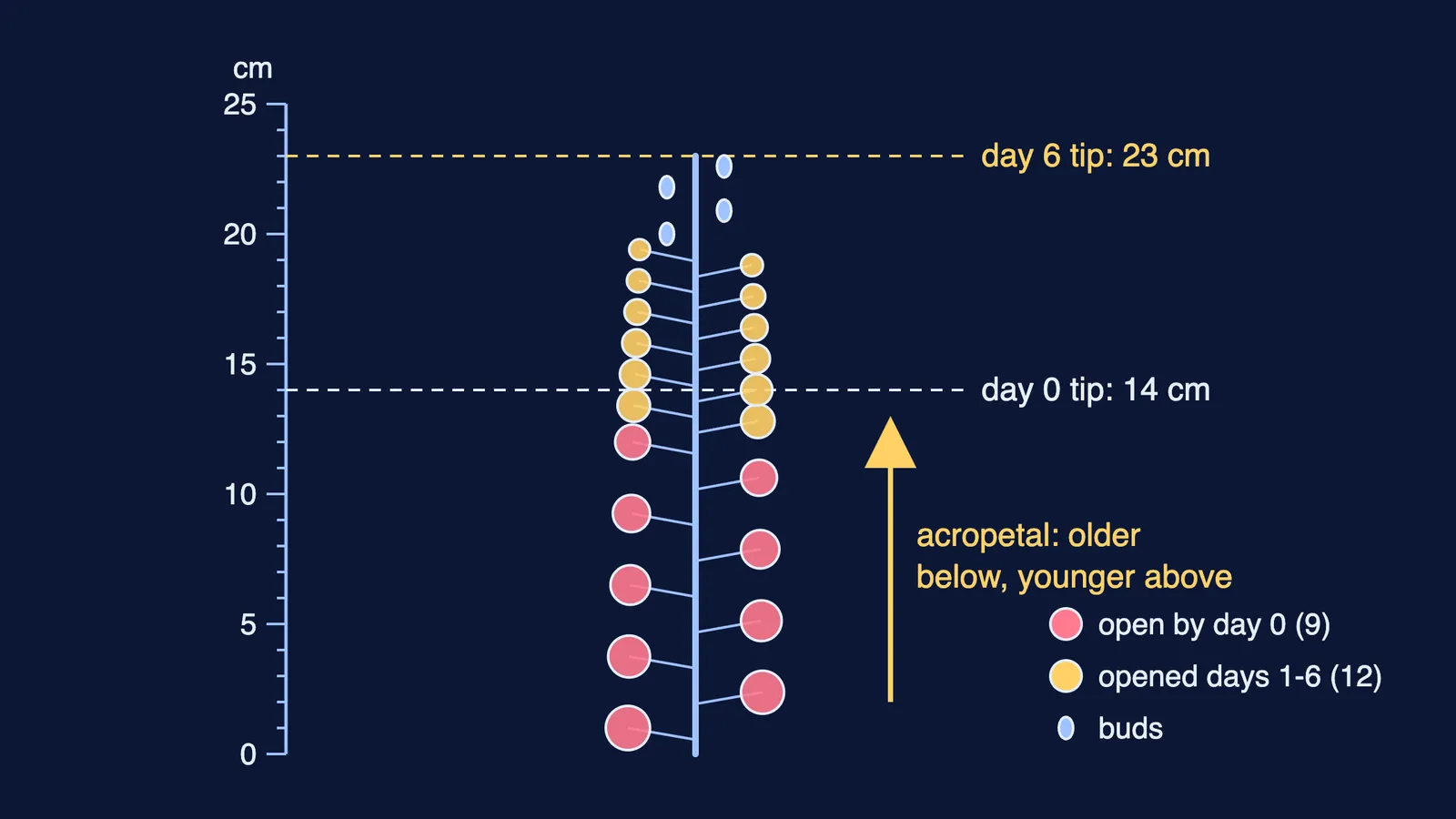
Arjun, a Class 11 student, tags one mustard flowering shoot on his uncle's farm. On day 0 the main axis is 14 cm long with 9 open flowers; on day 6 it is 23 cm long with 21 open flowers. The oldest flowers sit at the bottom, and new buds keep appearing at the tip. He opens one flower: 4 sepals, 4 petals and 6 stamens, 2 of them shorter than the other 4. Any cut through the centre gives two equal halves, and the ovary sits above the sepals, petals and stamens.
(i) This inflorescence is (a) cymose, because the oldest flowers are at the bottom (b) racemose, because the main axis keeps growing (c) cymose, because buds form at the tip (d) racemose, because the axis ends in a flower
(ii) Find the average growth of the axis per day and the average number of flowers that opened per day.
(iii) Name the symmetry of the flower and its merosity.
(iv) Name the position of the ovary and what the stamens show. What would change if the axis tip turned into a flower?
Answers.
(i) (b). In racemose inflorescences the main axis keeps growing and flowers form in acropetal succession, oldest at the base.
(ii) Growth = (23 − 14) ÷ 6 = 1.5 cm per day. New open flowers = (21 − 9) ÷ 6 = 2 per day.
(iii) Actinomorphic, since it divides into two equal halves in any radial plane. With parts in fours, it is tetramerous.
(iv) The ovary is superior, so the flower is hypogynous. The 2 short and 4 long stamens show variation in filament length within one flower, which NCERT notes for mustard. If the tip became a flower, axis growth would stop and the inflorescence would be cymose, with flowers in basipetal order.
Case 3: A brinjal plot at a Nashik farm school
At a farm training centre, Kavya tags 40 brinjal flowers on one plot, and 28 of them set fruit. Each flower has 5 united sepals that stay on the fruit, 5 united petals whose edges just touch in the bud, and 5 stamens fixed on the petals. A cut ovary shows the ovary above the other parts, two chambers and a swollen central placenta with many ovules. In one ovary she counts about 480 ovules; a ripe fruit from the same plant holds 432 seeds. One flower, covered with a bag so no pollen could reach it, still grew into a small fruit with no seeds.
(i) The stamens are (a) epiphyllous (b) epipetalous (c) diadelphous (d) polyadelphous
(ii) What percentage of tagged flowers set fruit, and what percentage of ovules became seeds, if the two ovaries were alike?
(iii) Name the aestivation of the corolla and the placentation.
(iv) Explain the seedless fruit from the bagged flower, and say what each seed of a normal fruit develops from.
Answers.
(i) (b). Stamens attached to petals are epipetalous; epiphyllous means attached to the perianth, as in lily.
(ii) Fruit set = 28 ÷ 40 × 100 = 70%. Ovules to seeds = 432 ÷ 480 × 100 = 90%, so about 48 ovules did not become seeds.
(iii) Valvate, because the petal margins touch without overlapping. Axile placentation: ovules on a swollen axial placenta in a two-chambered ovary, as NCERT gives for Solanaceae.
(iv) A fruit formed without fertilisation is parthenocarpic; its ovules were never fertilised, so none became seeds. In a normal fruit, each seed develops from a fertilised ovule, while the ovary matures into the fruit.
How do you solve morphology case-study questions?
Turn counts into ratios. Leaves per node gives phyllotaxy; parts per whorl gives merosity.
Map each clue to an NCERT example. The chapter ties terms to plants: Alstonia for whorled, brinjal for epipetalous, lily for epiphyllous.
Keep similar terms apart. Phyllotaxy is about leaves on a stem, aestivation about petals in a bud, placentation about ovules in an ovary.
Check the flower order. Acropetal means racemose and basipetal means cymose; one wrong word costs the answer.
If a term such as placentation still feels blurry, the Fermi Concept Library gives every concept in biology its own lesson. To draw what Case 3 describes, see how to draw a floral diagram step by step, and for general technique, our guide to case-based questions in board exams.