On this page
These three original cases stay inside the rationalised NCERT Class 12 Physics chapter 5, Magnetism and Matter (Reprint 2026-27). Try each part first, then use our Magnetism and Matter board exam guide to fill any gaps.
The CBSE Class 12 Physics curriculum for 2026-27 marks the bar magnet as an equivalent solenoid, the dipole's axial and equatorial field, and the torque on a dipole as "qualitative treatment only", so Case 1 asks no formula-based numericals. Take μ₀ = 4π × 10⁻⁷ T m A⁻¹ throughout.
Case 1: What do a compass and a bar magnet show about field lines?
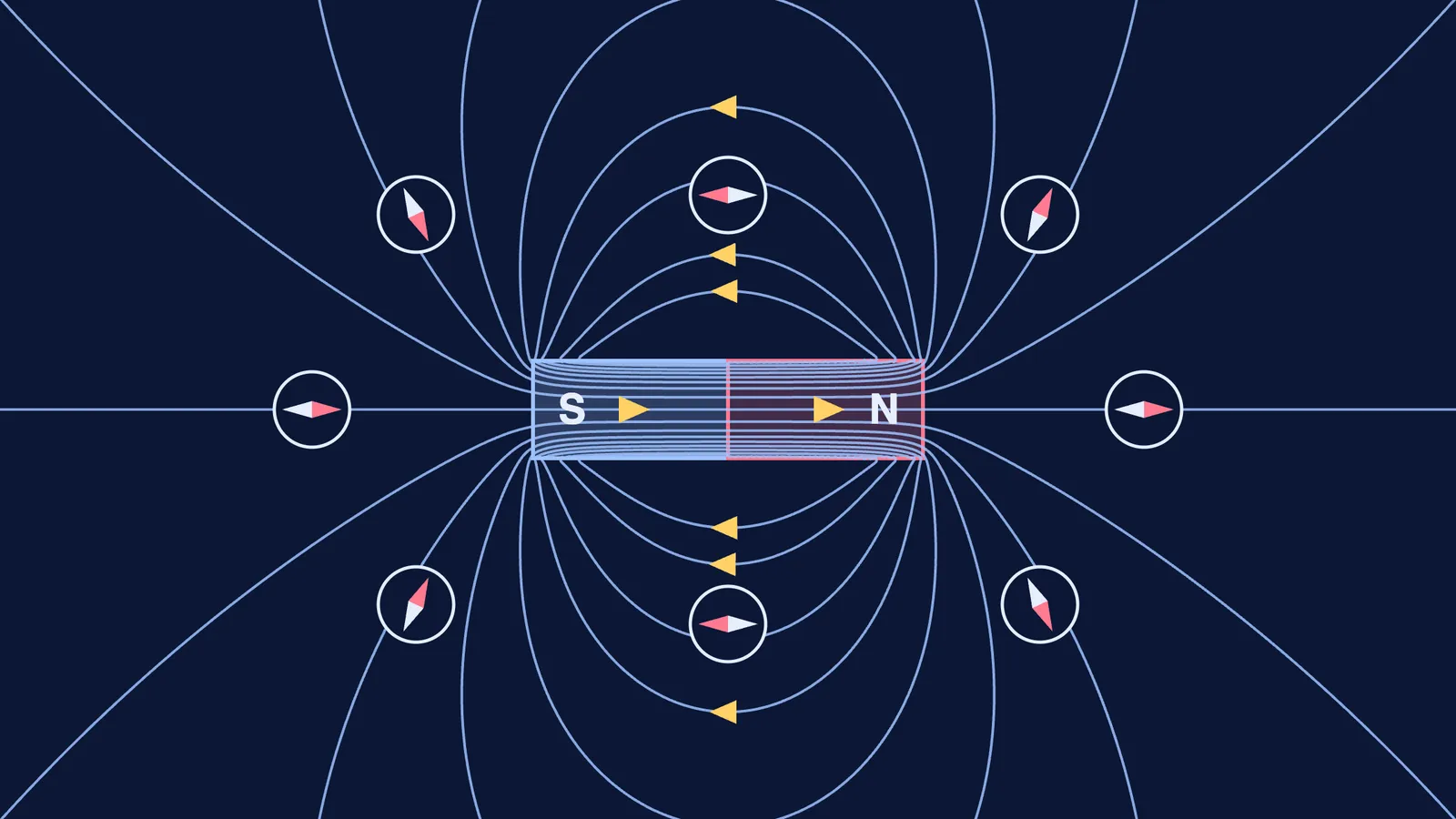
Kavya places a 5.0 cm bar magnet on a sheet of paper and maps its field with a small compass, joining the needle's directions into smooth lines. She marks point P on the axis beyond the N end and point Q on the perpendicular bisector, both 25 cm from the magnet's centre. Treat the magnet's field as the only field present.
(i) Inside the magnet, the field lines run: (a) from N to S (b) from S to N (c) nowhere, as there is no field inside (d) into both poles.
(ii) Why can two of Kavya's field lines never cross?
(iii) She imagines a closed surface wrapped around the N end only. What is the net magnetic flux through it, and which law says so?
(iv) Compare the field at P and at Q in size and direction.
Answers.
(i) (b). Field lines are closed loops: outside they go from N to S, inside from S to N.
(ii) At a crossing point the field would have two directions, but the field at any point has only one direction.
(iii) Zero. Gauss's law for magnetism says the net magnetic flux through any closed surface is zero; isolated poles (monopoles) do not exist, so as many lines enter as leave.
(iv) Since 25 cm is much larger than 5.0 cm, the magnet acts as a short dipole: the axial field is about twice the equatorial field at the same distance, so B at P ≈ 2 × B at Q. At P the field points along the magnetic moment (from S to N, away from the N end); at Q it points opposite to the moment.
Case 2: Which samples are dia-, para- or ferromagnetic?
In a college lab in Pune, Arjun hangs three small rods, X, Y and Z, one at a time between the pointed pole pieces of an electromagnet, where the field is strongest at the tips. Rod X drifts slightly away from the tips. Rod Y drifts slightly towards them. Rod Z is pulled in hard. A data sheet gives susceptibility χ = −1.5 × 10⁻⁵ for X, χ = +2.0 × 10⁻⁵ for Y, and χ ≈ 900 for Z.
(i) Which rod tends to move from the stronger to the weaker part of the field? (a) X (b) Y (c) Z (d) none of them.
(ii) Classify X, Y and Z, and name one NCERT example of each type.
(iii) Find the relative permeability μr of X and Y. For the same H, is the field inside X larger or smaller than in vacuum, and by what fraction?
(iv) In the same field, Arjun cools Y to a very low temperature, and separately heats Z strongly. How does each one's magnetic behaviour change?
Answers.
(i) (a). A diamagnetic rod moves from high to low field.
(ii) X is diamagnetic (χ small and negative), for example bismuth or copper. Y is paramagnetic (χ small and positive), for example aluminium or sodium. Z is ferromagnetic (χ large and positive), for example iron, cobalt or nickel.
(iii) μr = 1 + χ, so μr for X is 0.999985 and for Y is 1.00002. Since B = μ0μrH, the field inside X is smaller than μ0H by 1.5 parts in 10⁵.
(iv) Y's magnetisation increases as its temperature falls, as random thermal motion disturbs the atomic dipoles less. Z's domain structure breaks up when it is hot enough, and it becomes paramagnetic; the loss of magnetisation is gradual.
Case 3: How strong is the field inside an electromagnet's core?
A repair workshop winds 960 turns of insulated wire evenly over a 0.60 m long core and passes a steady current of 0.75 A. A thin probe in a narrow slot reads B = 0.90 T inside the core. The workshop wants the core to lose its magnetism as soon as the current is switched off.
(i) Which core material suits that need? (a) alnico (b) soft iron (c) bismuth (d) aluminium.
(ii) Find the magnetic intensity H inside the core.
(iii) Find μr and χ of the core and name its type.
(iv) Find the magnetisation M, and the extra current that would be needed in the same coil without the core to give 0.90 T.
Answers.
(i) (b). Soft iron loses its magnetisation when the field is removed; alnico, a hard ferromagnet, keeps it.
(ii) n = 960/0.60 = 1600 turns per metre, so H = nI = 1600 × 0.75 = 1200 A/m.
(iii) Without the core, μ0H = 4π × 10⁻⁷ × 1200 ≈ 1.51 × 10⁻³ T. So μr = 0.90/(1.51 × 10⁻³) ≈ 597 and χ = μr − 1 ≈ 596. A large positive χ means the core is ferromagnetic.
(iv) M = χH ≈ 596 × 1200 ≈ 7.2 × 10⁵ A/m (check: B/μ0 − H gives the same). Without the core, B = μ0n(I + IM), so I + IM = 0.90/(4π × 10⁻⁷ × 1600) ≈ 448 A and IM ≈ 447 A.
How to attack case-study questions
Underline the data each part needs; in Case 3, parts (iii) and (iv) build on (ii).
For field lines, check: closed loops, no crossings, crowding where the field is strong.
Keep H, M and B apart: H = nI from the current, M = χH from the material, B = μ0(H + M).
Convert turns and length to n (turns per metre) first.
Sanity-check sizes: μr is very close to 1 for dia- and paramagnets, but hundreds or more for a ferromagnetic core.
For the format, read our guide to case-based questions in board exams, then try the case-study questions on Moving Charges and Magnetism. If field lines are hard to picture, the Fermi Simulation Lab has interactive simulations for the ideas that are easier to see than to read.