On this page
These three original cases, set in Indian labs and workshops, stay inside the rationalised NCERT Class 12 Physics chapter 4, Moving Charges and Magnetism (Reprint 2026-27). Try each part before reading the answers, then use our Moving Charges and Magnetism board exam guide to fill any gaps.
The CBSE Class 12 Physics syllabus for 2026-27 lists the straight solenoid for "only qualitative treatment", so no case asks for a solenoid's field. Take μ₀ = 4π × 10⁻⁷ T m A⁻¹ throughout.
Case 1: How strong is the field near a workshop cable?
Ritika's uncle runs a battery-charging workshop in Indore. A long, straight, vertical cable carries a steady current of 15 A from the charger. Ritika holds her phone's magnetometer app 5.0 cm from the cable and sees the reading jump when the charger switches on, then moves the phone out to 10 cm. Later her uncle switches on a second long cable, parallel to the first and 10 cm away, carrying 10 A in the opposite direction. Ignore the Earth's field.
(i) The magnetic field lines around the vertical cable are: (a) radial lines (b) horizontal circles centred on the cable (c) lines parallel to the cable (d) loops through the cable.
(ii) What is the magnetic field at the phone when it is 5.0 cm from the cable?
(iii) What does the field become when Ritika moves the phone to 10 cm?
(iv) (2 marks) Find the force per metre between the two cables. Do they attract or repel?
Answers.
(i) (b). The field lines are circles concentric with the wire, in planes perpendicular to it.
(ii) By Ampère's circuital law, B = μ₀I/2πr = (4π × 10⁻⁷ × 15)/(2π × 0.050) = 6.0 × 10⁻⁵ T, or 60 μT.
(iii) B falls as 1/r, so doubling the distance halves it: 3.0 × 10⁻⁵ T.
(iv) F/L = μ₀I₁I₂/2πd = (2 × 10⁻⁷ × 15 × 10)/0.10 = 3.0 × 10⁻⁴ N per metre. The currents are antiparallel, so the cables repel.
Case 2: What path does a proton take in a magnetic field?
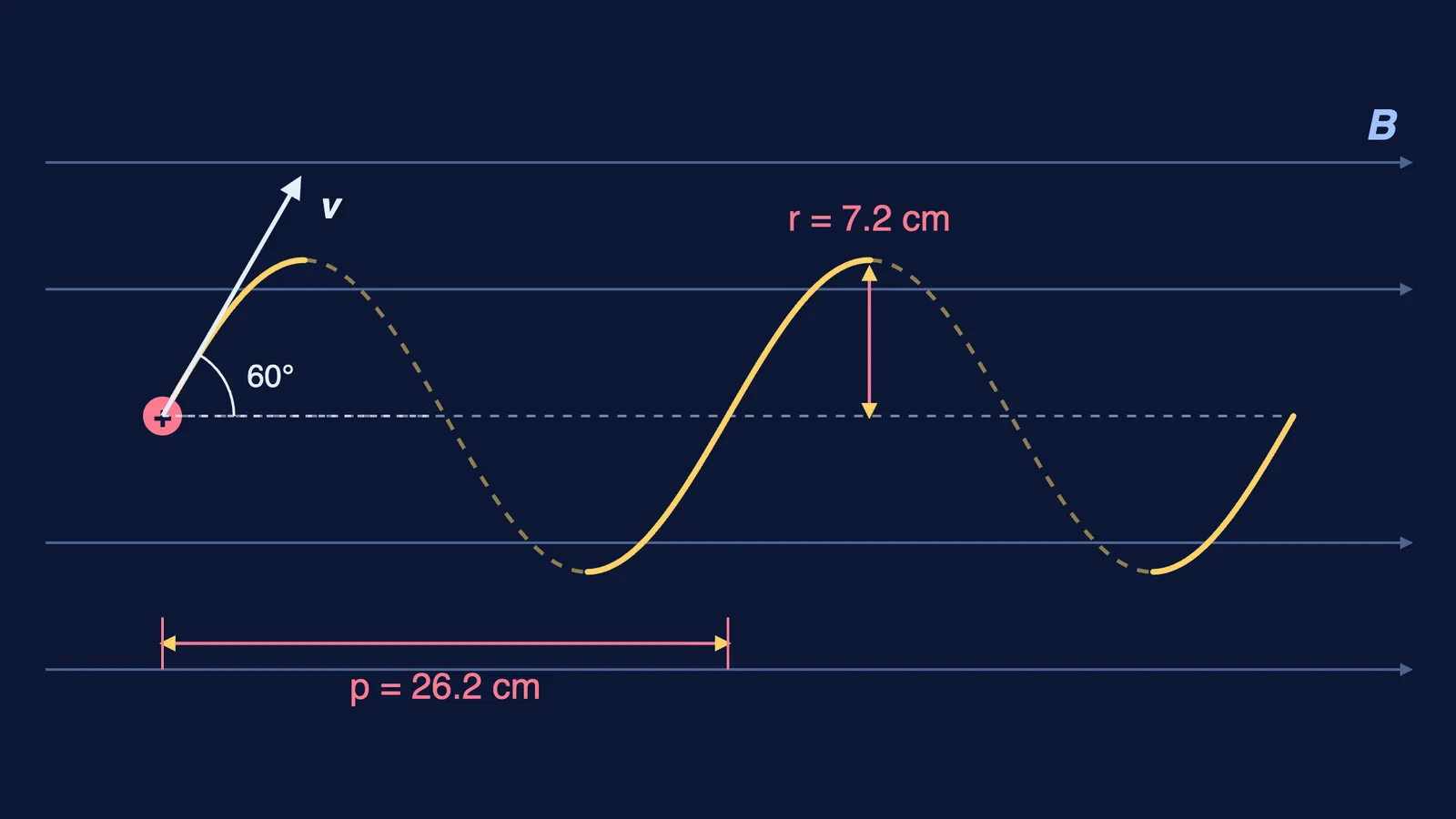
In a university accelerator lab in Bengaluru, a student sends protons (mass 1.67 × 10⁻²⁷ kg, charge 1.6 × 10⁻¹⁹ C) at 2.0 × 10⁶ m/s into a region of uniform magnetic field of 0.25 T. In the first run the beam enters at right angles to the field and the protons travel in a circle. In the second run she tilts the beam so that it enters at 60° to the field, and the protons trace a helix along the field direction.
(i) Inside the field, which quantity stays constant? (a) velocity (b) momentum (c) kinetic energy (d) acceleration.
(ii) Find the radius of the circle in the first run.
(iii) Find the frequency of revolution. What happens to the radius and the frequency if the speed is doubled?
(iv) (2 marks) In the second run, find the radius and the pitch of the helix.
Answers.
(i) (c). The magnetic force is perpendicular to the velocity, so it does no work and the speed cannot change.
(ii) r = mv/qB = (1.67 × 10⁻²⁷ × 2.0 × 10⁶)/(1.6 × 10⁻¹⁹ × 0.25) = 8.35 × 10⁻² m, about 8.4 cm.
(iii) f = qB/2πm = (1.6 × 10⁻¹⁹ × 0.25)/(2π × 1.67 × 10⁻²⁷) ≈ 3.8 × 10⁶ Hz. Doubling the speed doubles the radius to about 16.7 cm, but the frequency stays 3.8 MHz because it does not depend on speed.
(iv) Split the velocity: v⊥ = v sin 60° = 1.73 × 10⁶ m/s and v∥ = v cos 60° = 1.0 × 10⁶ m/s. Radius = mv⊥/qB ≈ 7.2 × 10⁻² m. The period T = 1/f ≈ 2.62 × 10⁻⁷ s, so the pitch p = v∥T ≈ 0.262 m, or 26.2 cm.
Case 3: Turning a galvanometer into meters
A Class 12 student in a Chennai school lab finds a moving coil galvanometer with coil resistance 40 Ω that gives full-scale deflection at 2.5 mA. Her teacher asks her to turn it into a 0 to 1 A ammeter, and separately into a 0 to 10 V voltmeter. To test the ammeter, she connects it in series with a 2.0 Ω resistor across a 1.5 V cell of negligible internal resistance, and it reads below the 0.75 A she expected.
(i) Why does the galvanometer have a soft iron cylinder inside the coil? (a) to make the field radial and stronger (b) to lower the coil's resistance (c) to shield the Earth's field (d) to stop the coil rotating.
(ii) What shunt does she need for the ammeter, and how is it connected?
(iii) What resistance does she need for the voltmeter, and how is it connected?
(iv) (2 marks) What does her ammeter read in the test circuit, and why is it less than 0.75 A?
Answers.
(i) (a). With a radial field, sin θ = 1 for every position of the coil, so the spring balances kφ = NIAB and the deflection φ is proportional to I.
(ii) S = I_gG/(I − I_g) = (0.0025 × 40)/(1 − 0.0025) ≈ 0.100 Ω, connected in parallel with the coil.
(iii) R = V/I_g − G = 10/0.0025 − 40 = 3960 Ω, connected in series with the coil.
(iv) The ammeter's resistance is GS/(G + S) ≈ 0.100 Ω. The current is 1.5/(2.0 + 0.10) ≈ 0.714 A, about 4.8% below 0.75 A. A real ammeter adds resistance, so its resistance must be small compared with the rest of the circuit.
How to attack case-study questions?
Underline the data each part needs; (iv) often reuses (ii).
Draw the geometry first: a wire seen end-on with circles, or v split into v∥ and v⊥.
A magnetic force does no work, so speed stays fixed, and qB/2πm does not depend on speed.
Write the meter rule before the numbers: small shunt in parallel for an ammeter, large resistance in series for a voltmeter.
Sanity-check sizes: a shunt is a fraction of an ohm, a voltmeter resistance thousands of ohms.
For the format, read our guide to case-based questions in board exams, then try the assertion-reason questions for this chapter. If helical motion is hard to picture, the Fermi Simulation Lab has interactive simulations for ideas that are easier to see than to read.