On this page
The 10 original questions below stay inside NCERT Class 12 Physics Chapter 4, Moving Charges and Magnetism, Chapter 5, Magnetism and Matter, and Unit 13 of the NMC syllabus for NEET (UG)-2026. Each has a key, a short reason and the trap.
How do you answer assertion-reason questions?
Judge each statement on its own. If both are true, ask whether R is the direct cause of A as the textbook gives it. Our step-by-step strategy for assertion-reason questions covers the method.
Use these keys for questions 1 to 6:
(A) Both A and R are true and R is the correct explanation of A.
(B) Both A and R are true but R is NOT the correct explanation of A.
(C) A is true but R is false.
(D) A is false but R is true.
Use these keys for questions 7 to 10:
(A) Both statements are correct.
(B) Both statements are incorrect.
(C) Statement I is correct, Statement II is incorrect.
(D) Statement I is incorrect, Statement II is correct.
Assertion-reason questions on magnetism and moving charges
Q1 (easy). Assertion (A): A charged particle moving along the direction of a uniform magnetic field feels no magnetic force. Reason (R): The magnetic force on a moving charge is q(v × B), which is zero when v is parallel to B.
Answer: (A). Both true, and R causes A: parallel vectors have zero cross product.
Trap: thinking every moving charge is pushed.
Q2 (easy). Assertion (A): A uniform, steady magnetic field cannot change the speed of a charged particle. Reason (R): The magnetic force on a moving charge acts along its velocity.
Answer: (C). A is true. R is false: the force is perpendicular to the velocity, which is why it does no work and only turns the particle.
Trap: mixing it up with the electric force qE.
Q3 (medium). Assertion (A): A bismuth rod is weakly repelled when brought near one pole of a strong magnet. Reason (R): Diamagnetism is present in all substances.
Answer: (B). Both true, but R does not explain A: aluminium also has diamagnetism yet is attracted, as its paramagnetism is stronger. Bismuth is repelled because its atoms have no net moment, leaving only the induced moment opposite the field.
Trap: taking a true general fact as the cause.
Q4 (medium). Assertion (A): A rectangular loop carrying a steady current in a uniform magnetic field feels zero net force. Reason (R): The net torque on such a loop is zero in every orientation.
Answer: (C). A is true: forces on opposite arms cancel. R is false: τ = m × B, which is zero only when the loop's moment is parallel or antiparallel to B.
Trap: assuming zero net force means zero torque.
Q5 (medium). Assertion (A): A galvanometer is converted into a voltmeter by connecting a small resistance in parallel with it. Reason (R): A voltmeter should draw very little current from the circuit it measures.
Answer: (D). A is false: a small parallel shunt makes an ammeter; a voltmeter needs a large series resistance. R is true.
Trap: swapping the ammeter and voltmeter recipes.
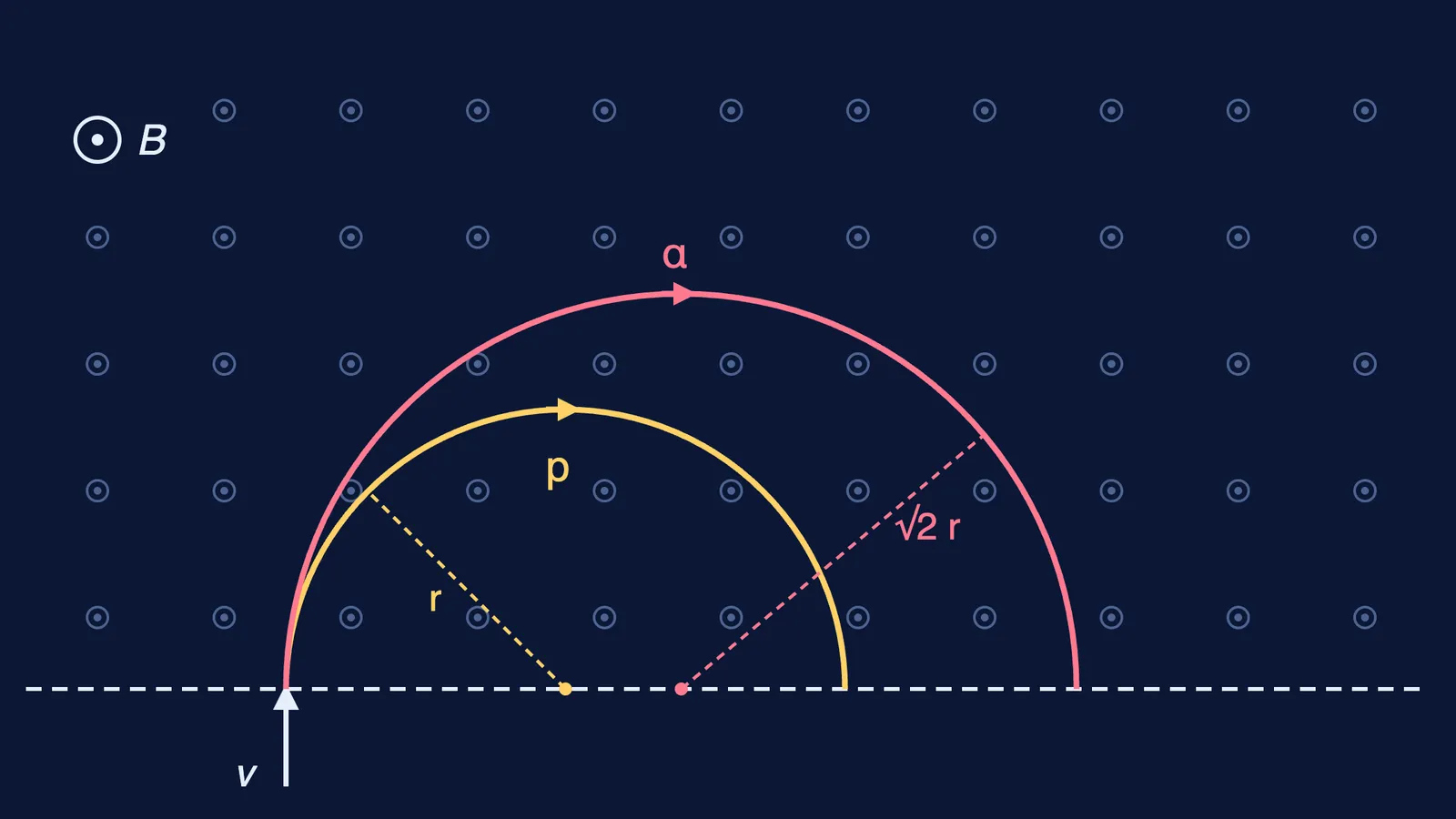
Q6 (hard). Assertion (A): A proton and an alpha particle are accelerated from rest through the same potential difference and then enter the same uniform magnetic field at right angles. The alpha particle's path has twice the radius of the proton's. Reason (R): For a charge moving perpendicular to a uniform magnetic field, r = mv/(qB).
Answer: (D). R is true. A is false: kinetic energy is qV, so mv = √(2mqV) and r = √(2mV/q)/B. With m four times and q twice the proton's, the radius is √2 times, about 1.41 times, not 2.
Trap: assuming both enter at the same speed.
Statement I and Statement II questions on magnetism and moving charges
Q7 (medium). Statement I: The magnetic field lines of a bar magnet start at its north pole and end at its south pole. Statement II: Two magnetic field lines never cross each other.
Answer: (D). Statement I is incorrect: magnetic field lines form continuous closed loops through the magnet. Statement II is correct: a crossing would give the field two directions.
Trap: borrowing the picture of electric field lines.
Q8 (medium). Statement I: If the radius of a circular loop is doubled while its current stays the same, the magnetic field at its centre halves. Statement II: Along the axis of a circular current loop, the field is strongest at the centre of the loop.
Answer: (A). Both correct. At the centre B = μ₀I/(2R), so doubling R halves B. On the axis B = μ₀IR²/[2(R² + x²)^(3/2)], which is largest at x = 0.
Trap: expecting the field to grow away from the centre.
Q9 (hard). Statement I: A long solenoid 25 cm long with 500 turns, carrying 2.0 A, has a field of about 1.3 mT inside. Statement II: Increasing the solenoid's radius, keeping turns per metre and current fixed, strengthens the field inside.
Answer: (B). Both incorrect. With n = 500/0.25 = 2000 per metre, B = μ₀nI = 4π × 10⁻⁷ × 2000 × 2.0 ≈ 5.0 × 10⁻³ T. B = μ₀nI has no radius in it.
Trap: using total turns as n, which gives 1.3 mT.
Q10 (hard). Statement I: Turning a magnetic dipole of moment 0.50 J/T in a 0.40 T field from its most stable to its most unstable position takes 0.40 J of work. Statement II: The torque on the dipole is greatest in its most unstable position.
Answer: (C). Statement I is correct: U = −mB cos θ goes from −0.20 J at 0° to +0.20 J at 180°, a change of 2mB = 0.40 J. Statement II is incorrect: τ = mB sin θ is zero at 180° and greatest at 90°.
Trap: linking highest energy with largest torque.
How should you use this set?
Cover the answers, try all 10, then tag each miss: wrong fact, wrong formula, or wrong A-R link.
Rewrite every false statement so it is true. If field paths are hard to picture, the Fermi Simulation Lab has interactive simulations for ideas that are easier to see than to read. Then try our magnetism NEET practice questions with solutions, and plan the chapter with the guide to magnetic effects of current and magnetism for NEET.