On this page
What do locomotion and movement case-study questions test?
Each case is a short passage with four questions of rising difficulty. Class 11 exams are set by your school, so treat these as case-based practice.
The CBSE Biology curriculum for 2026-27 lists Chapter 17, Locomotion and Movement: types of movement, skeletal muscle and how it contracts, the skeletal system, joints and six disorders. The cases and numbers are ours; every fact follows the NCERT Class 11 Biology chapter (Reprint 2026-27).
For the chapter in brief, read our Locomotion and Movement Class 11 guide. For the three muscle types, see striated, smooth and cardiac muscle differences; for method, how to handle case-based questions.
Case 1: What is moving during a kho-kho match?
Kavya, 16, plays kho-kho for her school team in Bhopal. At half-time, her biology teacher asks the team to list the movements in their bodies. They write: legs sprinting across the court, the heart beating faster, lunch being pushed along the gut, the windpipe clearing dust kicked up from the ground, and white blood cells gathering at Kavya's scraped knee. Kavya says every item on the list is locomotion.
(i) The white blood cells reaching the scraped knee show: (a) ciliary movement (b) flagellar movement (c) amoeboid movement (d) muscular movement
(ii) Their coach is an adult weighing 70 kg. Estimate how many kilograms of that is muscle.
(iii) Name the muscle type behind the sprinting legs, the beating heart and the moving gut, and say whether each is striated and whether it is voluntary.
(iv) Is Kavya right that every item on the list is locomotion? Explain.
Answers.
(i) (c). Leucocytes move by pseudopodia formed by streaming of protoplasm, with microfilaments involved, as in Amoeba.
(ii) Per NCERT, muscles make up about 40-50 per cent of adult body weight: 0.40 × 70 = 28 kg to 0.50 × 70 = 35 kg.
(iii) Legs: skeletal muscle, striated and voluntary. Heart: cardiac muscle, striated but involuntary. Gut: visceral (smooth) muscle, non-striated and involuntary.
(iv) No. Locomotion is voluntary movement that changes the body's place, so only the sprinting counts. The rest are movements: all locomotions are movements, but not all movements are locomotions.
Case 2: What happens inside a sarcomere when it shortens?
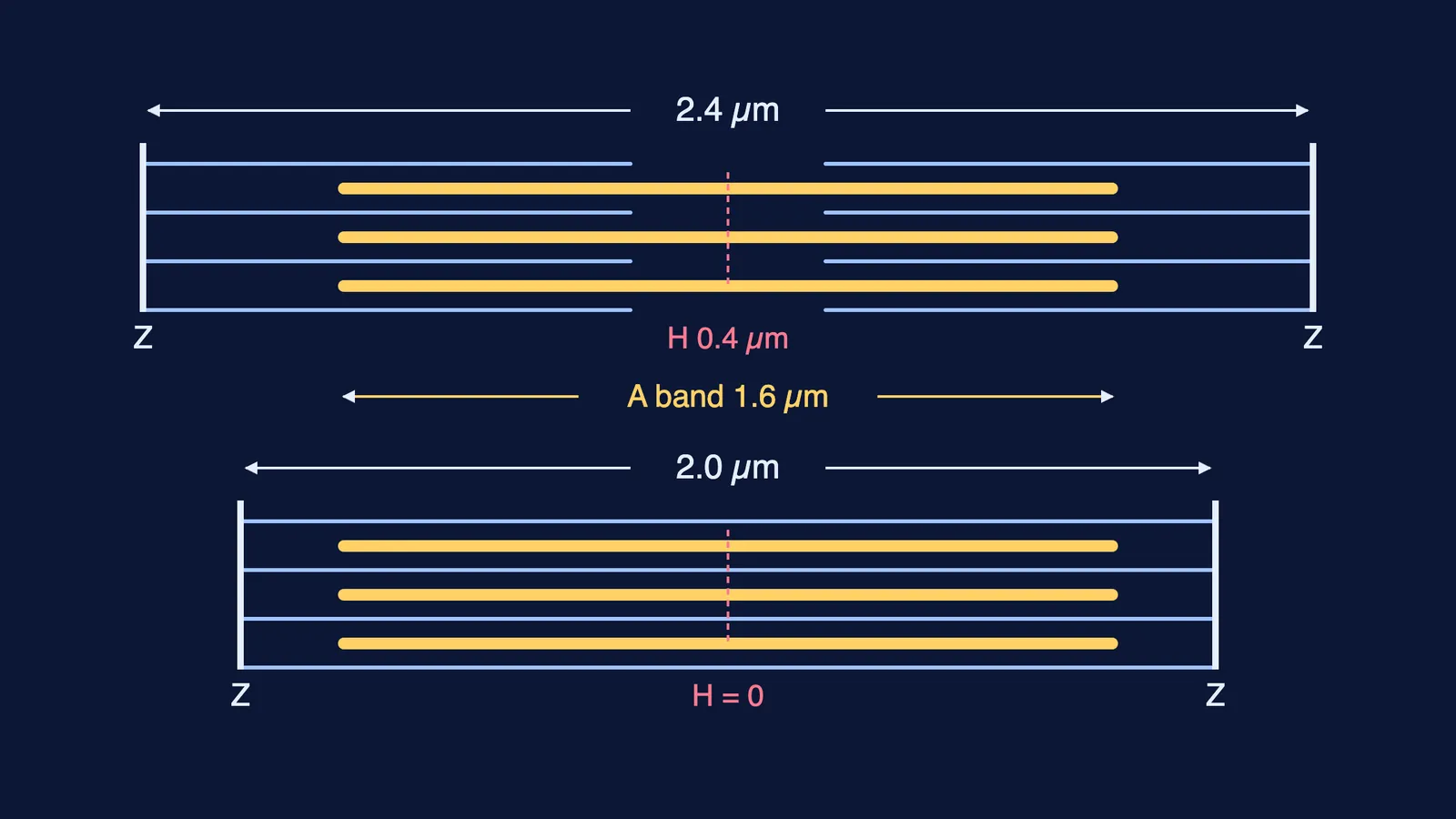
A zoology lab in Hyderabad photographs one myofibril from a frog's leg muscle under an electron microscope. In a resting sarcomere, the distance between two Z lines is 2.4 µm, the dark band is 1.6 µm long and the central H zone is 0.4 µm wide. After the nerve to the muscle is stimulated, the same sarcomere measures 2.0 µm. A second fibre is treated with a drug that stops its sarcoplasmic reticulum releasing calcium ions.
(i) The 1.6 µm dark band is made mainly of: (a) actin (b) myosin (c) tropomyosin (d) troponin
(ii) Calculate the length of the I band at rest and after contraction.
(iii) How far does each Z line move towards the centre, and what is the width of the H zone after contraction?
(iv) Will the drug-treated fibre contract when its motor neuron fires? Explain.
Answers.
(i) (b). The dark A (anisotropic) band holds the thick myosin filaments; the light I band holds actin.
(ii) The A band keeps its length, so I band = sarcomere − A band. At rest: 2.4 − 1.6 = 0.8 µm. After contraction: 2.0 − 1.6 = 0.4 µm.
(iii) The sarcomere shortens by 2.4 − 2.0 = 0.4 µm, shared by two Z lines, so each moves 0.2 µm inwards. The thin filaments on both sides slide 0.2 µm into the H zone: 0.4 − (2 × 0.2) = 0 µm, so the H zone disappears.
(iv) No. The action potential still spreads, but without Ca++ there is nothing to bind troponin. Troponin keeps masking the myosin-binding sites on actin, so no cross bridges form and the thin filaments do not slide.
Case 3: What links three patients in one orthopaedic clinic?
At a Chennai clinic, Dr Iyer sees three patients. Mrs Lakshmi, 67, past menopause, broke her wrist after a minor slip; her X-ray shows low bone mass and a compressed third lumbar vertebra. Mr Rao, 52, has a red, swollen joint at the base of his big toe, and his blood report shows high uric acid. Ms Fathima, 29, finds her eyelids droop and her arms tire as each day goes on; tests show her own antibodies attacking the junctions between her nerves and skeletal muscles.
(i) Mr Rao's condition is most likely: (a) tetany (b) osteoporosis (c) gout (d) muscular dystrophy
(ii) Counting down from the skull, which vertebra is Mrs Lakshmi's third lumbar vertebra, and in which region is the vertebra just above the lumbar region?
(iii) Name Mrs Lakshmi's disorder and the common cause NCERT gives for it.
(iv) Name Ms Fathima's disorder. Using the steps of muscle contraction, explain why her skeletal muscles weaken.
Answers.
(i) (c). Gout is inflammation of joints due to accumulation of uric acid crystals.
(ii) The column runs cervical (7), thoracic (12), then lumbar, so the third lumbar is vertebra 7 + 12 + 3 = 22. The vertebra just above the lumbar region is the 12th thoracic.
(iii) Osteoporosis: age-related, with decreased bone mass and more chance of fractures. Decreased levels of estrogen is a common cause.
(iv) Myasthenia gravis, an autoimmune disorder of the neuromuscular junction. Normally a nerve signal there releases acetylcholine, which fires an action potential in the sarcolemma, triggers Ca++ release and lets cross bridges form. When the junction is damaged, signals do not pass properly to the muscle fibres, leading to fatigue, weakening and even paralysis of skeletal muscle.
How to attack case-study questions
Underline every number and unit before answering.
In sarcomere numericals, start from what stays fixed: the A band keeps its length, so changes show up in the I band and H zone.
Write the contraction chain in order (signal, acetylcholine, action potential, Ca++, troponin, cross bridge, sliding) and find which link the case breaks.
For bones and vertebrae, keep NCERT's counts on one line: 7 cervical, 12 thoracic, 5 lumbar, 1 sacral, 1 coccygeal.
For disorders, match the clue in the passage (uric acid, estrogen, antibodies, low Ca++) to NCERT's one-line definition.
If an idea here keeps tripping you up, the Fermi Concept Library has a lesson for every concept in biology.