On this page
Three original cases, easy to hard, with worked answers. Theory first? Read our How Forces Affect Motion Class 9 chapter guide.
What does the chapter expect you to apply?
Chapter 6 of Exploration, the new NCERT Class 9 Science book, asks what changes motion: only the net force does. Newton's first law: with no net force, an object stays at rest or keeps a constant velocity. Newton's second law: the net force produces an acceleration a = F/m in its direction, and 1 N gives 1 kg an acceleration of 1 m s⁻². Newton's third law: forces come in equal and opposite pairs acting on two different objects. Weight is F = mg, with g = 9.8 m s⁻². For connected objects treated as one system, only external forces count. The CBSE Class IX Science curriculum for 2026-27 lists force, friction and all three laws under this chapter.
Case 1: A lift in a Pune apartment tower
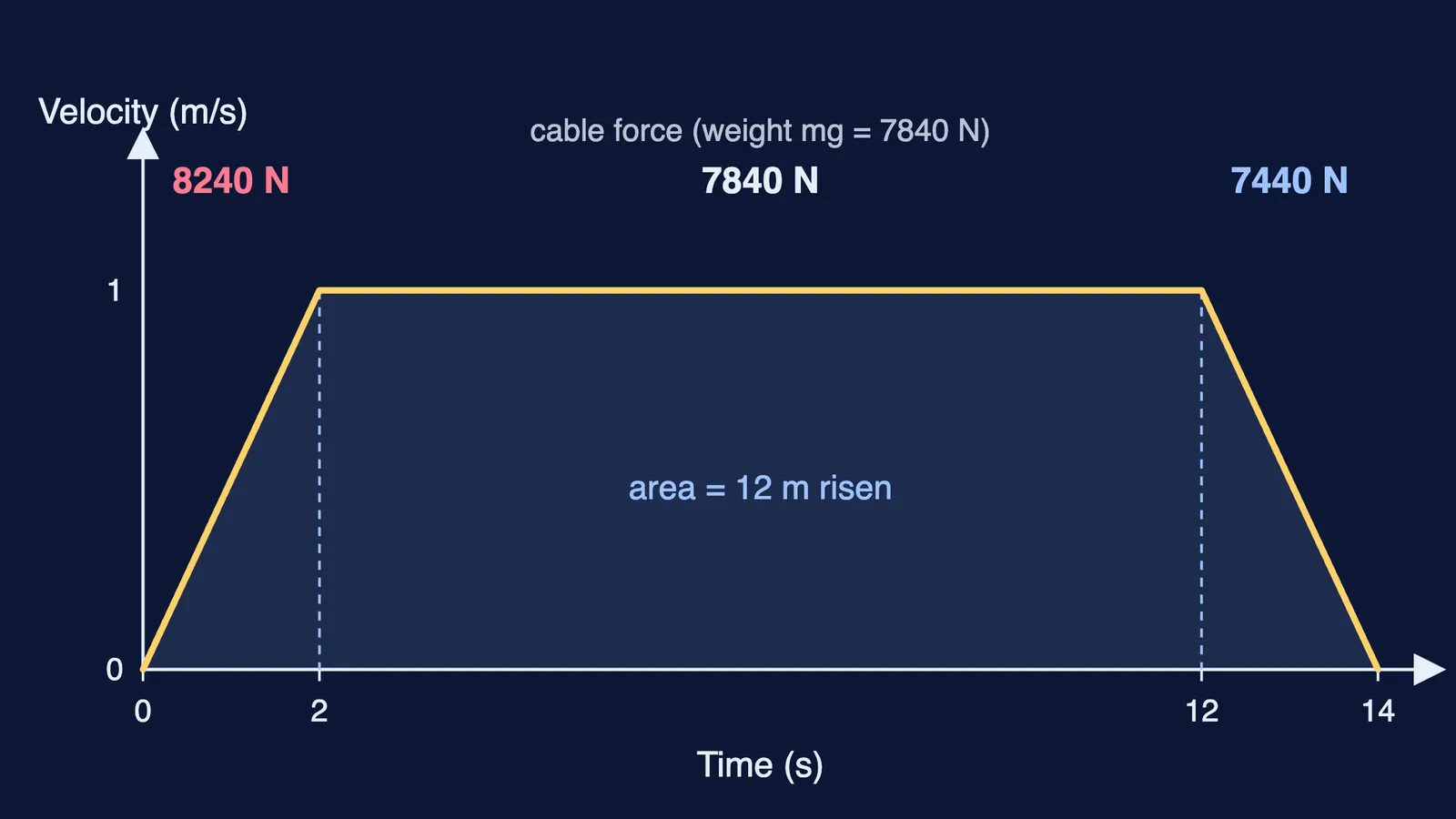
Ananya's family rides the lift to the fourth floor of their Pune building. The loaded car has a total mass of 800 kg. A steel cable pulls the car up. Starting from rest, the car speeds up evenly for 2 s until it reaches 1.0 m s⁻¹. It then moves at this steady speed for 10 s, and finally slows evenly to rest in 2 s at the fourth floor, 12 m above the ground. Ignore friction and air resistance.
(i) During the 10 s at steady speed, the net force on the lift car is: (a) upward (b) downward (c) zero (d) equal to its weight
(ii) What is the weight of the loaded lift car?
(iii) What force does the cable exert on the car during the steady part of the ride?
(iv) Find the cable force while the car speeds up and while it slows down.
Answers.
(i) (c). Constant velocity means zero acceleration: the forces are balanced.
(ii) W = mg = 800 kg × 9.8 m s⁻² = 7840 N, downward.
(iii) 7840 N upward. It must balance the weight exactly.
(iv) Acceleration = (1.0 − 0) ÷ 2 = 0.5 m s⁻². Speeding up, the net force is 800 × 0.5 = 400 N upward, so cable force = 7840 + 400 = 8240 N. Slowing down, the net force is 400 N downward, so cable force = 7840 − 400 = 7440 N.
Case 2: A hockey ball on synthetic turf
At a hockey academy in Bhubaneswar, Rohan hits a 0.16 kg ball along a level synthetic turf. It leaves his stick at 6 m s⁻¹ and slows evenly, stopping 4 s later. The coach then has the turf watered, and Rohan hits the ball at 6 m s⁻¹ again. It rolls much longer: the friction from the wet turf is now only 0.16 N. Ignore air resistance in both trials.
(i) After the ball leaves the stick, the horizontal force on it acts: (a) along its motion (b) opposite to its motion (c) along its motion at first, then opposite to it (d) nowhere, since nothing pushes it
(ii) What is the ball's deceleration on dry turf?
(iii) Find the friction force on the ball on dry turf, and how far the ball travels.
(iv) On wet turf, how long does the ball roll, and how far does it go?
Answers.
(i) (b). With the stick gone, friction is the only horizontal force, and it opposes motion.
(ii) a = (0 − 6) ÷ 4 = −1.5 m s⁻², a deceleration of 1.5 m s⁻².
(iii) F = ma = 0.16 kg × 1.5 m s⁻² = 0.24 N, backward. s = ut + ½at² = 6 × 4 − ½ × 1.5 × 4² = 24 − 12 = 12 m.
(iv) a = 0.16 N ÷ 0.16 kg = 1 m s⁻². Time = 6 ÷ 1 = 6 s. s = 6 × 6 − ½ × 1 × 6² = 36 − 18 = 18 m.
Case 3: A baggage tug at Chennai airport
A battery-powered tug at Chennai airport pulls two baggage trailers in a line along a level apron. The front trailer has a mass of 300 kg and the rear one 200 kg, joined by a steel coupling. The tug pulls the front trailer forward with a steady 700 N. The ground exerts a friction force of 60 N on the front trailer and 40 N on the rear trailer. They start together from rest.
(i) Taking the two trailers as one system, which of these is an internal force? (a) the tug's pull (b) friction from the ground (c) the pull of the coupling between the trailers (d) the Earth's gravitational force
(ii) What is the acceleration of the trailers?
(iii) What are their speed and the distance covered after 4 s?
(iv) What force does the coupling exert on the rear trailer, and what force does the rear trailer exert back on the coupling?
Answers.
(i) (c). It acts between two parts of the system, so it is internal and drops out.
(ii) Net external force = 700 − 60 − 40 = 600 N. Mass = 300 + 200 = 500 kg. a = 600 ÷ 500 = 1.2 m s⁻².
(iii) v = u + at = 0 + 1.2 × 4 = 4.8 m s⁻¹. s = ½ × 1.2 × 4² = 9.6 m.
(iv) The rear trailer alone needs a net force of 200 × 1.2 = 240 N, and friction pulls it back with 40 N, so the coupling pulls it forward with 240 + 40 = 280 N. By the third law, the rear trailer pulls back on the coupling with 280 N. Check on the front trailer: 700 − 280 − 60 = 360 N = 300 × 1.2.
How to attack case-study questions on forces and motion?
List every force on the object, with its direction, before you calculate. Only the net force decides the motion.
Constant velocity, upward or sideways, means zero net force. Do not add an extra "force of motion".
Find the acceleration from the speeds and times first, then use F = ma.
For connected objects, draw a box around the system and use only external forces.
For a third-law pair, name both objects. If the two forces act on the same object, they are not a pair.
For more, see our guide to case-based questions and the key terms of How Forces Affect Motion. If a step keeps slipping, the Fermi Problem Library has worked problems with a step-by-step solver that explains the reasoning rather than printing an answer.