On this page
Three original cases, easy to hard, with worked answers. For the derivations behind them, read our Electrostatic potential and capacitance Class 12 board guide first.
What do case-study questions on this chapter look like?
The CBSE 2026-27 Physics sample paper has two case study-based questions of four marks each, in Section D, and calculators are not allowed. Every idea below sits inside the Chapter 2 list in the CBSE 2026-27 Physics syllabus and the rationalised NCERT Chapter 2, which gives the stored energy of a capacitor as U = Q²/2C = ½CV² = ½QV.
Case 1: The studio flash
Arjun's studio flash in Jaipur charges a 200 μF capacitor to 300 V before each shot. One evening a faulty supply charges it to only 100 V, and the pictures come out dark. The repair shop has no 200 μF part in stock, only two 100 μF capacitors rated for 300 V.
(i) The charge on the capacitor at 300 V is: (a) 0.6 mC (b) 6 mC (c) 0.06 C (d) 60 C
(ii) How much energy does the capacitor store at 300 V?
(iii) How much energy does it store at 100 V, and what fraction of the normal energy is that?
(iv) How should the two 100 μF capacitors be joined to replace the 200 μF part? What energy would they store at 300 V if joined the other way?
Answers.
(i) (c). Q = CV = 200 × 10⁻⁶ × 300 = 0.06 C.
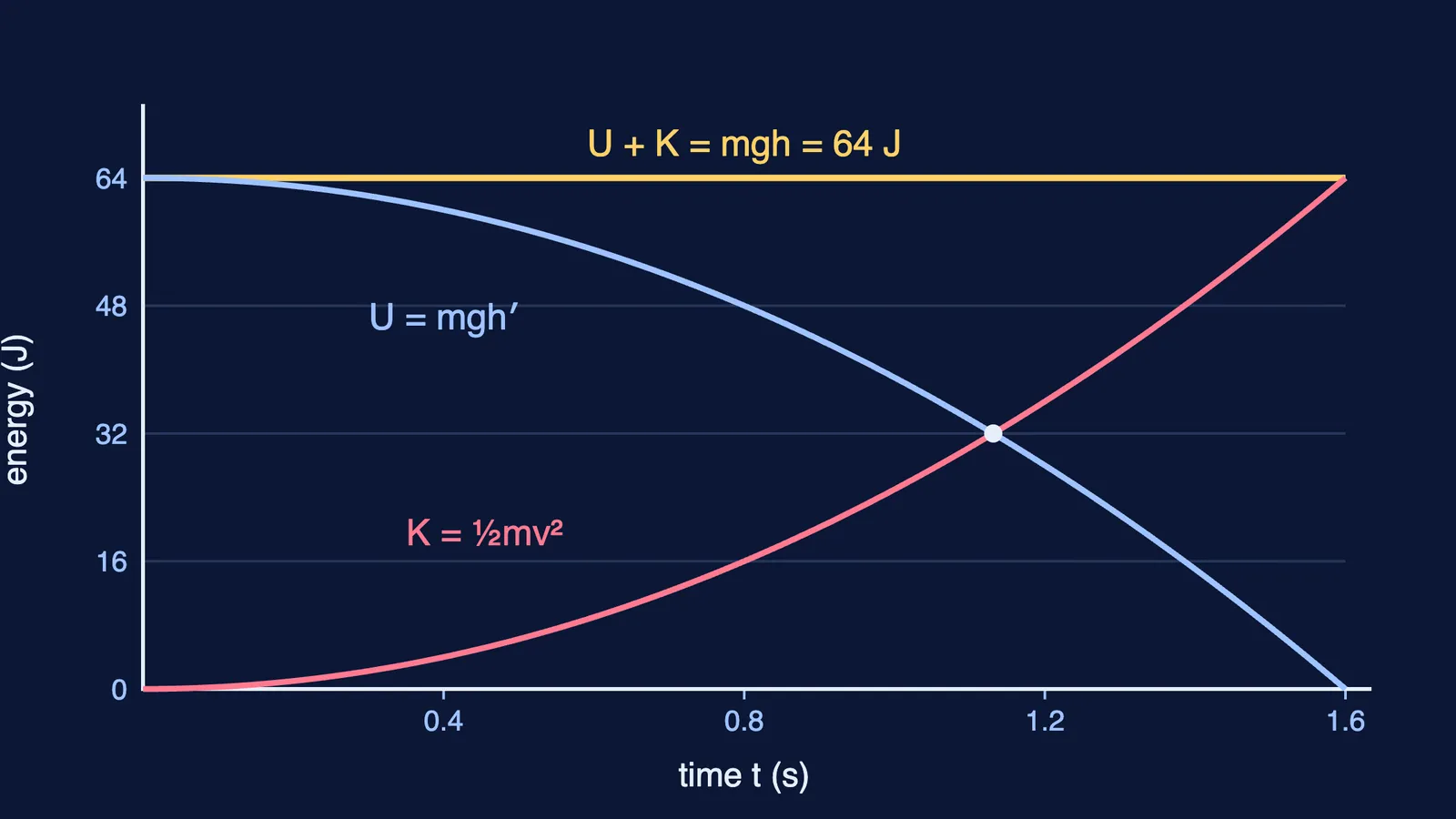
(ii) U = ½CV² = ½ × 200 × 10⁻⁶ × 300² = 9 J.
(iii) U = ½ × 200 × 10⁻⁶ × 100² = 1 J, which is 1/9 of 9 J. U ∝ V², so a third of the voltage gives a ninth.
(iv) In parallel: C = 100 + 100 = 200 μF. In series, 1/C = 1/100 + 1/100, so C = 50 μF and U = ½ × 50 × 10⁻⁶ × 300² = 2.25 J, a quarter of the normal energy.
Case 2: The zero-potential circle
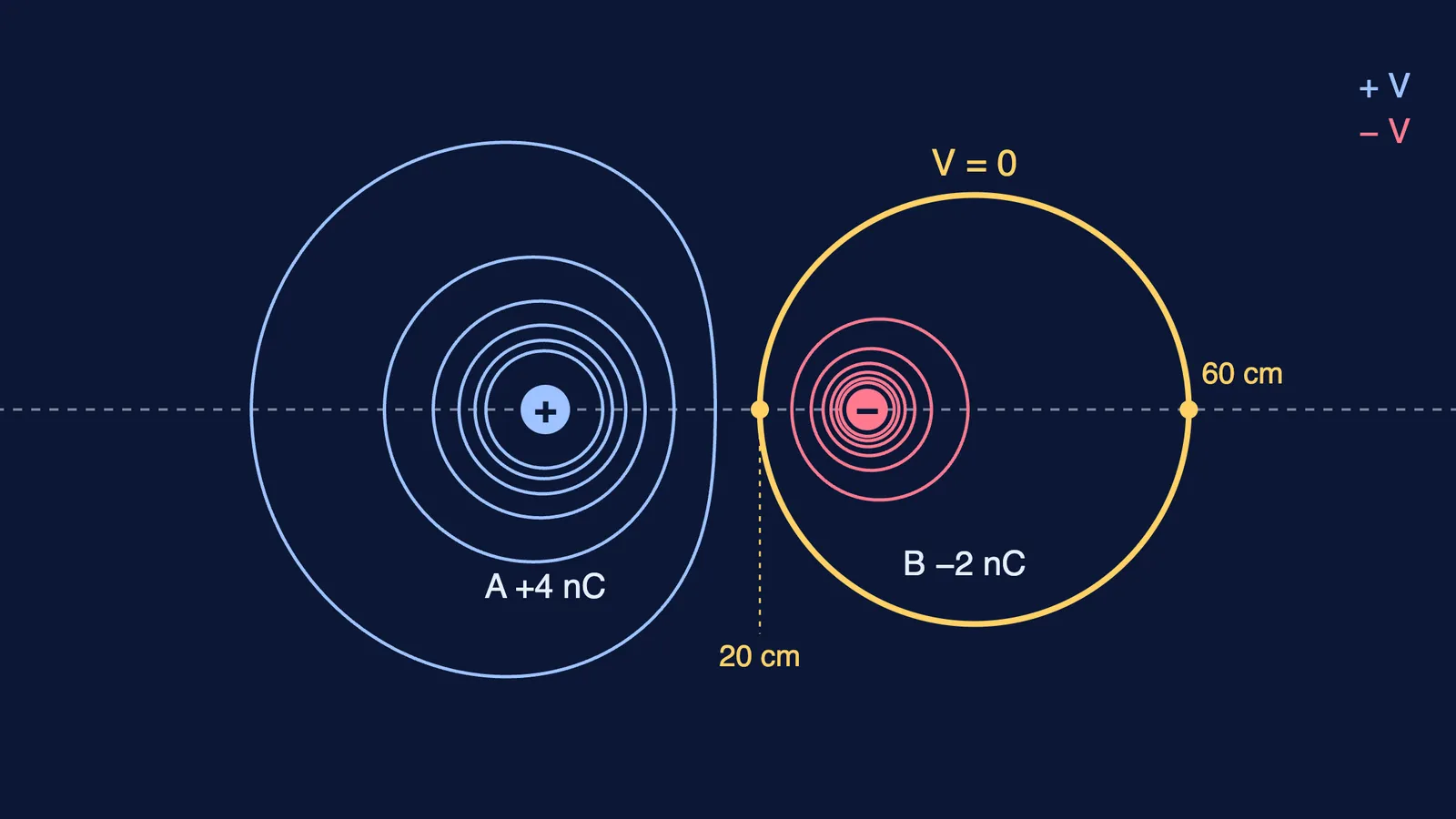
In a Lucknow school lab, Ishita mounts two small metal spheres on insulating stands, 30 cm apart. Sphere A carries +4 nC and sphere B carries −2 nC; treat both as point charges, take V = 0 at infinity and k = 9 × 10⁹ N m² C⁻². She moves a probe along the line AB and finds two points where the potential is zero.
(i) The potential at the midpoint of AB is: (a) zero (b) 120 V (c) 240 V (d) 360 V
(ii) Find the zero-potential point between A and B.
(iii) Find the second zero-potential point on line AB, and say why there is none on the far side of A.
(iv) Find the electrostatic potential energy of the pair, and the work needed to pull B slowly to 60 cm from A.
Answers.
(i) (b). V = k(q₁ + q₂)/r = 9 × 10⁹ × (4 − 2) × 10⁻⁹/0.15 = 18/0.15 = 120 V.
(ii) At x from A: 4/x = 2/(0.30 − x), so 6x = 1.2 and x = 0.20 m, i.e. 20 cm from A.
(iii) Beyond B: 4/x = 2/(x − 0.30), so x = 0.60 m, i.e. 60 cm from A. On the far side of A, every point is closer to the larger charge, so 4/r₁ always beats 2/r₂ and V stays positive.
(iv) U = kq₁q₂/r = 9 × 10⁹ × 4 × 10⁻⁹ × (−2 × 10⁻⁹)/0.30 = −2.4 × 10⁻⁷ J. At 60 cm, U = −1.2 × 10⁻⁷ J, so W = U_final − U_initial = +1.2 × 10⁻⁷ J.
Case 3: The oil-tank level gauge
An edible-oil cooperative near Rajkot uses a capacitive level gauge in its tank: two vertical parallel metal plates, 1.0 m tall, a few millimetres apart, open at the bottom so oil fills the gap to the same level as in the tank. With the tank empty (air between the plates), the gauge reads 60 pF. The oil has dielectric constant K = 3.
(i) With the tank full, the gauge reads: (a) 20 pF (b) 60 pF (c) 180 pF (d) 540 pF
(ii) Treating the oil and air parts as two capacitors, find the reading when the oil stands 50 cm high.
(iii) The gauge reads 150 pF. How high is the oil?
(iv) The empty gauge is charged to 10 V and isolated, then oil is filled to 50 cm. Find the new voltage and stored energy. How would the charge differ if the 10 V source had stayed connected?
Answers.
(i) (c). C = KC₀ = 3 × 60 = 180 pF.
(ii) The two parts are in parallel: both have the same voltage across them. Each half has 30 pF with air, so C = 3 × 30 + 30 = 120 pF.
(iii) For an oil fraction f, C = 60(3f + 1 − f) = 60(1 + 2f) pF. So 150 = 60(1 + 2f), giving f = 0.75: the oil is 75 cm high.
(iv) Q = 60 pF × 10 V = 600 pC stays fixed. V = Q/C = 600/120 = 5 V. Energy falls from ½ × 60 pF × 10² = 3 nJ to Q²/2C = 1.5 nJ. With the source connected, V stays 10 V and Q rises to 120 pF × 10 V = 1200 pC.
How to attack case-study questions on this chapter?
Convert μF, nF, pF and nC to SI units first.
Pick the energy formula that uses what stays constant: Q²/2C when the capacitor is isolated, ½CV² when a source holds the voltage.
For point charges, potential is a sum of scalars with signs; draw the line and mark where each charge sits before solving for a zero.
Decide series or parallel by asking what is shared: the same charge (series) or the same voltage (parallel).
Sanity-check with ratios: a full dielectric multiplies C by K; energy scales as V².
For more practice, read our guide to case-based questions in board exams and the assertion-reason set on electrostatics. If a step keeps going wrong, the Fermi Problem Library has worked problems with a step-by-step solver that explains the reasoning rather than printing an answer.