On this page
In Electrostatics, most assertion-reason statements sound true. The marks go to whoever can tell a true reason from the correct one. These 10 original questions run easy to hard.
What do these Electrostatics questions cover?
Every item stays inside Unit 11, Electrostatics, of the NEET (UG)-2026 syllabus published by the National Medical Commission. Each statement was checked against NCERT Class 12 Physics Part I, Chapter 1, Electric Charges and Fields, and Chapter 2, Electrostatic Potential and Capacitance (Reprint 2026-27). New to the chapter? Read our guide on how to prepare Electrostatics for NEET.
How do you answer assertion-reason questions?
Judge each statement alone. If both are true, say "A, because R" and check that it holds.
Assertion-reason keys (Q1 to Q6):
(A) Both A and R are true and R is the correct explanation of A.
(B) Both A and R are true but R is NOT the correct explanation of A.
(C) A is true but R is false.
(D) A is false but R is true.
Statement I and II keys (Q7 to Q10):
(A) Both statements are correct.
(B) Both statements are incorrect.
(C) Statement I is correct, Statement II is incorrect.
(D) Statement I is incorrect, Statement II is correct.
Assertion-reason questions on Electrostatics
Q1 (easy). Assertion (A): Field lines of static charges cannot cross where the field is non-zero. Reason (R): A positive test charge at a point feels force in one direction only, given by the field line's tangent there.
Answer: (A). Both are true. Two lines crossing would give two tangents, so two force directions at one point. R directly explains A.
Trap: distrusting "cannot" as absolute. Here it is correct.
Q2 (easy). Assertion (A): When a glass rod is rubbed with silk, the rod becomes positive and the silk gains an equal negative charge. Reason (R): Electric charge is quantised.
Answer: (B). Both are true. Electrons move from rod to silk, so the charges are equal by conservation of charge. Quantisation (whole multiples of e) does not explain that.
Trap: choosing (A) because R is a true fact nearby.
Q3 (medium). Assertion (A): A rigid dipole released in a uniform electric field does not accelerate as a whole, whatever its orientation. Reason (R): Because the two forces on it cancel, it cannot start rotating either.
Answer: (C). A is true: qE and −qE cancel. R is false: the forces act at different points and form a couple, τ = p × E, zero only when p is along or against E.
Trap: assuming zero force means zero torque.
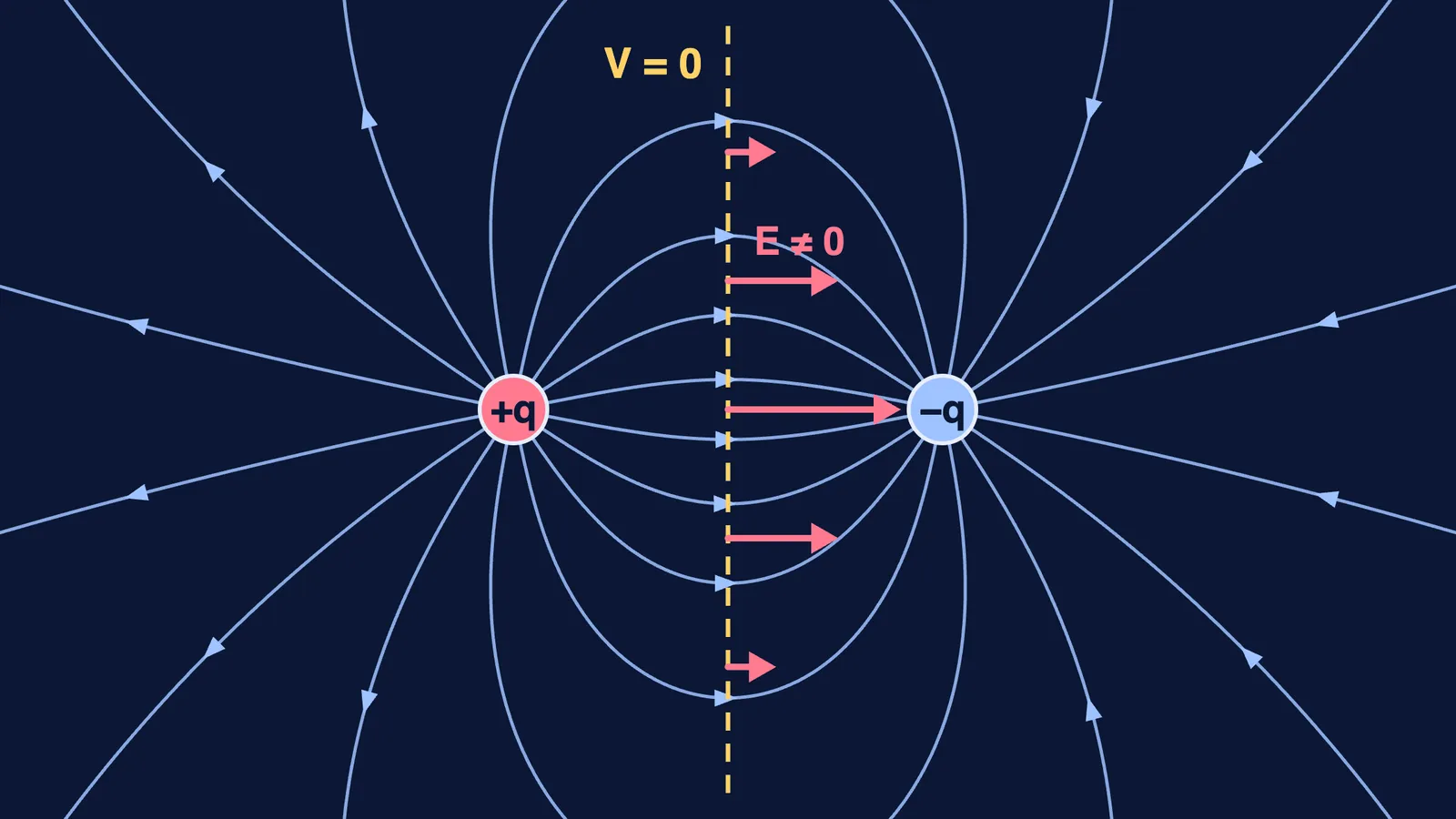
Q4 (medium). Assertion (A): Wherever the electric potential is zero, the electric field is also zero. Reason (R): The electric field equals the negative of the rate of change of potential with distance, E = −dV/dl.
Answer: (D). A is false: on a dipole's equatorial plane V = 0 (zero at infinity), yet E is not zero; it points opposite to p. R is true and shows why: E depends on how fast V changes, not on V.
Trap: treating "V = 0" and "E = 0" as the same condition.
Q5 (medium). Assertion (A): In electrostatics, a point deep inside a charged copper block and a point on its surface are at equal potential. Reason (R): The field is zero inside the block and has no component along its surface.
Answer: (A). Both are true, and R is the reason: with no field inside or along the surface, moving a test charge within or on the conductor takes no work.
Trap: reading "same potential" as "zero potential".
Q6 (hard). Assertion (A): Two capacitors of different capacitance, joined in series across a battery, carry equal charges. Reason (R): The equivalent capacitance of a series combination is smaller than the smallest individual capacitance.
Answer: (B). Both are true. A comes from charge conservation: the inner plates and joining wire are isolated and neutral, so carry −Q and +Q. R follows from 1/C = 1/C₁ + 1/C₂, derived from those equal charges.
Trap: R is a consequence of A, not its cause.
Statement I and Statement II questions on Electrostatics
Q7 (easy). Statement I: Far from a small dipole, doubling the distance along a fixed direction cuts its potential to one quarter. Statement II: The same doubling cuts its field to one eighth.
Answer: (A). Both are correct. Far away, a dipole's potential goes as 1/r² and its field as 1/r³, one power faster than a point charge's.
Trap: using point-charge powers for a dipole.
Q8 (medium). Statement I: The field of a uniformly charged infinite plane sheet falls as 1/r with distance from it. Statement II: The field of a uniformly charged, infinitely long straight wire is the same at every distance from it.
Answer: (B). Both are incorrect; the results are swapped. The sheet's field, σ/2ε₀, is independent of distance; the wire's, λ/(2πε₀r), falls as 1/r.
Trap: pinning the right formulas on the wrong shapes.
Q9 (hard). Statement I: Two like point charges a finite distance apart have positive electrostatic potential energy, taking zero at infinite separation. Statement II: To bring two unlike charges slowly closer together, an external agent must do positive work.
Answer: (C). I is correct: U = q₁q₂/(4πε₀r) is positive when q₁q₂ > 0. II is incorrect: unlike charges attract, so the agent holds them back and does negative work.
Trap: assuming moving charges always costs positive work.
Q10 (hard). Statement I: Moving a point charge around outside a closed surface leaves the field at every point of the surface unchanged. Statement II: That move leaves the total flux through the surface unchanged.
Answer: (D). I is incorrect: the field on the surface is due to all charges, inside and outside, so it changes. II is correct: an outside charge adds zero net flux.
Trap: mixing up the field (all charges) with the flux (enclosed charge only).
How should you use this set?
Sort every miss: wrong about A, wrong about R, or wrong about the link.
For each link miss, write the real reason in one line.
For each truth miss, reread that NCERT section.
If Q3, Q4 or Q7 felt abstract, the Fermi Simulation Lab has interactive simulations for ideas that are easier to see than to read.
For timed MCQs on this chapter, try our Electrostatics NEET practice questions with solutions. For a method that works in any subject, see our strategy for assertion-reason questions.