On this page
Three original cases, easy to hard, with worked answers. For derivations and answer layout, see our Electric charges and fields Class 12 board exam guide.
What do case-study questions on Electric Charges and Fields look like?
The CBSE 2026-27 Physics sample paper has two case study-based questions of four marks each, in Section D. Calculators are not allowed, so every number here works by hand. Each idea is in the CBSE 2026-27 Physics syllabus and the rationalised NCERT Chapter 1. Use k = 9 × 10⁹ N m² C⁻² and e = 1.6 × 10⁻¹⁹ C.
Case 1: Balloons at the science fair
At a school science fair in Pune, Riya rubs a rubber balloon with a woollen scarf. The balloon ends up with a charge of −40 nC. She charges an identical second balloon the same way and hangs both on silk threads, their centres 0.20 m apart. The balloons and the scarf were uncharged before rubbing. Treat each balloon as a point charge at its centre. Her friend Arjun claims that if the balloons are moved to 0.10 m apart, the force will double.
(i) After rubbing, the scarf's charge is: (a) −40 nC (b) +40 nC (c) zero (d) +80 nC
(ii) How many electrons moved to the first balloon?
(iii) Find the force between the two balloons. Is it attractive or repulsive?
(iv) Is Arjun right? Show it.
Answers.
(i) (b). Charge is conserved: the scarf loses the electrons the balloon gains.
(ii) n = q/e = (40 × 10⁻⁹)/(1.6 × 10⁻¹⁹) = 2.5 × 10¹¹ electrons.
(iii) F = kq²/r² = (9 × 10⁹ × 1.6 × 10⁻¹⁵)/0.04 = 3.6 × 10⁻⁴ N. Both charges are negative, so it is repulsive.
(iv) No. F ∝ 1/r², so halving r makes the force four times larger: F′ = 4 × 3.6 × 10⁻⁴ = 1.44 × 10⁻³ N, not double.
Case 2: The model molecule in Kochi
For a school exhibition in Kochi, Ananya builds a large model of a polar molecule. A light insulating rod 4.0 cm long carries tiny beads at its ends with charges +5.0 nC and −5.0 nC. The rod is pivoted at its centre between two large parallel plates, where the field is uniform at 2.0 × 10⁵ N/C. She releases it at rest with the rod perpendicular to the field. Next, she plans to replace the plates with a charged metal ball, so the field is stronger on one side of the rod.
(i) In the uniform field, the net force on the rod is: (a) zero (b) 1.0 × 10⁻³ N along E (c) 2.0 × 10⁻³ N along E (d) 1.0 × 10⁻³ N against E
(ii) Find the dipole moment of the model, with its direction.
(iii) Find the torque on it at the moment of release.
(iv) In the non-uniform field, with p lined up along E, will the rod feel a net force? In which direction?
Answers.
(i) (a). The forces qE and −qE cancel in a uniform field. Each is 5.0 × 10⁻⁹ × 2.0 × 10⁵ = 1.0 × 10⁻³ N, which is the trap in (b).
(ii) p = q × 2a = 5.0 × 10⁻⁹ × 0.040 = 2.0 × 10⁻¹⁰ C m, pointing from the −5.0 nC bead to the +5.0 nC bead.
(iii) θ = 90°, so τ = pE sin 90° = 2.0 × 10⁻¹⁰ × 2.0 × 10⁵ = 4.0 × 10⁻⁵ N m, the largest possible value, turning p towards E.
(iv) Yes. The forces no longer cancel. With p parallel to E, the net force points in the direction of increasing field, so the rod is pulled towards the ball.
Case 3: The dust filter at a cement plant
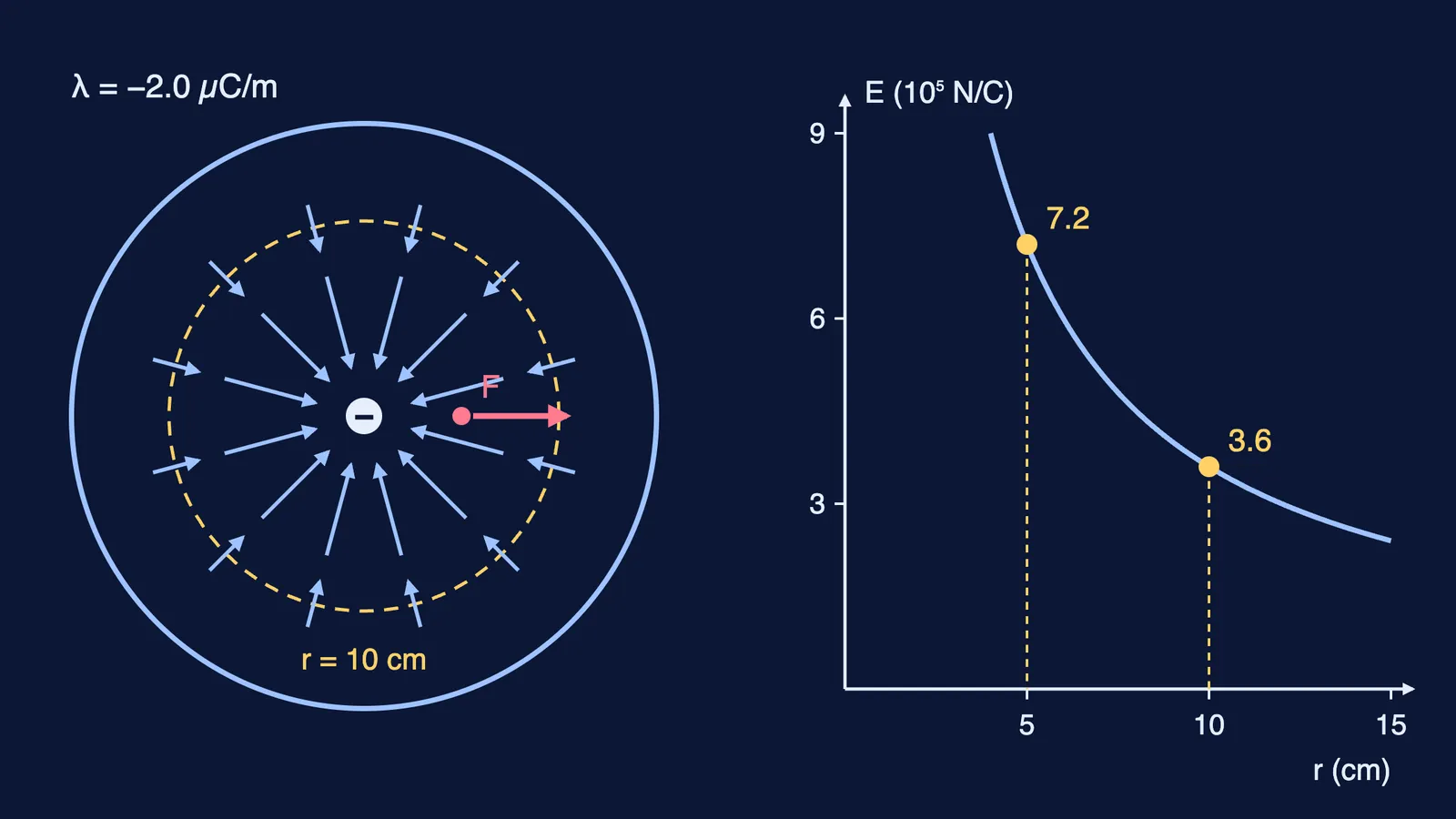
An engineer at a cement plant near Satna models a dust filter as a thin straight wire along the axis of a metal cylinder 3 m long and 15 cm in radius. The wire carries a uniform charge of λ = −2.0 µC/m. Since the cylinder is long compared with its radius, she treats the wire as infinite. Each dust grain entering picks up about −8.0 × 10⁻¹⁶ C. She imagines a coaxial Gaussian cylinder of radius 10 cm and length 50 cm around the wire.
(i) The field of the wire varies with distance r as: (a) 1/r² (b) 1/r (c) independent of r (d) r
(ii) Find the electric flux through her Gaussian cylinder. Would it change if its radius were 5 cm?
(iii) Find the magnitude and direction of the field 10 cm from the wire.
(iv) Find the force on a typical grain 5 cm from the wire, its direction, and what happens to it as the grain moves out to 10 cm.
Answers.
(i) (b). Gauss's law gives E = λ/(2πε₀r) = 2kλ/r.
(ii) Φ = q_enclosed/ε₀ = λL/ε₀ = 4πk × (−2.0 × 10⁻⁶ × 0.50) ≈ −1.13 × 10⁵ N m²/C. No: the enclosed charge is unchanged, and the flat ends carry no flux because E is radial.
(iii) E = 2kλ/r = (2 × 9 × 10⁹ × 2.0 × 10⁻⁶)/0.10 = 3.6 × 10⁵ N/C, pointing radially inward, since λ is negative.
(iv) At 5 cm, E = 7.2 × 10⁵ N/C, so F = qE = 8.0 × 10⁻¹⁶ × 7.2 × 10⁵ ≈ 5.8 × 10⁻¹⁰ N. The grain is negative and E points inward, so F points outward, towards the cylinder wall. At 10 cm the field halves, so the force halves to about 2.9 × 10⁻¹⁰ N.
How should you attack case-study questions on this chapter?
Write the sign of every charge first; most direction errors start there.
Convert nC and µC to coulombs and cm to metres in the first line.
For a dipole, first ask whether the field is uniform: uniform means torque only; non-uniform adds a net force.
For Gauss's law, name the Gaussian surface and the parts with no flux.
Check by scaling: halve r and a line charge's field doubles; a point charge's field quadruples.
For more practice, see our guide to case-based questions in CBSE board exams and try the Electrostatics assertion-reason questions. If fields are hard to picture, the Fermi Simulation Lab has interactive simulations for the ideas that are easier to see than to read.