On this page
Theory first: our Describing Motion Around Us Class 9 chapter guide.
What does Describing Motion Around Us ask you to apply?
Chapter 4 of Exploration, the new NCERT Class 9 Science book, defines average speed as total distance travelled divided by the time interval, and average velocity as displacement divided by the time interval. Average acceleration is the change in velocity divided by the time interval. On a velocity-time graph, the slope gives acceleration and the area gives displacement. For constant acceleration, v = u + at, s = ut + ½at² and v² = u² + 2as. Motion on a circle at constant speed is uniform circular motion; it is accelerated because the direction keeps changing. The CBSE Class IX Science curriculum for 2026-27 lists the same ideas.
Case 1: A cycle ride to school in Lucknow
Kabir cycles to school along a straight road in Lucknow. His smartwatch logs his position from his gate every 2 minutes: 0 m at 0 min, 540 m at 2 min, 1080 m at 4 min, 1080 m at 6 min (he waits at a railway crossing), 1740 m at 8 min and 2400 m at 10 min, when he reaches the school gate. He never turns back.
(i) Between 4 min and 6 min, Kabir's position-time graph is: (a) a steep rising line (b) a line parallel to the time axis (c) a falling line (d) a curve
(ii) Find his average velocity from 0 to 4 min, in m s⁻¹ and km h⁻¹.
(iii) Does the log suggest uniform motion from 6 to 10 min? Find his average velocity in this part.
(iv) Find his average speed for the whole ride, and explain why it is lower than his average velocity in both moving parts.
Answers.
(i) (b). His position does not change, so he is at rest.
(ii) 1080 m ÷ 240 s = 4.5 m s⁻¹ away from home. In km h⁻¹: 4.5 × 18/5 = 16.2 km h⁻¹.
(iii) Yes: he covers 660 m in each 2-minute interval, equal distances in equal intervals. Average velocity = 1320 m ÷ 240 s = 5.5 m s⁻¹, so this part of the graph is steeper.
(iv) 2400 m ÷ 600 s = 4 m s⁻¹, below 4.5 and 5.5 m s⁻¹: the 2-minute stop adds time but no distance.
Case 2: A giant wheel at the Mysuru Dasara fair
Meera rides a giant wheel at the Dasara fair in Mysuru. Her seat is 14 m from the centre of the wheel. The wheel turns at a steady speed and takes 176 s for one full revolution. Meera starts at the lowest point. Take π = 22/7.
(i) After one full revolution, Meera's displacement is: (a) 88 m (b) 28 m (c) 14 m (d) zero
(ii) Find the distance she covers in one revolution and her speed.
(iii) When she first reaches the top, find the time taken, the distance travelled, her displacement and her average velocity.
(iv) Her brother says, "The speed never changes, so Meera is not accelerating." Correct him, and find her displacement after a quarter revolution.
Answers.
(i) (d). She is back at her starting point.
(ii) Distance = 2πR = 2 × 22/7 × 14 = 88 m. Speed = 88 m ÷ 176 s = 0.5 m s⁻¹.
(iii) Half a revolution takes 88 s and covers 44 m. Displacement = the diameter, 28 m straight up. Average velocity = 28 ÷ 88 ≈ 0.32 m s⁻¹ upward.
(iv) In uniform circular motion the direction of velocity changes all the time, so the velocity changes and she is accelerating. After a quarter turn (44 s, 22 m along the circle), she is 14 m sideways and 14 m up from the start, so displacement = √(14² + 14²) ≈ 19.8 m.
Case 3: A rejected take-off in a flight simulator
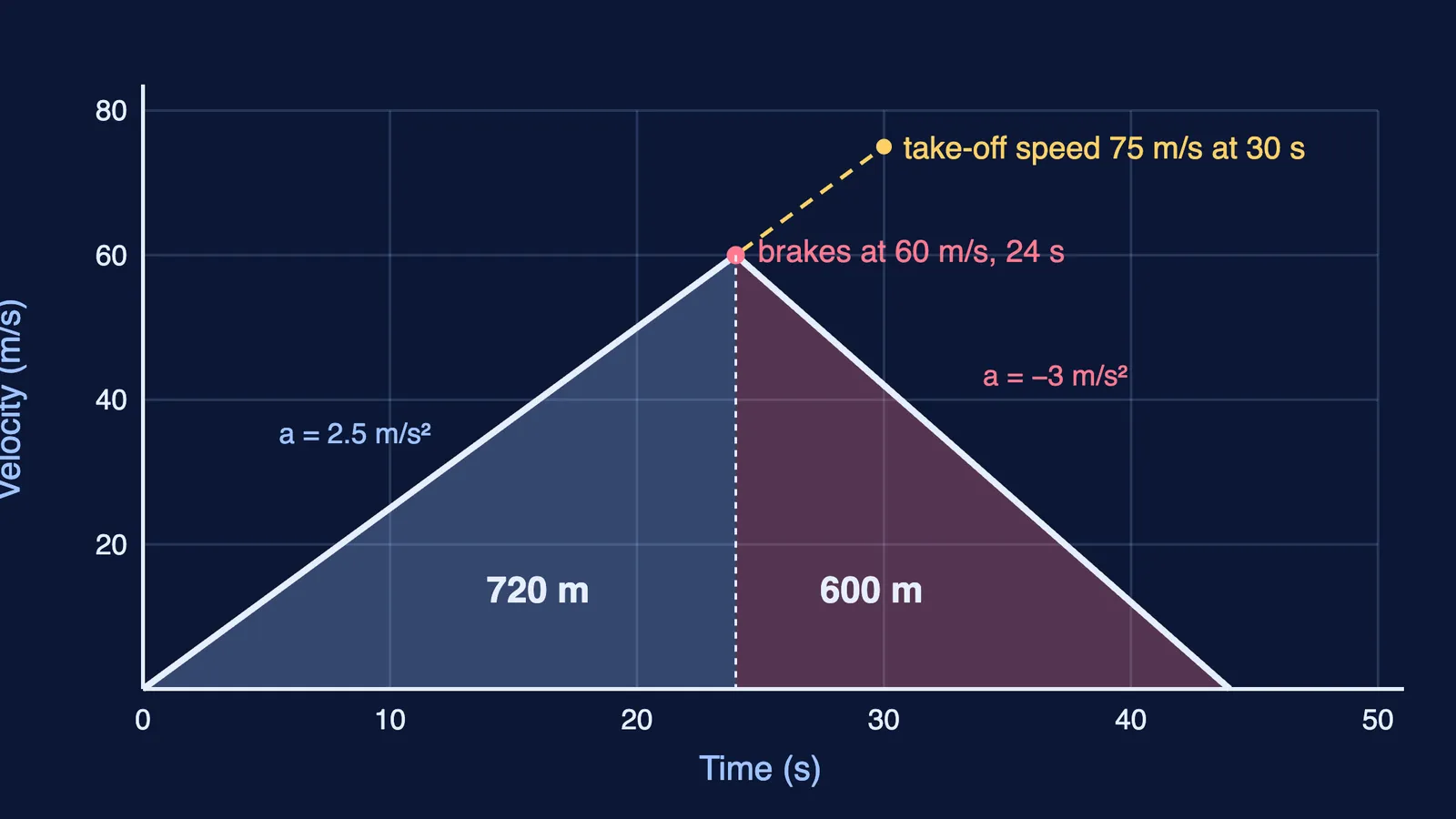
A trainee pilot practises on a flight simulator: a jet on a straight runway 2000 m long. In a normal run, the jet starts from rest, speeds up with constant acceleration and reaches its take-off speed of 270 km h⁻¹ in 30 s. In the next run, the jet speeds up as before, and a warning sounds as it reaches 216 km h⁻¹. The trainee brakes at once, giving a constant acceleration of −3 m s⁻² until the jet stops.
(i) The take-off speed in m s⁻¹ is: (a) 27 (b) 75 (c) 97.2 (d) 750
(ii) Find the acceleration and the runway length used in the normal take-off.
(iii) In the second run, when and where does the warning come?
(iv) How long does braking take, how far does the jet travel while braking, and how much runway is left when it stops?
Answers.
(i) (b). 270 × 5/18 = 75 m s⁻¹.
(ii) a = (75 − 0) ÷ 30 = 2.5 m s⁻². s = ½ × 2.5 × 30² = 1125 m.
(iii) 216 km h⁻¹ = 60 m s⁻¹. From v = u + at: t = 60 ÷ 2.5 = 24 s. From v² = u² + 2as: s = 60² ÷ (2 × 2.5) = 720 m.
(iv) From 0 = 60 + (−3)t: t = 20 s. From 0 = 60² + 2(−3)s: s = 600 m. Total = 720 + 600 = 1320 m, so 2000 − 1320 = 680 m of runway is left. Graph check: ½ × 44 s × 60 m s⁻¹ = 1320 m.
How do you attack case-study questions on motion?
Convert km h⁻¹ to m s⁻¹ (multiply by 5/18) and minutes to seconds before any formula.
Ask "distance or displacement?" every time. Average speed uses distance; average velocity uses displacement.
In a position table, equal changes in equal intervals mean uniform motion; no change means rest.
Use the kinematic equations only for constant acceleration; list u, v, a, s and t, and keep the minus sign when slowing down.
Check answers two ways: equation and graph area should agree.
More practice: Describing Motion Class 9 formulas with worked examples and the chapter's key terms, explained simply. If a step keeps slipping, the Fermi Problem Library has worked problems with a step-by-step solver that explains the reasoning rather than printing an answer.