On this page
What do these chemical coordination case-study questions cover?
Class 11 exams are set by your school, so treat these as case-based practice. They stay inside the Chapter 19 line of the CBSE Biology curriculum for 2026-27: the human endocrine glands, an elementary idea of hormone action, and related disorders such as diabetes.
Every fact below matches the NCERT chapter Chemical Coordination and Integration (Reprint 2026-27); the scenarios and numbers are our own. For the theory, read our Class 11 guide to chemical coordination and integration.
Case 1: Why does your heart keep racing after a near miss?
Aarav, 17, is riding pillion on his cousin's scooter in Pune when a bus swerves towards them. Nobody is hurt, but his smartwatch logs his heart rate jumping from 74 to 111 beats per minute within a minute. His palms are sweaty, the hair on his arms stands up and he is breathing fast. Even after the bus has gone and they have parked, his heart keeps pounding for several minutes. His teacher calls this the "fight or flight" response, driven by hormones from the gland above each kidney.
(i) Which part of the gland secretes adrenaline and noradrenaline? (a) Adrenal cortex (b) Adrenal medulla (c) Thyroid (d) Posterior pituitary
(ii) Name two changes in Aarav, other than heart rate, caused by these hormones.
(iii) By what percentage did his heart rate rise?
(iv) Explain how these hormones make extra fuel available to his muscles, and why his heart kept pounding after the danger passed even though nerve signals are fast.
Answers.
(i) (b) Adrenal medulla.
(ii) Any two of: sweating, piloerection (raised hairs), faster breathing, a stronger heartbeat, greater alertness or dilated pupils.
(iii) Rise = 111 − 74 = 37 beats per minute, and 37 ÷ 74 × 100 = 50%.
(iv) These catecholamines stimulate the breakdown of glycogen, which raises blood glucose, and of lipids and proteins. NCERT describes neural coordination as fast but short-lived; adrenaline carried in the blood keeps acting on the heart for longer.
Case 2: What brings blood sugar back down after breakfast?
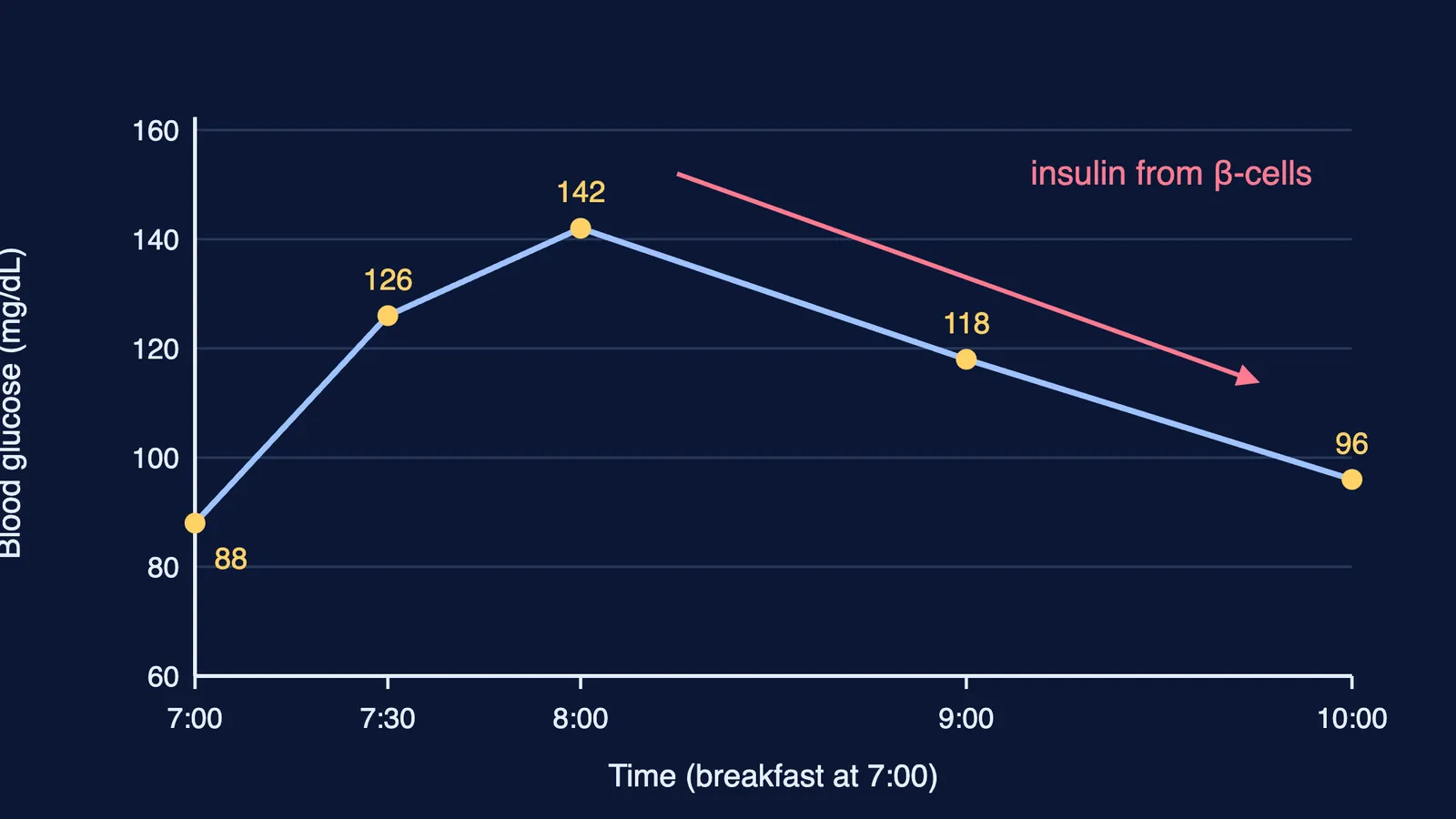
For a school project in Chennai, Meera, 16, wears a glucose sensor for a morning. Before her idli breakfast at 7:00 it reads 88 mg/dL. It reads 126 at 7:30, peaks at 142 at 8:00, then falls to 118 at 9:00 and 96 at 10:00 without her eating again. Her grandfather says his own readings stay high for hours after meals, and his last urine test showed glucose and ketone bodies.
(i) Which cells release the hormone that brings Meera's level down? (a) α-cells (b) β-cells (c) Leydig cells (d) Juxtaglomerular cells
(ii) That hormone is a peptide. Does it enter the liver cell? Name its receptor type and one second messenger such hormones use.
(iii) Find the average rate of fall between 8:00 and 10:00, in mg/dL per hour.
(iv) Name the grandfather's likely disorder and the urine findings that fit it. Using insulin's actions, explain why his glucose stays high after meals.
Answers.
(i) (b) β-cells of the Islets of Langerhans, which secrete insulin. The α-cells secrete glucagon, which raises blood glucose.
(ii) Normally no. Peptide hormones bind membrane-bound receptors and generate second messengers such as cyclic AMP, IP3 or Ca++, which regulate the cell's metabolism.
(iii) Fall = 142 − 96 = 46 mg/dL over 2 hours, so 46 ÷ 2 = 23 mg/dL per hour.
(iv) Diabetes mellitus, caused by insulin deficiency and/or insulin resistance; glucose and ketone bodies in the urine fit it, as NCERT links prolonged hyperglycemia to loss of glucose through urine and harmful ketone bodies. Without insulin's effect, hepatocytes and adipocytes take up and use less glucose and less is converted to glycogen, so hyperglycemia persists.
Case 3: Why does a head injury make someone pass so much urine?
A 20-year-old in a Kolkata hospital is recovering from a head injury. Over the next week he is always thirsty and passes about 7.2 litres of dilute urine a day; his roommate on the ward passes about 1.6 litres. A urine test shows no glucose. A scan finds the posterior pituitary tissue intact, but the stalk linking the pituitary to the hypothalamus is damaged. The doctor suspects a shortage of the hormone that normally makes the kidney hold on to water.
(i) Where is this hormone (vasopressin) synthesised? (a) Posterior pituitary (b) Hypothalamus (c) Adrenal cortex (d) Kidney
(ii) Name the condition. Which test result in the passage points away from diabetes mellitus?
(iii) His urine output is how many times his roommate's, and how much extra water does he lose each day?
(iv) The posterior pituitary is intact. Explain why vasopressin release still falls, and why control of the anterior pituitary could also be disturbed.
Answers.
(i) (b) Hypothalamus.
(ii) Diabetes insipidus, from impaired synthesis or release of ADH. The urine has no glucose, which points away from diabetes mellitus.
(iii) 7.2 ÷ 1.6 = 4.5 times, and 7.2 − 1.6 = 5.6 litres extra per day.
(iv) Vasopressin is made by hypothalamic neurons and transported along their axons through the stalk to the neurohypophysis, so a damaged stalk cuts off the supply. Without ADH, the distal tubules reabsorb less water. The anterior pituitary is controlled by hypothalamic releasing and inhibiting hormones that reach it through a portal circulation, so damage at this link can disturb it too.
How to attack case-study questions on this chapter
Name the gland, then the part. Many answers turn on medulla versus cortex, or anterior versus posterior.
Watch "synthesised" versus "released". Oxytocin and vasopressin are made in the hypothalamus and released by the posterior pituitary.
Use the hormone's chemistry to pick the receptor. Peptides work through membrane receptors and second messengers; steroids and iodothyronines act inside the cell, mostly on gene expression.
Do the arithmetic first. Write the working for percentages, rates and ratios before explaining.
Pair the opposites. Insulin and glucagon, and TCT and PTH, are tested as push-pull pairs.
For the structure behind these questions, see our guide to case-based questions in board exams, and compare hormones with nerve impulses in neural control and coordination for Class 11. If a hormone's action will not stick, look it up in the Fermi Concept Library, where every biology concept has its own lesson.